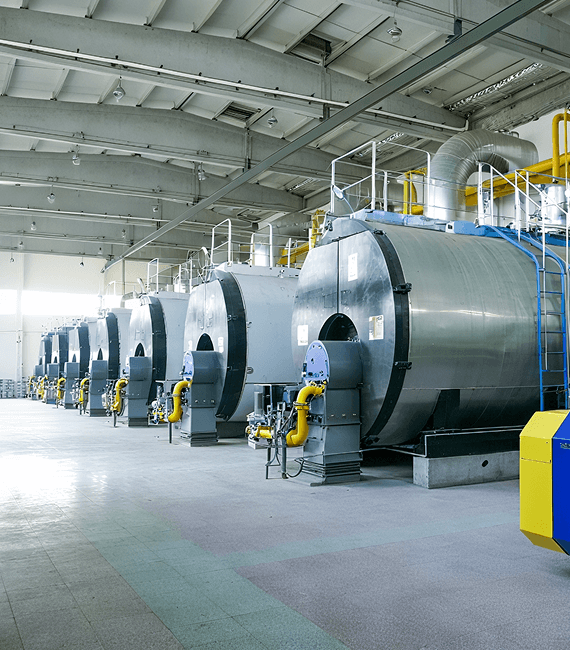

The operational status of industrial boilers directly impacts a company's production efficiency and costs, with feedwater quality serving as a critical influencing factor. Many problems such as scaling, corrosion, and substandard steam quality in boilers are caused by poor feedwater quality, making deionized water an important feedwater option.
The core principle behind the preparation of deionized water is the removal of cations and anions from the water. Cations primarily include calcium, magnesium, sodium, and iron, while anions consist of chloride, sulfate, and carbonate ions; these ions are precisely the root causes of boiler scaling and corrosion.
The preparation process is typically achieved through the use of ion-exchange resins: cation-exchange resins adsorb cations present in the water, replacing them with hydrogen ions; conversely, anion-exchange resins adsorb anions, replacing them with hydroxide ions. The hydrogen ions and hydroxide ions then combine to form water molecules, thereby achieving the complete removal of ions.
The two most distinctive characteristics of deionized water are its low electrical conductivity and low dissolved solids content. Lower conductivity indicates a lower concentration of ions in the water, signifying a higher degree of purity; low dissolved solids content implies that saline impurities have been substantially removed from the water, thereby preventing the subsequent formation of deposits within the boiler.
Compared to raw water or ordinary tap water, the differences exhibited by deionized water are stark. Raw water contains high concentrations of hardness ions—such as calcium and magnesium—along with various other impurities; while ordinary tap water undergoes basic treatment, it still retains residual ions and suspended solids. In contrast, deionized water is virtually free of these impurities, boasting a level of purity far superior to that of the other two sources.
This difference in purity is particularly critical for industrial boilers operating under high-pressure and high-temperature conditions, as it directly impacts both the operational safety and the service life of the boiler.
Boiler scaling is, in essence, the result of chemical reactions involving calcium and magnesium ions present in the water, which occur under conditions of high temperature and high pressure. When calcium bicarbonate and magnesium bicarbonate present in water are heated within a boiler, they decompose to form substances that are sparingly soluble in water—such as calcium carbonate and magnesium hydroxide. These substances gradually accumulate on the boiler's heat-transfer surfaces and the inner walls of its piping, forming a hard layer of scale.
According to relevant studies, when water contains high concentrations of sulfates and chlorides, these substances may also exceed their saturation limits as the water evaporates, subsequently precipitating to form scale. The primary constituents of such scale are typically calcium carbonate, calcium phosphate, and similar compounds. The fundamental function of deionized water is to eliminate calcium and magnesium ions from the water source itself; without these "raw materials" for scale formation, scale naturally cannot develop. This aspect is critical to boiler operation, as scale possesses extremely poor thermal conductivity merely a fraction (typically one-tenth to one-fiftieth) of that of steel.
If scale accumulates on the inner walls of a boiler, it impedes heat transfer, leading to increased fuel consumption. Furthermore, localized overheating caused by this insulation effect can trigger safety hazards, such as boiler tube deformation or rupture. The use of deionized water effectively maintains the cleanliness of the boiler's heat-transfer surfaces, thereby ensuring efficient and proper heat transfer.
The piping and furnace walls of industrial boilers are predominantly constructed from metallic materials. Chloride ions and sulfate ions present in the water are the primary culprits behind metal corrosion. Chloride ions disrupt the passive film on metal surfaces, initiating pitting corrosion; conversely, sulfate ions accelerate general corrosion in low-alloy steels. In severe cases, this can lead to perforations in the piping and furnace walls, thereby compromising the safe operation of the boiler.
Experimental studies have demonstrated that when the chloride ion concentration in water reaches 100 ppm, it triggers pitting corrosion in materials commonly used in boilers, such as 13Cr stainless steel. Moreover, depending on their concentration, sulfate ions can either promote or inhibit the propagation of corrosion pits; nevertheless, their overall presence invariably heightens the risk of corrosion.
Deionized water is characterized by its low electrical conductivity. The lower the conductivity, the lower the concentration of ions within the water, and consequently, the weaker the conditions conducive to electrochemical corrosion. Since the essence of electrochemical corrosion lies in the transfer of electrons between ions and the metal surface, a reduction in ion concentration naturally serves to inhibit the corrosion reaction. The long-term use of deionized water effectively protects metal components within the boiler such as piping and furnace walls minimizing corrosive wear and preventing equipment failures caused by corrosion.
For many industries, the quality of the steam generated by boilers directly impacts product quality. Industries such as pharmaceuticals, electronics, and food processing, for instance, demand extremely high levels of steam purity; if steam carries entrained impurities, it can contaminate products leading to product rejection or even trigger safety hazards.
Impurities found in steam primarily originate from the boiler feedwater. If the feedwater contains significant quantities of impurities such as ions and suspended solids these contaminants will become entrained within the steam during the water evaporation process and subsequently enter downstream production systems.
Deionized water is virtually free of ionic impurities and suspended solids; utilizing it as boiler feedwater minimizes impurity entrainment in the steam to the greatest extent possible, thereby significantly enhancing steam purity. This not only safeguards product quality but also prevents the accumulation of deposits within steam pipelines and steam-consuming equipment, thereby reducing maintenance costs for downstream machinery.
During boiler operation, impurities present in the water can cause fluctuations in operational parameters. For instance, scale accumulation can lead to uneven temperature distribution within the furnace, while variations in ion concentration can disrupt chemical reactions occurring inside the boiler vessel. These factors destabilize boiler operations and may even result in parameter excursions or emergency shutdowns.
Deionized water features stable quality and is free of extraneous impurities, thereby mitigating these destabilizing factors. Furthermore, the purity of the water ensures the consistent efficacy of boiler water treatment chemicals, preventing their neutralization or reduced effectiveness caused by interference from impurities.
When water quality remains stable and chemical treatments function precisely, the boiler's various operational parameters can be more effectively maintained within optimal ranges. This significantly enhances the overall controllability of the system, ultimately ensuring long-term stable operation and reducing the likelihood of unplanned shutdowns caused by equipment failure.
A boiler's heat transfer efficiency directly determines its fuel utilization rate. The boiler's heating surfaces serve as the core of heat transfer; if these surfaces remain clean and free of scale, heat can be rapidly transferred from the fuel to the water, thereby boosting heating efficiency and reducing fuel consumption.
Conversely, if scale accumulates on the heating surfaces, heat transfer becomes impeded. To achieve the required steam output and temperature, the boiler must consume more fuel, resulting in energy waste. The use of deionized water, however, completely prevents the formation of scale, keeping the heating surfaces clean.
Unencumbered by the effects of scale, the boiler's heat transfer efficiency can consistently be maintained at a high level, thereby minimizing energy loss. Furthermore, stable water quality ensures that the boiler operates in a steady state over the long term, preventing efficiency declines caused by issues such as scaling and corrosion. In the long run, this translates into significant energy cost savings for the enterprise.
Traditional boilers utilizing ordinary feedwater frequently encounter issues with scaling and corrosion, necessitating regular cleaning and descaling operations. These procedures not only consume significant manpower, material resources, and time but also disrupt normal production activities. Moreover, frequent cleaning subjects boiler components to a certain degree of wear and tear, thereby shortening the equipment's service life.
With the adoption of deionized water, boiler scaling and corrosion issues are effectively brought under control, leading to a drastic reduction in the frequency of cleaning and descaling operations. Many enterprises that have switched to deionized water have found that their descaling cycles can be extended several-fold to the point where frequent chemical descaling is no longer even necessary.
Reducing the frequency of descaling not only lowers maintenance costs but also minimizes the occurrence of unplanned downtime. Unplanned downtime has a profound impact on corporate production, potentially leading to production interruptions and delayed order fulfillment; deionized water, by enhancing boiler operational stability and reducing fault-related shutdowns, serves to safeguard production continuity.
Concurrently, by mitigating corrosion and wear, deionized water effectively extends the service life of the boiler and its associated components. This reduces the need for equipment replacement, thereby lowering long-term operating costs for the enterprise.
During boiler operation, it is essential to implement chemical controls on the water quality within the boiler such as adjusting pH levels, regulating Total Dissolved Solids (TDS) content, and adding water treatment agents. The efficacy of these control measures directly impacts the operational safety of the boiler. Deionized water is characterized by its purity and absence of extraneous ionic impurities, ensuring that it does not interfere with pH regulation. Compared to standard feedwater, the pH of deionized water is significantly easier to adjust; it can rapidly stabilize within the optimal range required for boiler operation typically between 9.0 and 11.0 thereby preventing corrosion or alkaline embrittlement caused by abnormal pH levels.
Furthermore, due to the minimal impurity content in the water, the response of water treatment chemicals becomes more precise. These chemicals are not required to first react with impurities present in the water; instead, they can act directly to achieve their intended effect. This reduces chemical consumption and prevents the formation of byproducts resulting from chemical-impurity reactions that could otherwise compromise water quality.
Total Dissolved Solids (TDS) control also becomes considerably easier. Since deionized water inherently possesses an extremely low TDS content, subsequent operational monitoring need only focus on the minimal dissolved solids introduced through chemical additives. This allows for the effortless maintenance of TDS levels within standard limits, thereby reducing both the complexity and cost associated with water quality control.
Many enterprises confuse deionized water with softened water, assuming that both are suitable for use as boiler feedwater. In reality, however, there are significant differences between the two, and they are suited to different applications.
The primary function of softened water is simply to remove calcium and magnesium ions that is, to reduce water hardness thereby minimizing scale formation. However, it does not remove other impurities such as chloride ions or sulfate ions; consequently, its purity is limited.
Deionized water, on the other hand, goes beyond the removal of calcium and magnesium ions to eliminate all cations and anions present in the water, resulting in a purity level far superior to that of softened water. Simply put, while softened water addresses the issue of "scaling," deionized water effectively resolves two major problems simultaneously: "scaling" and "corrosion."
These differences become immediately apparent during boiler operation. In boilers utilizing softened water, although scaling is mitigated, corrosion may still occur due to the presence of chloride and sulfate ions; furthermore, the purity of the generated steam may fail to meet the stringent requirements of demanding industries.
Conversely, the use of deionized water prevents both scaling and corrosion while enhancing steam purity. This makes it the ideal choice for high-pressure, high-temperature boilers, as well as for industries with strict specifications regarding steam quality. It should be noted, however, that the cost of producing deionized water is relatively higher than that of softened water; enterprises should therefore make their selection based on their specific boiler type and production requirements.
While deionized water offers numerous benefits for boiler operation, there are specific precautions that must be observed during its use; failure to do so may compromise performance or even lead to equipment malfunctions.
Deionized water requires deoxygenation treatment. Although deionized water is free of ionic impurities, it may still contain dissolved oxygen, which can cause oxidative corrosion of the boiler's metal components. Therefore, prior to feeding deionized water into the boiler, it is essential to reduce its dissolved oxygen content either by passing it through a deaerator or by adding chemical oxygen scavengers (such as sodium sulfite).
Water alkalinity must be carefully controlled. Deionized water typically has low alkalinity; if the alkalinity drops too low, it may lead to acidic corrosion within the boiler. Conversely, if the alkalinity becomes excessively high, it may trigger alkaline embrittlement.
Conductivity levels should be monitored on a regular basis. Conductivity serves as a critical indicator for assessing the purity of deionized water. A sudden rise in conductivity signals a decline in the water's purity; this may indicate a malfunction in the water generation equipment, necessitating immediate inspection and repair to prevent substandard water from entering the boiler.
In summary, the core value of utilizing deionized water in industrial boilers lies in three key areas: scale prevention, corrosion prevention, and the enhancement of steam quality. By addressing the primary pain points of boiler operation at the source, it effectively mitigates equipment damage caused by scaling and corrosion, thereby elevating steam purity and safeguarding product quality.