
The operational efficiency of biomass boilers depends heavily on fuel quality. Among the various fuel parameters, moisture content is the one most frequently overlooked on-site, yet it profoundly affects thermal efficiency, operational stability, and equipment lifespan. Aside from mechanical malfunctions, most boiler issues encountered at plants stem from inadequate control of fuel moisture content.
Moisture content refers to the proportion of water within the total mass of the fuel. The industry employs two statistical standards—"as-received basis" and "dry basis"—each suited to different scenarios. Moisture content on an "as-received basis" accounts for the total moisture in the raw fuel; it reflects actual conditions at the time of furnace entry and serves as the primary basis for combustion adjustments.
Moisture content on a "dry basis" is used solely for laboratory testing and quality benchmarking and cannot guide on-site operations. Moisture levels vary significantly across different biomass fuels: raw wood chips range from 35% to 55%, straw from 25% to 40%, and rice husks from 20% to 30%, whereas industrially dried, densified pellets maintain a stable moisture content of 8% to 15%, representing the highest quality.
Variations in moisture content are primarily driven by three factors. Regarding raw material characteristics, woody fuels have a higher water-retention capacity, while straw is more prone to absorbing and losing moisture. In terms of processing, raw fuel has a much higher moisture content than dried, densified pellets. Regarding storage environments, open-air stockpiling significantly increases fuel moisture, whereas enclosed, ventilated storage helps stabilize the fuel's moisture levels.
From the perspective of boiler heat balance, effective thermal efficiency is defined as the usable heat remaining after subtracting various heat losses from the fuel's total calorific value. Moisture in the fuel does not generate heat during combustion; instead, it continuously consumes thermal energy within the furnace and increases various forms of heat loss.
The conversion of liquid water into water vapor requires the absorption of a specific amount of latent heat of vaporization; this is the primary reason why high-moisture fuel increases heat loss. Upon entering the furnace, wet fuel is first heated and dried by high-temperature flue gas. The continuous evaporation of internal moisture consumes a significant amount of the furnace's effective heat. Since this heat cannot be used to heat feedwater or generate steam, it constitutes a purely wasted heat loss.
The evaporation of moisture generates a large volume of water vapor, directly increasing the total volume of flue gas. Even if the flue gas exit temperature remains constant, the larger volume of gas carries away more thermal energy. At the same exit temperature, the flue gas resulting from the combustion of wet fuel carries significantly more heat than that from dry fuel. The higher the fuel's moisture content, the greater the proportion of water vapor in the flue gas, and consequently, the higher the heat loss through the exhaust. This is a primary reason why boilers using high-moisture fuel often exhibit higher flue gas exit temperatures and lower thermal efficiency.
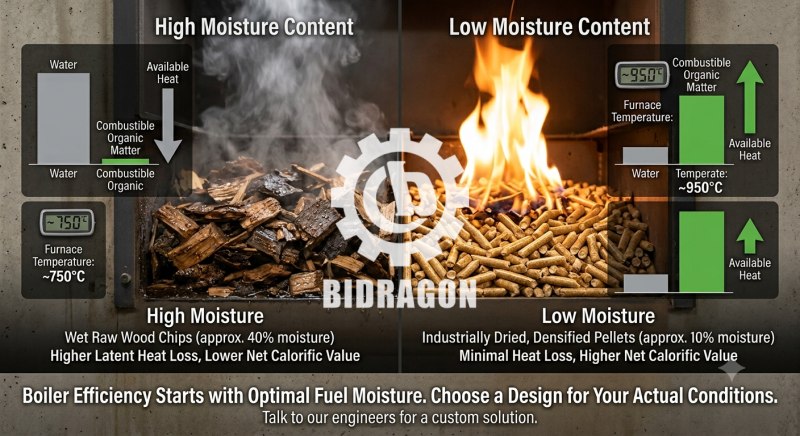
In industrial boiler operations, the net calorific value (lower heating value) serves as the key metric for evaluating a fuel's usable energy. The calculation of net calorific value already accounts for the latent heat carried away by moisture vaporization. Moisture within the fuel displaces combustible organic matter, thereby reducing the fuel's effective calorific value.
For a given unit mass of wet fuel, a higher moisture content implies a lower proportion of combustible components. Consider, for example, 1 kilogram of straw with a 20% moisture content: 200 grams consist of water, leaving only 800 grams of material capable of combustion. Moisture not only fails to release heat but actually consumes heat to evaporate. For every percentage point increase in fuel moisture content, the effective combustible content decreases correspondingly, leading to a drop in net calorific value. This is the fundamental reason why wet fuel yields less steam than dry fuel when the feed rate remains constant.
A stable furnace temperature and rapid ignition are prerequisites for the complete combustion of fuel. When fuel with high moisture content enters the furnace, the drying and vaporization processes continuously absorb heat. This directly lowers the overall furnace temperature and degrades the thermal environment within the furnace. Consequently, the fuel's heating rate slows down, and ignition is significantly delayed.
Ignition delay disrupts the boiler's normal combustion rhythm. Fuel moves forward on the grate before completing pyrolysis and ignition, preventing it from burning fully in the high-temperature core zone. Low temperatures can lead to incomplete combustion of volatile fuels, producing large amounts of combustible gases such as carbon monoxide. Unburned gases are discharged directly from the furnace, resulting in heat loss due to incomplete combustion. The higher the fuel moisture content, the more pronounced the drop in furnace temperature and the more severe the issue of incomplete combustion.
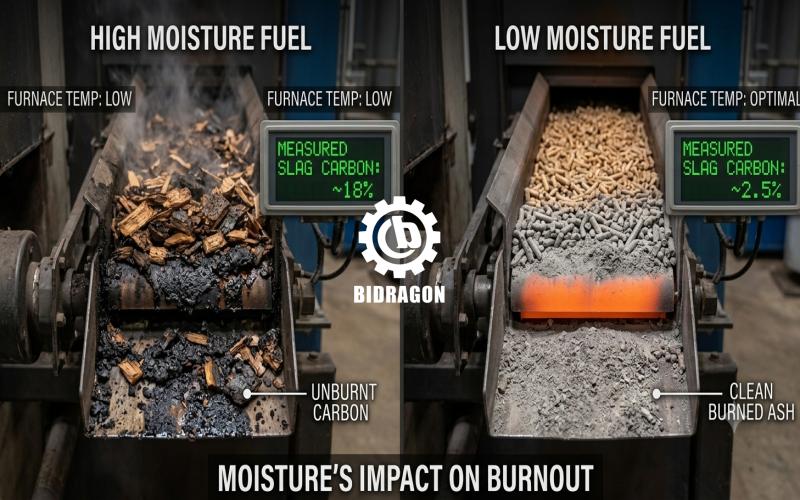
Biomass fuel on the grate must sequentially undergo four stages: drying, pyrolysis, ignition, and burnout. Each stage requires sufficient residence time. High moisture content significantly prolongs the drying process, consuming the majority of the available residence time on the grate.
Excessive drying time compresses the time available for ignition and burnout. Consequently, some fuel is transported to the ash discharge zone before fully burning out, exiting the system as solid residue. Furthermore, the low-temperature furnace environment inhibits the oxidation of fixed carbon, preventing the carbon within fuel particles from burning completely. Ultimately, the residual carbon content in the slag and fly ash rises sharply, leading to a marked decline in fuel utilization efficiency. In actual operating conditions, the black, agglomerated appearance of ash and slag following the combustion of high-moisture fuel is a clear indicator of excessive residual unburnt carbon.
Is moisture quietly costing you efficiency your boiler was never designed to give back?
The right boiler for your fuel matters more than the fuel itself. Talk to our engineers about a design built for your actual operating conditions.

The suitable fuel moisture content range varies by boiler type and must be determined based on the specific furnace design, combustion method, and original manufacturer specifications. While overdrying fuel increases production costs, excessive moisture reduces combustion efficiency; therefore, on-site operations require a balance between cost and energy efficiency. All control standards must adhere to the boiler manufacturer's design specifications.
Chain-grate boilers, commonly used in small- and medium-sized facilities, are compatible with various types of loose biomass fuels, with an optimal moisture content range of 12% to 20%. This range aligns well with the grate's operating speed, ensuring stable furnace temperatures and controllable heat loss. If the moisture content falls below 12%, the fuel burns too rapidly, potentially leading to issues such as excessive furnace temperatures and flame impingement on heating surfaces. Conversely, if the moisture content exceeds 20%, operational problems arise, including delayed ignition, incomplete combustion, and a significant increase in heat loss through flue gases.
Fluidized bed boilers offer broader fuel compatibility, with an optimal moisture content range of 15% to 25%. Their large furnace thermal capacity helps buffer the heat absorption losses associated with moist fuel. However, if the fuel moisture content consistently exceeds 25%, issues such as low bed temperatures, unstable fluidization, and reduced combustion efficiency can still occur.
Boilers designed specifically for biomass pellets are subject to the strictest control standards, requiring fuel moisture content to remain stable between 8% and 15%. Pellet fuels have a dense structure, resulting in a slow rate of moisture evaporation. Excessive moisture content directly leads to ignition difficulties and incomplete combustion, thereby negating the high-efficiency combustion advantages inherent to pellet fuels.
When fuel moisture content exceeds limits, the most immediate issue is a drop in the boiler's effective output. With feed rates and operating parameters held constant, wet fuel yields a lower effective heating value, resulting in a significant reduction in steam generation. Plants often encounter situations where boilers fail to reach rated loads or steam temperature and pressure fall short, making it impossible to meet production energy demands. Furthermore, frequent fluctuations in steam parameters directly compromise the stability of downstream production processes.
Incomplete combustion caused by high-moisture fuel leads to a substantial increase in flue gas pollutant emissions. The low-temperature environment within the furnace generates large quantities of unburned gases and fine carbon particles. This raises flue gas particulate concentrations, significantly increasing the likelihood of black exhaust and excessive dust emissions. The reducing gases produced by incomplete combustion alter the furnace's combustion atmosphere, fostering the creation of additional combustion by-products and increasing the burden of environmental compliance for the enterprise.
When moisture content is excessively high, the furnace temperature drops too low to sustain stable, self-supporting combustion. To prevent flameout and maintain furnace temperature, plants are often forced to use auxiliary fuels such as diesel or natural gas. This incurs additional operating costs, completely negating the cost advantages of biomass fuel and drastically reducing the boiler's economic efficiency.
Incomplete combustion resulting from high-moisture fuel accelerates slagging and ash accumulation on the boiler's heating surfaces. Unburned carbon particles and sticky ash are carried by the flue gas and adhere to the surfaces of water walls, superheaters, and economizers. Moist, low-temperature flue gas increases ash adhesiveness, making deposits difficult to remove via standard soot-blowing methods. Persistent ash accumulation impedes heat transfer, further lowering the boiler's thermal efficiency. Long-term buildup can also trigger safety hazards such as tube wall overheating and localized high-temperature corrosion.
High levels of water vapor in the flue gas are a primary cause of low-temperature corrosion in boilers. Flue gas generated from high-moisture fuel has a high water vapor content, which condenses on low-temperature heating surfaces such as air preheaters and economizers. This condensate combines with sulfides and nitrides in the flue gas to form acidic, corrosive substances. Acidic substances cause continuous wear on the metal walls of the equipment; long-term operation leads to issues such as air preheater tube blockages, wall thinning, and air or water leakage, significantly shortening the equipment's service life.
Fuel with excessive moisture content is highly viscous and has poor flowability, causing numerous malfunctions in the feeding system. Damp wood chips and straw tend to clump together, leading to problems like material bridging in silos, feeder blockages, and uneven feeding. Frequent feeding irregularities exacerbate fluctuations in combustion conditions, increase the likelihood of equipment wear and jamming, and raise the workload for daily operation and maintenance.
Corrosion, fouling, feeder jams — is fuel moisture already costing you?
Our biomass boilers are built with wider moisture tolerance and reinforced components, so fuel variability doesn't mean lost efficiency. Talk to our engineers.
Accurate testing is the foundation of moisture content control. Three main testing methods are used on-site, catering to different requirements regarding precision and operating conditions.
The oven-drying method is the industry benchmark and offers the highest precision. It is suitable for fuel acceptance and data benchmarking. Moisture content is calculated based on the difference in sample mass before and after drying, yielding stable and reliable data. Its drawback is the long testing cycle, making it unsuitable for real-time operational adjustments.
Portable moisture meters are the mainstream rapid testing equipment in plants. They are easy to operate and provide quick results, making them ideal for spot-checking incoming materials and routine inspections. Although slightly less precise than the oven-drying method, they fully meet the needs of on-site combustion parameter adjustments and offer excellent cost-effectiveness.
Near-infrared (NIR) online sensors are commonly used in automated fuel supply facilities. They monitor fuel moisture content in real-time on conveyor belts or at silo outlets, with data integrated into the boiler control system. They can promptly detect moisture fluctuations, supporting the automatic optimization of equipment operation.
Sampling protocols directly determine testing accuracy. Due to the poor uniformity of biomass fuel, single-point sampling leads to significant errors; therefore, multi-point composite sampling is required. Enterprises should establish fixed testing frequencies and normalize batch spot-checks and routine inspections to ensure the data accurately guides combustion control.
Using boiler waste heat to pre-dry fuel is the optimal, low-cost method for reducing moisture. Waste heat such as low-temperature flue gas or heat dissipated from equipment can be recovered to dry wet fuel without additional energy consumption. This not only lowers fuel moisture content but also reduces moisture variance between batches, stabilizing the quality of fuel fed into the boiler.
Blending wet and dry fuels is a simple and efficient on-site control method. To address issues with diverse fuel sources and significant moisture fluctuations, high-moisture fuel can be mixed with dry sawdust or finished pellets in specific proportions to keep the overall moisture content within the required range. This stabilizes combustion conditions at a low cost without requiring equipment modifications.
Optimizing storage methods allows for controlling fuel moisture absorption at the source. Open-air stockpiling should be abandoned in favor of enclosed, moisture-proof storage facilities that incorporate ventilation gaps and standardized stacking heights to prevent moisture accumulation or water pooling at the base. During the rainy season, priority should be given to using dry stock, while newly arrived wet fuel should be ventilated and air-dried separately to prevent the overall moisture content from exceeding limits.
When fuel moisture content fluctuates, the ratio of primary to secondary air must be dynamically adjusted. High-moisture fuel consumes more oxygen and generates a larger volume of flue gas; increasing primary air flow accelerates fuel drying and the release of volatiles, preventing smoldering and carbon buildup. Optimizing secondary air replenishes oxygen in the furnace and promotes the complete combustion of combustible gases. Conversely, when fuel is relatively dry, reducing primary air velocity helps avoid localized overheating within the furnace.
Grate speed and fuel feed rates must be adjusted in alignment with fuel moisture content. Since high-moisture fuel burns and burns out more slowly, reducing grate speed and slightly adjusting the feed rate extends the fuel's residence time in the furnace, ensuring complete burnout. Failure to adjust these parameters can lead to excessive residual carbon and increased slag volume. For dry fuel, feed rates and speeds can be appropriately increased to match the combustion rhythm and boost boiler output.
Economizers and air preheaters effectively mitigate heat losses caused by high moisture content. Preheating combustion air and feedwater compensates for temperature drops in the furnace and reduces heat loss through flue gas. Keeping the boiler's tail-end heating surfaces clean during daily operations stabilizes heat transfer efficiency and minimizes the negative impact of wet fuel on boiler economic performance.
Fuel moisture content is a key operational parameter that can be precisely controlled. Many boilers suffering from suboptimal energy efficiency can see improvements through the refined management of fuel moisture. Enterprises can stabilize moisture levels by employing methods such as waste-heat pre-drying, blending wet and dry fuels, and implementing standardized storage practices. Adjusting airflow, grate speed, and feed rates based on real-time moisture data not only reduces energy efficiency losses but also mitigates slagging and extends equipment service life.