
Industrial boilers are core thermal equipment in factory production; their operational stability directly determines whether production lines can run continuously. Boiler alarms serve as early warnings of equipment malfunctions and safety alerts. Most unplanned shutdowns, equipment damage, and safety incidents stem from operators failing to correctly interpret or properly respond to these alarms.
Drawing on hands-on operational experience, I will outline the causes, risk levels, and response procedures for common industrial boiler alarms. This aims to help operators quickly troubleshoot issues and standardize operations, thereby effectively minimizing losses from downtime and reinforcing the safeguards for safe equipment operation.
Modern industrial boilers are equipped with automated control and safety monitoring systems. Sensors collect real-time data on water level, pressure, temperature, combustion, water quality, and the operation of auxiliary equipment. The system compares the results with preset security standards. An alarm will be triggered if the parameters exceed the limit.
Boiler alarms fall into two categories. Standard warnings indicate minor parameter deviations, allowing the boiler to continue operating briefly; operators can make minor adjustments without shutting down the unit. Safety interlock alarms, however, signal high-risk conditions. Upon activation, the system automatically shuts down the boiler, cuts off the fuel supply, and releases pressure to prevent serious incidents such as dry firing, tube rupture, or furnace explosions.
The efficiency of the response to boiler alarms directly impacts both production and safety. Delays in addressing minor faults can accelerate equipment wear and increase energy consumption. Mishandling high-risk alarms can lead to equipment damage, production line shutdowns, and even endanger personal safety. This is a crucial reason why operators must understand alarm logic.
Water level is the most common trigger for boiler alarms, falling into two categories: low water level and high water level. Low water level alarms are frequently caused by malfunctions in the feedwater system. Issues such as feedwater pump wear, stuck valves, or pipeline blockages can result in insufficient water replenishment, while leakage from blowdown valves or pipelines causes a continuous loss of boiler water, ultimately triggering an alarm. High water level alarms primarily stem from improper operational adjustments. A failure to timely reduce feedwater flow when the boiler load drops suddenly can cause a "false rise" in water level; additionally, scaling on water level probes or signal malfunctions can generate false high-water-level alarms.
Low water level is a high-risk abnormal operating condition. If the water level is too low, the upper part of the furnace tube will be separated from the cooling water cover, resulting in dry burning and overheating, causing the tube wall temperature to rise rapidly. Prolonged water shortage can result in tube deformation or bulging. In severe cases, the tubes may rupture or leak, leading to major equipment safety accidents.
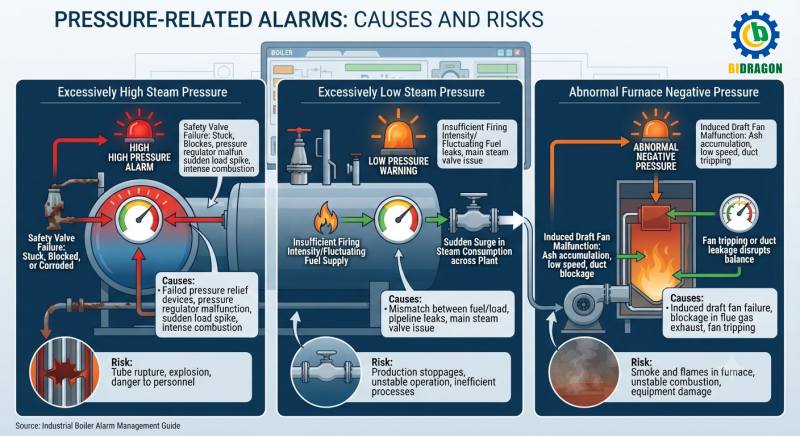
Abnormal boiler pressure conditions generally fall into three categories: excessively high steam pressure, excessively low steam pressure, and abnormal furnace negative pressure. Excessive steam pressure is often caused by the failure of pressure stabilizing and relieving devices. The safety valve is stuck, blocked, or corroded and cannot open and release pressure normally. Malfunctions in pressure regulators can also lead to a continuous buildup of pressure within the boiler. Additionally, sudden spikes in boiler load or excessively intense fuel combustion can trigger alarms for over-pressure conditions in the short term.
Excessively low steam pressure primarily stems from a mismatch between fuel supply and production load. Fluctuations in fuel supply, insufficient firing intensity, or sudden surges in steam consumption across the plant can all cause pressure to drop. Pipeline leaks or abnormal positioning of the main steam valve can also result in persistently low pressure. Abnormal furnace negative pressure is typically caused by induced draft fan malfunctions. Issues such as ash accumulation on the fan, insufficient rotational speed, or duct blockages can impede flue gas exhaust and lead to excessively high negative pressure. Fan tripping or duct leakage will disrupt the negative pressure balance. In severe cases, problems such as smoke and flames may occur in the furnace.
Abnormal boiler temperatures primarily manifest as excessively high flue gas temperatures, furnace temperature deviations, and abnormal outlet temperatures at the superheater and economizer. Excessively high flue gas temperature is the most common fault; ash accumulation and scaling on heating surfaces impede heat transfer. This causes heat to be lost with the flue gas, which not only reduces thermal efficiency and increases energy consumption but also accelerates the aging and wear of equipment in the tail-end flue.
Furnace temperature deviations are often caused by improper combustion regulation. Imbalanced fuel ratios, unreasonable air distribution, and uneven combustion due to carbon buildup or burner issues can lead to incomplete combustion, resulting in localized overheating or low overall furnace temperatures. Ash accumulation and blockages in the economizer and superheater, along with restricted fluid flow, significantly reduce heat transfer efficiency, causing fluctuations in outlet water and steam temperatures as well as localized overheating. These conditions easily lead to high-temperature damage to the piping.
Combustion system faults are a primary cause of boiler shutdowns. Common alarms include ignition failure, flameout during operation, and abnormal flame monitoring. Ignition failure typically occurs during equipment startup or shutdown. Issues such as carbon buildup or moisture on ignition electrodes, insufficient fuel pressure, pipeline blockages, or poor atomization at low temperatures can prevent the fuel from igniting properly.
Causes for flameout during boiler operation vary widely. Interruptions in fuel supply, pressure fluctuations, excessive furnace airflow blowing out the flame, or the obscuring of the flame by ash accumulation and slagging within the furnace can all trigger flameout alarms. Additionally, abnormalities in the furnace purge sequence can lead to residual combustible gases, locking out the ignition function and triggering an alarm. Issues such as ash accumulation, water ingress, or poor electrical contact in the flame monitor can cause signal recognition failure, triggering false flameout alarms and disrupting normal boiler operation.
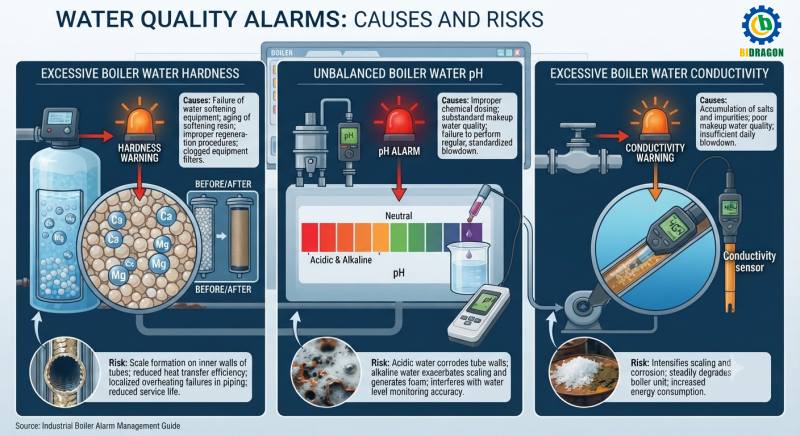
Abnormal water quality poses a highly insidious risk to boilers. While such faults rarely cause an immediate shutdown, they lead to continuous corrosion and degradation, thereby shortening the boiler's service life. Water quality alarms mainly correspond to three core indicators exceeding the standard: boiler water hardness, pH value, and conductivity. Excessive boiler water hardness is usually caused by the failure of water softening equipment. Issues such as the aging of softening resin, improper regeneration procedures, or clogged equipment filters reduce water treatment effectiveness, preventing the removal of calcium and magnesium ions. When hard water enters the boiler, scale forms on the inner walls of the tubes; this scale reduces heat transfer efficiency and can gradually lead to localized overheating failures in the piping.
Boiler water pH levels may become unbalanced, shifting too high or too low. Primary causes include improper chemical dosing, substandard makeup water quality, and failure to perform regular, standardized blowdown operations. Acidic boiler water corrodes the boiler's tube walls. Alkaline water exacerbates scaling and generates foam, which interferes with the accuracy of water level monitoring. Excessive boiler water conductivity indicates an accumulation of salts and impurities, typically resulting from poor makeup water quality or insufficient daily blowdown. Long-term accumulation of impurities inside the boiler intensifies scaling and corrosion, steadily degrading the boiler unit itself.
Auxiliary equipment such as fans and water pumps is essential for the stable operation of the boiler. Faults in these components or in electrical systems can easily disrupt boiler operating conditions and, in severe cases, trigger an interlocking shutdown. Induced-draft fans and forced-draft fans are particularly prone to failure. Inadequate long-term lubrication can lead to excessive bearing temperatures. Dust accumulation on fan impellers or loose mounting bolts can cause excessive vibration and fluctuations in operating current. Blockages in air ducts or fan overloading can directly trigger overcurrent trips, thereby disrupting normal boiler operation. Common malfunctions in boiler feedwater pumps primarily manifest as unstable water supply, insufficient supply pressure, and equipment tripping. These issues stem from both mechanical and electrical causes. Wear on pump seals and impeller damage can compromise water supply performance, while motor overloads, aging wiring, and voltage fluctuations can trigger protective shutdowns. Frequent start-stop cycles and dry running due to a lack of water can also directly trigger fault alarms. Boilers operate in high-temperature, dusty environments characterized by harsh working conditions; prolonged operation can lead to dust accumulation and aging of sensors, as well as loose or damaged wiring. Ultimately, this results in erratic data readings and signal anomalies, generating numerous false alarms. Operators must accurately distinguish between instrumentation faults and genuine operational hazards to avoid incorrect assessments and responses.
Boiler alarms fall into two categories: genuine fault alarms and false alarms caused by sensor malfunctions. Operators must quickly distinguish between them to avoid production losses from unnecessary shutdowns while also preventing safety accidents caused by overlooking potential hazards. Checking on-site instrumentation is the most direct and effective method of assessment. If the control system triggers an alarm but the local readings for water level, pressure, and temperature—as well as the overall operating conditions—remain normal, the alarm can generally be attributed to sensor failure or a wiring fault. In this case, operators need only troubleshoot the instruments and wiring rather than initiating an emergency shutdown.
Conversely, if the alarm coincides with significant anomalies in local operating parameters—such as a continuously dropping water level, sudden pressure spikes or drops, furnace flameout, or abnormal flue gas conditions—it indicates a genuine emergency. Operators must immediately activate emergency response protocols. Minor alarms that occur repeatedly or intermittently should not be ignored either; such phenomena often signal underlying issues like component aging or poor electrical connections. Even minor fluctuations in operating conditions can cause these latent hazards to escalate into major failures, serving as a primary cause of sudden boiler shutdowns.
Still relying on a boiler that alarms more often than it used to?
If your system is triggering repeated false alarms or unexplained shutdowns, the root cause is often aging components not operator error. Our industrial boilers are built with corrosion-resistant sensors, redundant safety interlocks, and real-time diagnostic monitoring, designed to cut false-alarm rates and extend safe operating life.
Talk to our engineers about an equipment assessment or upgrade.

When a boiler alarm sounds, operators must not simply reset or silence the alarm, nor should they blindly adjust equipment parameters. They must follow established procedures to handle the situation and avoid exacerbating the fault through improper action. First, check the control system to identify the alarm type and the abnormal parameters. Then, proceed to the site to verify the boiler's actual operating conditions. Accurately pinpoint the fault location—determining whether it involves water level, pressure, combustion, or auxiliary equipment—and assess the risk level of the malfunction. In the case of a minor fault with slight parameter deviations, operators may continue to monitor the boiler's condition and make small adjustments while observing the status; however, if the condition deteriorates, an immediate shutdown is mandatory.
When the boiler experiences high-risk alarms such as low water level, overpressure, flameout, gas leak, or auxiliary equipment tripping, the operator must immediately implement shutdown protection. Quickly cut off the fuel, power, and steam supplies, and strictly avoid the dangerous practice of continuing to operate the boiler while it is malfunctioning. Throughout the troubleshooting process, keep the shift supervisor and central control room personnel informed of the fault status and the progress of the response. After troubleshooting and restoring the boiler to normal operation, all relevant information must be fully recorded. This includes the alarm time, fault type, troubleshooting process, and handling methods. This information will serve as a reference for subsequent boiler fault review and preventative maintenance.
Most boiler alarms do not stem from sudden, isolated failures; rather, they result from the long-term accumulation of issues such as fouling, component aging, mechanical wear, and instrument inaccuracy. Conducting standardized, regular maintenance can prevent the vast majority of common boiler alarms at the source. Routine inspections can promptly detect minor potential problems, such as slight fluctuations in boiler parameters, abnormal operation of auxiliary equipment, pipe blockages, and deviations in instrument data. Operators can address these issues in their early stages, preventing potential problems from escalating. Regularly cleaning and descaling the boiler, calibrating testing instruments, and maintaining auxiliary equipment such as fans and water pumps can stabilize the boiler's heat exchange performance and reduce false alarms from instruments and boiler malfunctions. Some factories shorten maintenance cycles to meet production schedules, which accelerates equipment wear, increases alarm frequency, and ultimately leads to unexpected shutdowns and equipment damage. A stable, compliant maintenance schedule is the foundation for the boiler's long-term, smooth operation.
Safety interlocks serve as the final line of defense for a boiler. The interlock system operates independently of the standard control system, providing a fail-safe mechanism in the event of human error or failure of the conventional automatic control system. The system protects the boiler based on preset, hard safety thresholds. When parameters exceed safe limits, it autonomously executes protective actions—such as cutting off fuel, initiating an emergency shutdown, depressurizing equipment, and closing valves—to rapidly halt hazardous operating conditions. There are various common scenarios for boiler interlock protection: low-water-level shutdowns prevent dry firing and tube ruptures; overpressure fuel cutoffs and depressurization mitigate explosion risks; and flame-out fuel cutoffs prevent secondary furnace explosions. Interlocks lock the equipment's status before a failure spirals out of control, thereby minimizing accident risks. Unauthorized bypassing or short-circuiting of interlock devices during on-site operations is strictly prohibited. Frequent interlock alarms indicate persistent, underlying hazards; disabling protection to allow the boiler to operate with existing faults significantly increases the probability of major safety accidents.
Alarm issues in industrial boilers fall primarily into seven categories. Each type of alarm corresponds to a specific equipment anomaly or operational malfunction; boilers do not trigger frequent alarms without cause. When operators accurately identify and properly handle every alarm, they effectively protect the equipment and ensure safe, stable production at the facility. Compared to emergency responses following a failure, routine inspections and regular maintenance serve as superior preventive measures, effectively reducing alarm frequency and stabilizing long-term boiler operation.