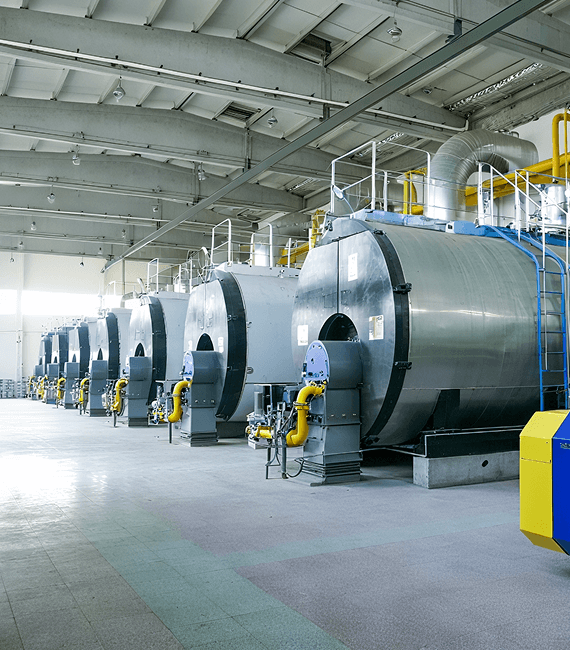

Many enterprises keep industrial boilers out of service for extended periods due to factors such as production halts, retrofitting, or off-season lulls. Personnel often mistakenly believe that an idle boiler can simply be inspected and immediately fired up for operation. However, prolonged idleness can lead to hidden defects affecting the boiler structure, components, and control systems. Starting the machine directly without following the standard maintenance procedures can easily lead to problems such as leaks, valve jamming, and abnormal pressure, causing equipment damage, production stoppages, or even major safety accidents. Drawing on industry standards and practical experience, I will now provide a detailed explanation of the complete, standardized process for restarting and recommissioning industrial boilers that have been out of service for a long time.
Industrial boilers are classified as high-pressure special equipment; during continuous operation, they function within high-temperature, high-pressure, and aqueous environments, maintaining relatively stable component conditions. However, after a long period of inactivity, the equipment deviates from its stable operating state. Exposure to the ambient environment and the static nature of the shutdown lead to ongoing degradation of critical components.
Prolonged exposure of the boiler's metal structure to humid air causes gradual oxidation and corrosion on the inner surfaces of the boiler drum and heating surfaces, transforming smooth metal into surfaces covered with rust layers and tubercles. Rubber and graphite seals in piping and valves gradually age and harden, losing their original elasticity and sealing capability. Simultaneously, residual water and humidity within the boiler foster the accumulation of impurities, leading to water quality deterioration and sludge deposition.
If the boiler is started up without systematic inspection and testing, the weakened, corroded metal surfaces are prone to bulging or developing perforations and leaks during the temperature and pressure ramp-up. Aged seals may fail, resulting in steam or hot water leakage, while seized valves may be unable to properly regulate pressure and water levels. In severe cases, dangerous operating conditions such as overpressure operation and low water level loss of control may occur, directly causing safety accidents of special equipment.
Not sure whether your idle boiler still has some life left in it, or if repairs might end up costing more than expected?
Whether you need replacement parts, a system upgrade, or a full new unit, we can help you figure out the most cost-effective path forward — reach out and we'll walk through your options with you.

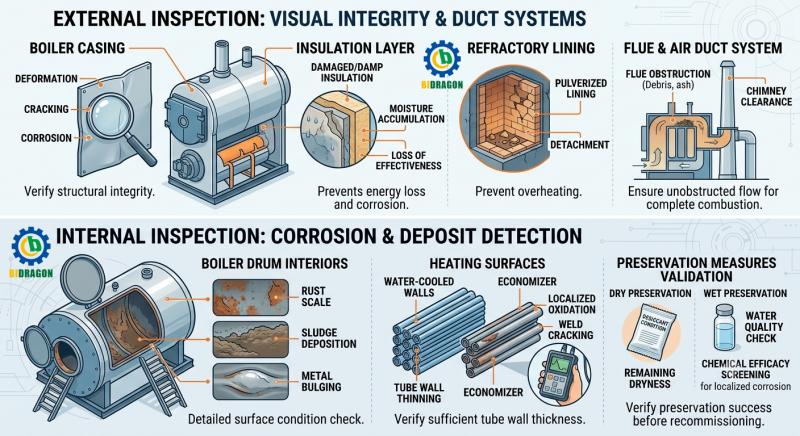
External inspection is the primary step in the restart process, focusing on verifying the structural integrity of the boiler and the flue/air duct system. The boiler casing must be checked for deformation, cracking, or extensive corrosion. Particular attention should be paid to the refractory lining on the exterior of the furnace chamber and flues; prolonged exposure to moisture while idle can cause the lining to pulverize, detach, or crack. Damaged refractory structures can lead to excessive heat loss during operation and overheating of the boiler body.
The equipment's insulation layer must also be inspected, as moisture in the plant environment can cause insulation material to become damp and lose its effectiveness. Damaged insulation not only increases operational heat loss but also accelerates corrosion on the boiler body and external piping.
Finally, thoroughly clean the flue/air ducts and the chimney. If a boiler is not used for a long time, it will accumulate ash, fallen leaves, bird nests and other debris, which can easily block the flue gas passage. Starting the boiler without proper cleaning can result in obstructed exhaust flow, incomplete combustion, and positive pressure within the furnace chamber, creating safety hazards such as flue gas backflow or furnace deflagration. After cleaning, verify that the entire air and flue duct system is clear and free of obstructions.
Internal boiler hazards are often concealed and pose the highest risks. Before restarting, manholes and handholes must be opened to conduct a comprehensive inspection. Particular attention should be paid to the inner surfaces of boiler drums and headers for signs of rust, bulging, or deformation. Areas prone to prolonged dampness or water accumulation often harbor rust scale and sludge, which can impair the heat transfer efficiency of the boiler's heating surfaces.
The key heating surfaces, such as water-cooled walls, superheaters, and economizers, need to be inspected. Prolonged equipment idleness can lead to metal oxidation and tube wall thinning; insufficient wall thickness creates a high risk of tube rupture during high-pressure operation. Additionally, structural defects such as bending, deformation, or weld cracking on heating surfaces must be identified.
The effectiveness of preservation measures taken during the shutdown period must be verified item by item. For dry preservation, inspect the condition of the desiccant and the dryness of the boiler interior. For wet preservation, check boiler water quality and chemical efficacy, and screen for localized corrosion. If preservation has failed, thorough cleaning and remediation are required before proceeding with further operations.
The boiler's integrated water-steam system relies on valves and piping for stable operation. Prolonged periods of inactivity can lead to valve sticking and seal failure, making these common points of leakage upon restart. All valves, including the main steam valve, water supply valve, drain valve, and vent valve, need to be manually operated one by one. Verify that they operate smoothly, travel the full stroke, and show no signs of binding or seizing. Valve internals that have remained idle for extended periods are prone to rust and adhesion; attempting to force their operation could result in valve malfunction or an inability to close them properly.
Gaskets and sealing rings are consumable parts prone to wear. Prolonged inactivity can cause them to age, harden, crack, and lose elasticity. Even if there is no visible damage, it is recommended to completely replace the seals on boilers that have been out of service for more than a year to prevent leakage or cross-flow of water and steam during operation.
Simultaneously, inspect all supports, hangers, and expansion joints associated with the water-steam piping. Rusted or loose pipe supports can lead to stress-induced displacement. Expansion joints left idle for long periods are susceptible to deformation and a loss of their ability to compensate for thermal expansion and contraction. If thermal deformation cannot be accommodated as the boiler heats up and pressurizes, it may result in failures such as weld cracking or pipe rupture.
Instrumentation and control systems are prone to inaccuracy or malfunction after exposure to moisture; therefore, each component must be verified before the system is returned to service. The calibration validity of pressure gauges, water level indicators, and thermometers must be checked; instruments with expired calibration are prohibited from use. On-site inspections must confirm that readings are accurate and free from sticking or irregularities, dials are legible, and piping is unobstructed and free of leaks.
For safety valves, it is necessary to confirm that calibration records are complete. Prolonged inactivity can lead to issues such as valve disc sticking or spring failure. Manual actuation tests must be performed to ensure the valves can properly lift and relieve pressure in the event of overpressure.
Finally, comprehensive testing of the automatic control and interlocking systems must be conducted. Key verification areas include high/low water level, overpressure, over-temperature, flame-out protection, and shutdown interlock functions. Moisture and aging can compromise protection mechanisms; the system may only proceed to the next stage once all alarm and interlock functions have been successfully tested.
Boiler auxiliaries include equipment such as induced draft fans, forced draft fans, and feedwater pumps, and are the core components for the stable operation of boilers. During periods of inactivity, issues such as bearing corrosion, motor dampness, and mechanical binding can easily occur. Begin by manually rotating the fan and pump impellers to verify smooth movement, ensuring there is no sticking, abnormal noise, or sensation of frictional resistance.
Replenish lubricant in all moving parts and replace any old lubricant that has degraded or become contaminated with water; this prevents dry running, abnormal noise, and overheating damage during equipment trial runs. After lubrication and maintenance, conduct individual trial runs to monitor operating speed, vibration, and noise levels; the equipment is deemed satisfactory if it operates without abnormal shaking or noise.
Inspection of the electrical system is particularly critical, as the humid plant environment can reduce the insulation resistance of motors and control circuits. Measure the electrical insulation values of all auxiliary equipment to ensure compliance with standards and to prevent electrical faults such as leakage, short circuits, or motor burnout. Additionally, inspect wiring terminals for looseness or oxidation, and check distribution boxes for moisture or dust accumulation, performing necessary cleaning and rectification before putting the equipment back into service.
For boilers that have been out of service for an extended period, hidden defects may exist in internal welds, tube walls, and pipe connections, even if visual inspections reveal no abnormalities. The hydrostatic test is the primary method for verifying the strength and tightness of a boiler's pressure-bearing components and is an essential step in restarting a long-idled boiler. It can accurately detect hidden dangers such as leaks, deformations, and weld cracks that cannot be detected by the naked eye.
The hydrostatic test pressure must strictly adhere to boiler design specifications; for standard industrial boilers, the test pressure is typically 1.25 times the rated working pressure. Before the test, all blowdown valves and steam traps must be closed, and all outlets sealed. Water should be filled slowly into the boiler while air is thoroughly vented to prevent residual air from affecting the test results.
Pressure must be raised slowly and steadily in stages; rapid, one-step pressurization is strictly prohibited. After reaching each pressure stage, the process should pause to allow sufficient time to inspect all pressure-bearing components, including the boiler body, welds, piping, and valve flanges. Particular attention should be paid to signs of water seepage, dampness, or rapid pressure drops.
After the pressure-holding phase, the pressure should be reduced slowly while continuously monitoring the boiler body for issues such as plastic deformation, bulging, or weld cracking. The test is considered successful if there is no leakage or deformation and the pressure remains stable. If any abnormalities occur, the pressure must be released and corrective measures taken. The hydrostatic test must be repeated after corrections are made, and the boiler may only proceed with the return-to-service process if it passes the test.
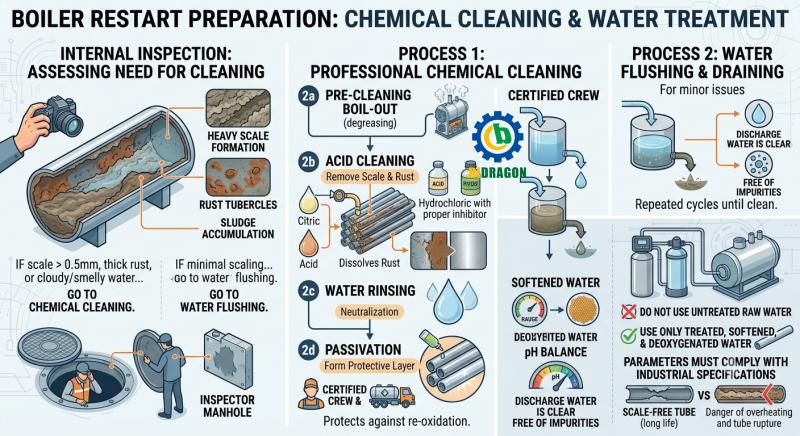
When a boiler sits idle for an extended period, residual moisture inside can deteriorate. Uneven layers of rust and scale may form on the inner walls; while these impurities might not be easily visible to the naked eye, they directly compromise operational safety and equipment longevity.
If, after opening the manhole, you find obvious thick scale, large areas of rust, sludge accumulation on the inner wall of the furnace, or if the furnace water is cloudy, black, and has an odor, then professional chemical cleaning is required. Processes such as acid cleaning and passivation are used to thoroughly remove scale and rust products from the tube walls. Passivation is performed after cleaning to protect the metal surfaces and prevent rapid re-oxidation or corrosion.
If the internal scaling and rusting are minor, the boiler can be cleaned by repeatedly flushing with clean water and draining until the discharge runs clear and free of impurities. Before refilling and restarting, water quality standards must be strictly enforced. Boiler feedwater requires softening and deoxygenation; parameters such as hardness, oxygen content, and pH levels must comply with industrial boiler feedwater specifications.
The use of untreated raw water for filling is strictly prohibited. Substandard water quality leads to rapid new scale formation, resulting in poor heat transfer and localized overheating. Long-term operation under these conditions can cause issues such as bulging and tube ruptures, while also accelerating corrosion of the piping and boiler body, thereby shortening the equipment's service life.
Ignition and start-up may only proceed after all inspections, pressure tests, verifications, and water quality treatments have been completed. A boiler that has been shut down for an extended period is in a "cold state," with the boiler body, piping, and refractory materials at very low temperatures; rapid heating or pressure buildup is strictly prohibited. Sudden temperature fluctuations generate immense thermal stress, which can lead to furnace wall cracking, weld damage, and pipe deformation.
First, perform ventilation and purging of the furnace chamber and flue gas passages to thoroughly remove any residual combustible gases and eliminate the risk of ignition-induced deflagration. Once purging is complete, activate the ignition system and warm up the boiler using a low flame and low load. This warm-up phase must last long enough to allow the temperature across all parts of the boiler body to rise slowly and evenly, gradually drying out the refractory materials and any trace moisture within the unit. The warm-up and drying process requires 5 to 7 days for large boilers and 2 to 3 days for smaller ones; the rate of temperature rise must be strictly controlled according to the equipment's specific drying curve.
After the warm-up phase, slowly increase the furnace temperature and internal pressure, maintaining a slow rate of pressure rise throughout and holding the pressure steady at specific intervals. During each stage of pressure increase and stabilization, carefully monitor changes in water level, pressure, and temperature to ensure parameters remain stable and normal. Simultaneously, observe the equipment's operating sound, flue gas exhaust, and piping seals for any issues such as abnormal noises, leaks, or irregularities in the exhaust.
Throughout the cold start-up process, the water level is a critical monitoring parameter. Precautions must be taken to avoid "high water" accidents caused by excessive levels or the risk of dry firing caused by low levels. Only after the pressure and temperature have reached rated operating parameters and equipment operation has stabilized should the load be gradually increased to commence normal production.
Safety accessories constitute the final line of defense for a boiler; a final review and verification must be completed before formal operation to prevent safety accidents caused by accessory failure. First, verify the safety valve: confirm that calibration is valid, the lead seal is intact, and the opening pressure meets the equipment's rated parameters; perform a manual test to ensure discharge and reset functions operate correctly without sticking or leakage.
Next, check measuring instruments such as pressure gauges, water level gauges, and thermometers. Confirm that all are within their valid calibration periods, display accurate readings, have clear and unobstructed piping, and show no signs of leakage or dial damage. Water level gauges require a blow-down test to ensure the displayed water level is accurate and responsive, and that high and low water level markers are clear and correct.
Once the verification of all safety accessories is complete, confirm that the third-party inspection lead seals remain intact and show no signs of unauthorized removal or tampering. Simultaneously, compile all inspection records, test data, and inspection reports related to this return-to-service process into a dedicated checklist. This list should detail equipment status, items inspected, rectification actions taken, and test results. It will serve as a reference for future shutdowns, restarts, and routine maintenance, enabling comprehensive safety management throughout the equipment's lifecycle.
Restarting an industrial boiler after a prolonged shutdown is not merely a matter of ignition and startup. It is a rigorous and systematic security management process. Many boiler-related accidents stem from enterprises cutting corners on inspection procedures. Such actions can not only damage the boiler equipment but also lead to violations of regulations governing special equipment, resulting in legal liability.
Before restarting a boiler that has been out of service for an extended period, enterprises are advised to entrust the inspection, testing, and startup operations entirely to certified operators and professional inspectors. Strict adherence to established procedures and the implementation of every safety detail are essential to effectively eliminate risks associated with the restart and to ensure the boiler's long-term, stable, and safe operation.