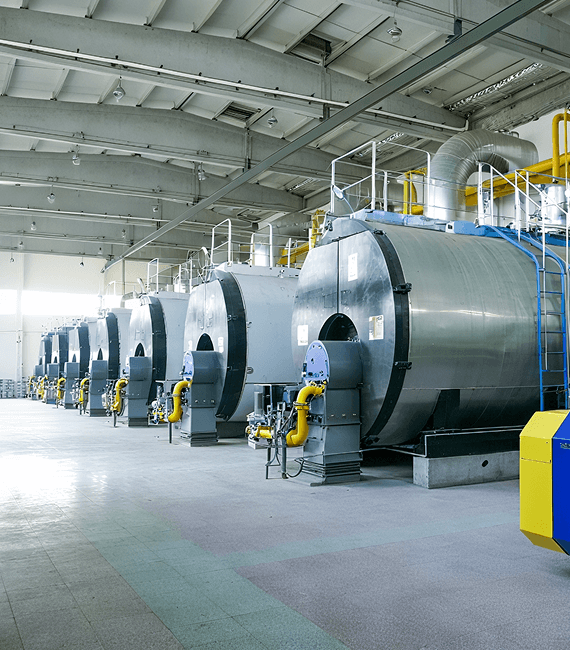

For most manufacturing plants, industrial boilers represent long-term assets with service lives ranging from 15 to 25 years. Once installed, there is very little room for adjustments later on.
Many companies focus solely on equipment pricing during procurement, obsessively comparing bottom-line quotes from different suppliers, yet rarely take the time to calculate the true cost: how much they will spend over the next decade or more on hidden expenses such as fuel consumption, maintenance repairs, and unexpected downtime.
From a total cost of ownership (TCO) perspective over the boiler's lifecycle, the initial purchase price typically accounts for only a small portion. Fuel costs usually make up the largest share, followed by maintenance, shutdowns, and retrofitting expenses—making overall operating costs easily exceed the original equipment investment.
Below, based on real-world engineering experiences, we'll discuss five of the most common selection pitfalls and practical strategies to avoid them.
【Not sure whether your current boiler selection meets your production needs? Our engineering team can provide a free application assessment and recommend the most suitable boiler solution based on your steam demand, fuel type, and operating conditions.】

This is the most common pitfall in the equipment selection process. For many enterprises, price is the primary evaluation metric; when selecting suppliers, quotes are often sorted from lowest to highest, with low-cost options prioritized.
However, an industrial boiler is not a simple consumable item where the transaction ends upon purchase; it is a core piece of production equipment designed for daily, long-term operation. The operating costs incurred over the subsequent decade or more represent the true bulk of the investment.
According to lifecycle cost analyses of industrial boilers conducted by the U.S. Department of Energy (DOE) and the Environmental Protection Agency (EPA), the initial purchase price typically accounts for only 15% to 25% of the total cost of ownership, whereas fuel costs generally exceed 60%.
In other words, saving a few tens of thousands on the initial purchase could lead to hundreds of thousands in additional fuel costs over the following years—a decision that is clearly not cost-effective.
Consider a common operating scenario: a 4-ton/hour gas-fired boiler operating 6,000 hours per year. Based on projected international industrial natural gas price ranges for 2025–2026—approximately $0.35 to $0.50 per cubic meter (varying by region and supply-demand dynamics)—the impact is significant.
If there is a 2-percentage-point difference in thermal efficiency between two boilers (e.g., 92% vs. 94%), the gap may seem minor, but when converted into annual fuel costs, the difference can easily range from $8,000 to $15,000.
Over a standard 15-year service life, the difference in fuel costs alone could reach $120,000 to $200,000—far exceeding the initial price difference between the two units.
Many enterprises try to save $10,000 or $20,000 on equipment costs during selection, only to end up spending ten times that amount on fuel—an extremely uneconomical decision.
Beyond fuel, there are also significant differences in maintenance costs depending on the quality of the boiler. Boilers built with average materials and workmanship are prone to issues like tube leaks and frequent burner malfunctions after just a few years of operation; weld joints often harbor hidden defects, and parts require more frequent replacement, leading to substantial cumulative repair costs over time.
In contrast, boilers featuring superior materials and craftsmanship—such as high-grade steel for tubes and automated welding processes—offer longer intervals between major overhauls and a lower risk of unexpected daily breakdowns. They avoid the need for constant emergency shutdowns and repairs, thereby significantly reducing hidden production losses.
Ultimately, when selecting a boiler, one cannot simply focus on the initial price quote; comparing operating costs over a 10- to 20-year period is essential to accurately assess the true investment.
Many purchasing personnel always have the mentality of "buying big rather than small" when choosing boiler capacity. They feel that if the production capacity expands in the future, small boilers will not be enough, so it is better to buy a large one in one go, just in case.
However, in actual operation, the waste caused by running a boiler at low load for extended periods is often more severe than the issues associated with insufficient capacity.
Industrial boilers are designed to maintain optimal combustion efficiency and operating conditions within a load range of 70% to 100%. If the system operates at a low load of 40% to 60% for an extended period, various problems will gradually emerge.
The most immediate impact is increased flue gas heat loss; combustion efficiency suffers, naturally leading to higher gas consumption. The burner will start and stop frequently, which not only consumes extra gas but also shortens the lifespan of the equipment.
Additionally, condensate in the flue gas is more likely to corrode the boiler body and flues, and emissions may easily exceed regulatory limits. Over time, the equipment ages much faster than a boiler operated at its rated load.
I once encountered a processing plant with a stable steam demand of 4 tons per hour. Concerned about future expansion, the manager installed an 8-ton boiler, which consequently operated at around 50% load year-round.
The calculated thermal efficiency is several percentage points lower than the rated operating condition, and the monthly gas cost is much higher than that of a factory of the same size using a 4-ton boiler, which is a completely unnecessary expense.
In reality, if there are concerns about load fluctuations or a need for backup capacity, selecting two 4-ton boilers is a more rational choice. A single unit can meet daily needs, both can run during peak demand, and a backup unit is available during maintenance shutdowns.
This configuration offers greater flexibility in load adjustment and higher overall operating efficiency, while also better handling seasonal fluctuations in steam demand. Generally speaking, selecting a boiler capacity that is 110% to 120% of the actual steam demand provides a sufficient safety margin; there is no need to blindly oversize the unit, as doing so would only lead to long-term energy waste.
【Choosing the right capacity is one of the most effective ways to reduce long-term fuel costs. Our engineering team can calculate the optimal boiler size based on your actual steam consumption profile and future expansion plans.】
Many people select boilers based solely on capacity and pressure ratings, assuming that as long as the numbers are similar, the boiler can be used across any industry. In reality, steam requirements vary dramatically across different industries. Choosing the wrong boiler not only affects product quality but may also fail to meet industry compliance standards.
The food processing industry demands extremely high steam purity. Clean steam is essential during production, with strict standards for feedwater quality and hygiene levels in the steam system—requirements that standard boilers often cannot meet.
Pharmaceutical manufacturing has even stricter requirements, needing compliance with GMP regulations. Many production processes require dedicated clean steam generators, featuring core components made of high-grade stainless steel and higher-precision control systems—far beyond what conventional industrial boilers can provide.
In the textile industry, steam load fluctuates significantly, with varying demands across different production stages. This requires burners with a wide modulation range to maintain stable steam pressure; otherwise, product quality consistency can easily be compromised.
Chemical processing frequently requires superheated steam at higher pressure levels. For certain specialized media, furnace construction must use special materials, differing substantially from the design principles of standard industrial boilers.
Before selecting a boiler, clearly define your core requirements: required steam output, operating pressure, steam quality specifications, load variability, and intended fuel type. Only by establishing these fundamental parameters can you ensure an appropriate and accurate boiler selection.
Misconception 4: Failing To Confirm Emission Requirements In Advance Leads To Higher Retrofit Costs Later On.
Environmental regulations worldwide are tightening, and ultra-low nitrogen oxide emissions have become a mandatory requirement in many regions. Particularly in Europe, North America, Japan, South Korea, and some Middle Eastern countries, strict controls are imposed on flue gas emissions from industrial boilers.
Many companies opt for cheaper standard configurations when purchasing boilers, only to retrofit them later with low-NOx burners, install flue gas recirculation systems, or upgrade control systems once local emission standards take effect.
The cost of such post-event rectification is usually much higher than choosing the standard configuration from the very beginning. Moreover, the stability of the renovated equipment is often not as good as the low-nitrogen solution directly provided by the original manufacturer.
What's more troublesome is that in some regions, environmental protection requirements are mandatory and non-compliance means no production can start. If the boiler is installed and then rectified, the production time lost in the middle often results in losses higher than the cost of the renovation itself.
The reliable approach is to understand the local emission standards before purchasing, and when selecting the boiler, directly confirm the technical route of the burner, the guaranteed value of nitrogen oxide emissions, and whether there is certification from a third-party authoritative institution.
Environmental compliance should be considered during the selection stage, and it cannot be done after the equipment is installed and then supplemented with lessons.
For manufacturing enterprises with continuous production, the most costly aspect of boiler failures is not the cost of repairing spare parts, but the production disruption caused by the shutdown. If a production line is shut down for one day, the loss could be several hundred thousand or even more, which is much higher than replacing a single part.
Therefore, when choosing a supplier, don't just focus on equipment parameters and quotations. You need to actually ask about the service capabilities.
For example, are there resident service engineers in the local area? Are the commonly used core spare parts stocked locally? Can they respond quickly to emergency failures?
Will they provide on-site startup debugging and operator training? Do they have a corresponding preventive maintenance service plan?
These questions may seem unrelated to the equipment itself, but when a failure occurs, they directly determine how long your boiler needs to be shut down before it can resume operation.
The service life of industrial boilers is nearly 20 years. During these 10-12 years, equipment is bound to have problems and requires regular maintenance and servicing.
Whether the supplier can provide stable and continuous service over the long term is actually much more important than the initial discount at the time of purchase. Some small brands offer low quotations, but their services don't keep up after selling out. When the equipment breaks down, it takes half a month to get spare parts, and the lost production capacity is already more than the money saved initially.
When evaluating suppliers, long-term service capability is a key item to focus on. Don't just focus on equipment parameters and prices.
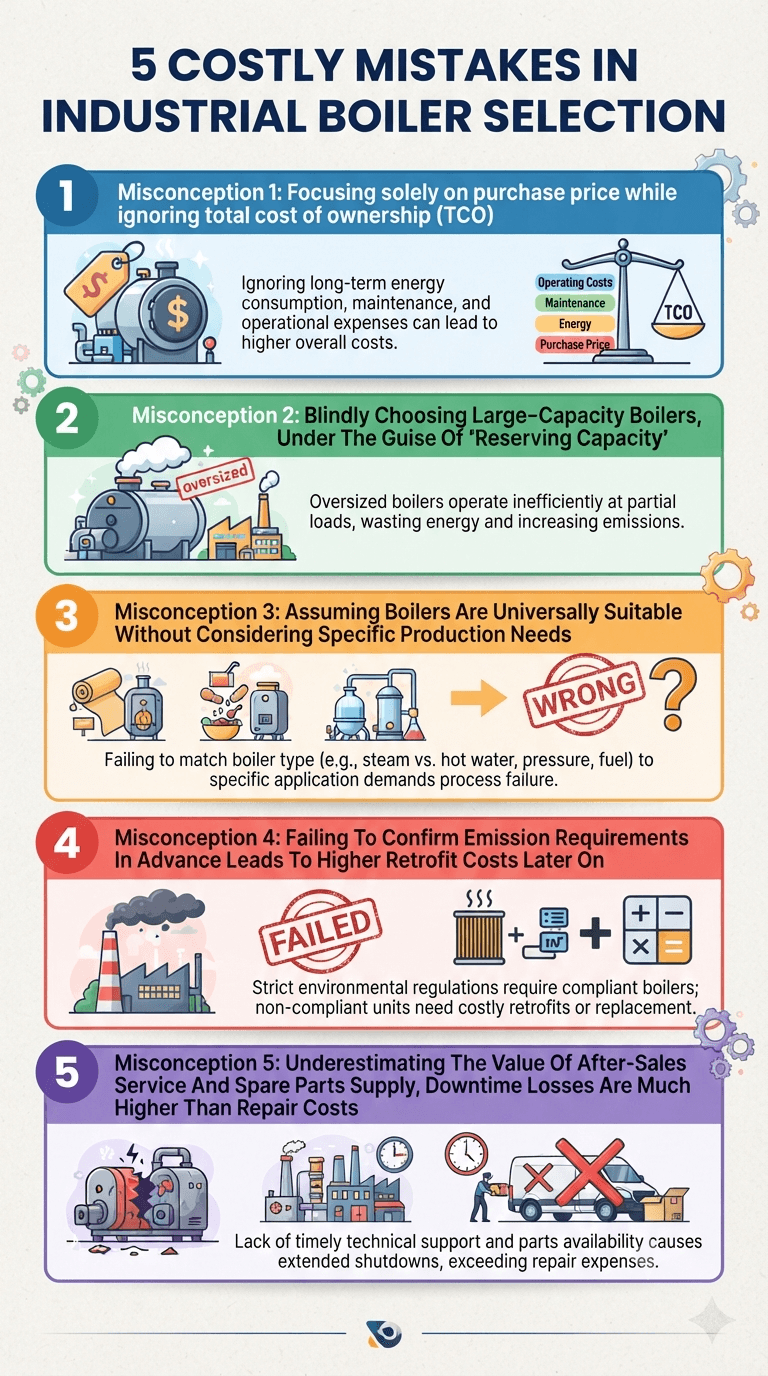
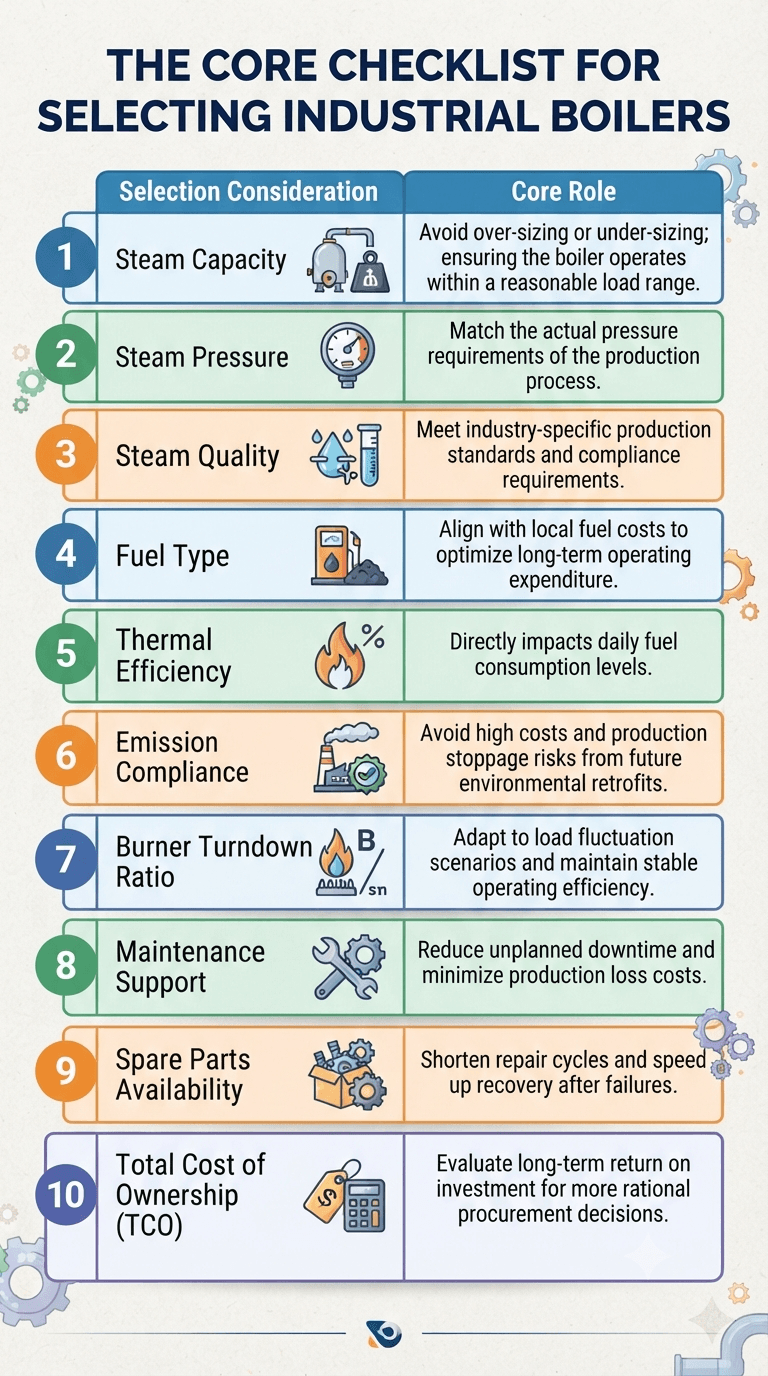
Having mentioned all the common pitfalls, in fact, when selecting boilers, you can refer to a basic checklist and confirm each of the core parameters one by one. This will basically help you avoid most common problems.
|
Selection Consideration |
Core Role |
|
Steam Capacity |
Avoid over-sizing or under-sizing, ensuring the boiler operates within a reasonable load range |
|
Steam Pressure |
Match the actual pressure requirements of the production process |
|
Steam Quality |
Meet industry-specific production standards and compliance requirements |
|
Fuel Type |
Align with local fuel costs to optimize long-term operating expenditure |
|
Thermal Efficiency |
Directly impacts daily fuel consumption levels |
|
Emission Compliance |
Avoid high costs and production stoppage risks from future environmental retrofits |
|
Burner Turndown Ratio |
Adapt to load fluctuation scenarios and maintain stable operating efficiency |
|
Maintenance Support |
Reduce unplanned downtime and minimize production loss costs |
|
Spare Parts Availability |
Shorten repair cycles and speed up recovery after failures |
|
Total Cost of Ownership (TCO) |
Evaluate long-term return on investment for more rational procurement decisions |
The selection of industrial boilers is never as simple as comparing who offers the lowest price. Essentially, it is a long-term decision that concerns the future operating costs, production stability, and environmental compliance over a period of 15 to 25 years.
For most manufacturing enterprises, the most important thing to focus on when choosing a boiler is not the paper price figures, but these matters: whether the equipment can match the actual working conditions, what level of thermal efficiency it has, whether it can meet the local emission requirements, whether the supplier has a reliable long-term service system, and ultimately whether it can reduce the total life cycle cost.
From a long-term operational perspective, a boiler that is highly matched to the working conditions, runs stably, and is easy to maintain often brings higher investment returns than the equipment with the lowest price. It can help enterprises actually reduce fuel consumption, lower the risk of unexpected shutdowns, and make production operations more stable and worry-free.
Whether you need a steam boiler, hot water boiler, thermal oil heater, or a complete boiler room solution, we're ready to support your project from design to commissioning.
Contact us today for a free consultation, boiler sizing recommendation, and customized quotation.