
In the corrugated paperboard and carton packaging industry, the core of the production line is not the speed of the machines, but the stable supply of thermal energy. From the preheating of the base paper, the forming of the corrugated structure, the application of glue and bonding, to the drying and shaping, every core process of the corrugated paperboard relies on steam. Therefore, the stability, cleanliness and energy consumption cost of the steam directly determine the quality of the finished paperboard, the production efficiency and the profits of the factory.
In the past, many small and medium-sized paperboard factories continued to use coal-fired boilers and biomass boilers, which not only caused severe pollution and high energy consumption, but also often had problems such as unstable steam pressure and slow heating, resulting in frequent occurrence of defective products such as warping, cracking, and poor bonding of the paperboard. With the tightening of environmental protection policies and the increase in production costs, gas-fired steam boilers have become the mainstream supporting equipment in the corrugated paperboard industry, suitable for both high-speed and low-speed corrugated lines, and taking into account environmental protection, efficiency and cost. This article will detail the application value, selection techniques and operation and maintenance points of gas-fired steam boilers in the production of corrugated paperboard.
Corrugated cardboard is a product of thermal processing, and its entire formation and solidification process relies on thermal energy. Steam is the most suitable heat source medium, featuring uniform temperature, stable heat conduction, and strong controllability. It cannot be replaced by other heat sources. The stability of steam supply directly affects the three core production indicators:

The production process of conventional five-layer and seven-layer corrugated cardboard is not complicated, but each step has strict requirements for heat energy. The core process can be divided into five major steps, and steam is indispensable throughout the process:
For corrugated paperboard factories, steam boilers are not auxiliary equipment but the core production equipment. The operational efficiency of the entire corrugating line is completely tied to the working efficiency of the boilers.
The stable steam provided by the boilers is the key to solving common quality problems such as paperboard burst lines, warping, delamination, and excessive moisture content. Many factories frequently encounter defective products that need rework. After checking equipment, glue, and raw materials, there is no improvement. The essence is that the steam pressure fluctuates greatly, the heating speed is slow, and the drying is uneven, which leads to the problem.
The energy consumption and stability of the boilers directly determine the profit level of the factory. Old-style boilers have low thermal efficiency, serious waste of residual heat, and complicated start-up and shutdown procedures, with high failure rates. Frequent shutdowns for maintenance not only increase maintenance costs but also cause production line shutdowns and order delays.
Traditional coal-fired and heavy oil-fired boilers have large pollutant emissions, which do not meet current environmental protection emission standards. They are easily subject to production restrictions, rectification, and sealing, while compliant gas-fired steam boilers are the fundamental guarantee for stable production and legal operation of paperboard factories.
The gas-fired steam boiler uses natural gas as fuel. It burns thoroughly, supplies stable steam, and has precise temperature control. It is fully suitable for the continuous and large-scale production requirements of corrugated cardboard. Its specific applications cover the entire production process:
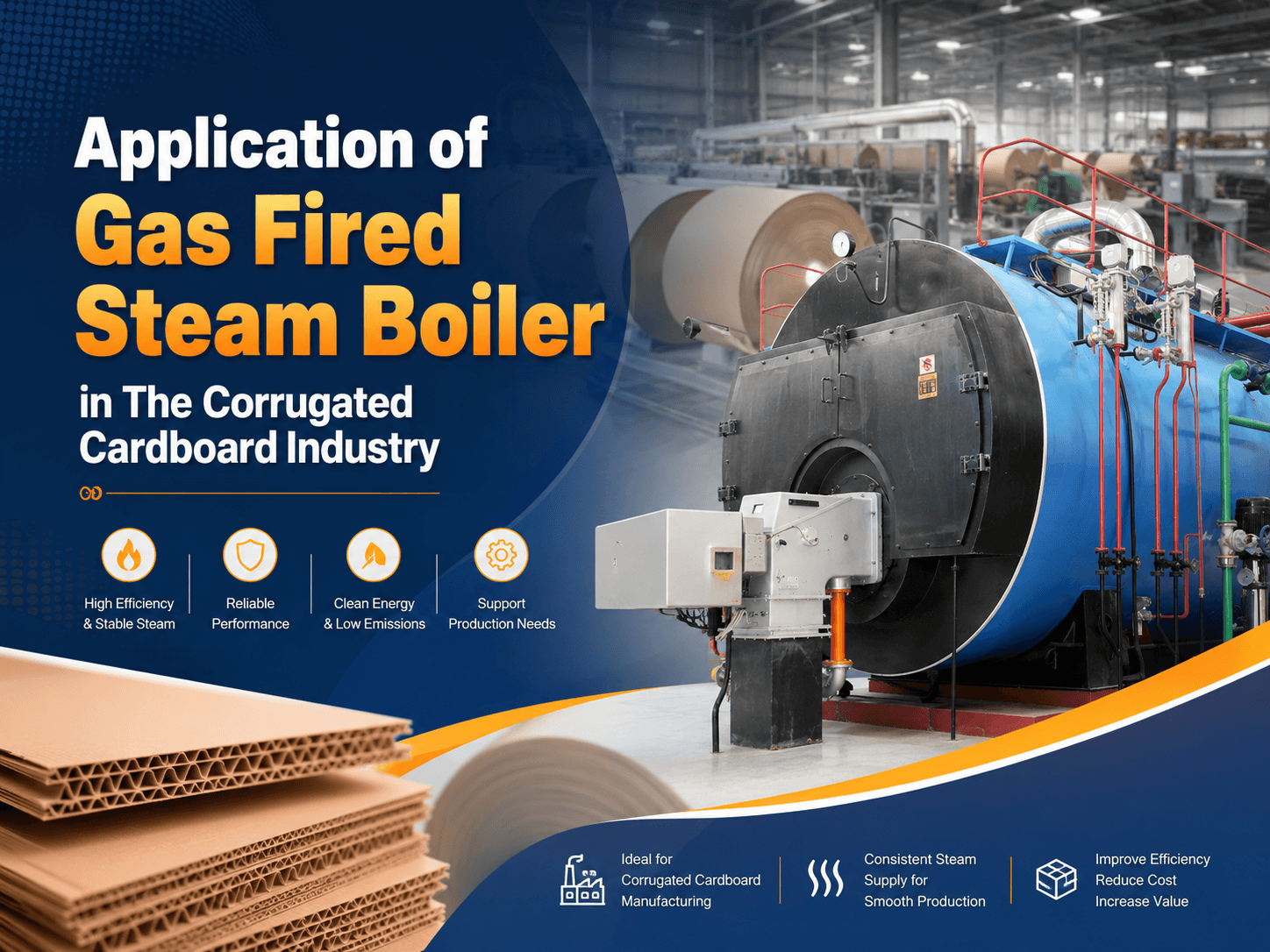
Compared with traditional boilers, gas steam boilers have specifically addressed the pain points of the paperboard factory, presenting remarkable advantages and being the core reason for the comprehensive replacement in the industry in recent years:
|
Comparison Criteria |
Gas-fired steam boiler |
Coal-fired steam boiler |
Coal-fired steam boiler |
Electric steam boiler |
|
Thermal efficiency |
92%–98% (condensing type) |
70%–80% |
70%–80% |
Approximately 95% |
|
Fuel cost (per tonne of steam) |
180–220 RMB |
130–160 RMB |
130–160 RMB |
350–400 RMB |
|
Environmental emissions |
Low-nitrogen and clean; guaranteed compliance |
High dust and sulfur emissions; subject to production restrictions |
High dust and sulfur emissions; subject to production restrictions |
Zero emissions; optimal environmental performance |
|
Steam supply stability |
Stable pressure; fluctuation ≤0.05 MPa |
Significant fluctuations; uneven temperatures |
Significant fluctuations; uneven temperature |
Extremely stable; no fluctuations |
|
Labor costs |
Fully automatic; no dedicated attendant required |
Requires dedicated personnel for coal feeding, slag removal, and ash cleaning |
Requires dedicated personnel for coal feeding, slag removal, and ash cleaning |
Fully automatic; unattended operation |
|
Failure rate |
Low maintenance; simple, durable structure |
High; prone to scaling and flue blockage |
High; prone to scaling and flue clogging |
Very low |
|
Applicable scenarios |
Core equipment for large, medium, and small cardboard factories |
Being phased out; new installations prohibited |
Being phased out; new installations prohibited |
Low-capacity facilities or sites subject to strict environmental regulations |
From the comparative data, it can be seen that the cost of electric boilers is too high and is not suitable for large-scale production; coal-fired boilers do not meet environmental protection standards and are gradually being phased out by the market; biomass boilers have insufficient stability and high labor costs; gas steam boilers have the highest comprehensive cost performance, perfectly balancing the three core requirements of cost, environmental protection, and stability, and are the optimal choice for the corrugated paperboard industry.

When many paperboard factories select boilers, they only consider the tonnage and ignore the matching of working conditions, which leads to problems such as small boilers being unable to handle the load and large boilers wasting energy. Here, we share 4 core selection points:
Conventional industry matching standards: A 2200mm wide paper production line is suitable for a 4-ton gas boiler; a 2500mm wide paper production line is suitable for a 4-6 ton boiler; a 2800mm high-speed wide-width paper production line is suitable for a 6-10 ton boiler. The peak steam consumption of a single corrugated paper production line is approximately 2t/h, and that of a double corrugated paper production line can reach 3.5t/h. The selection should reserve 10%-20% margin to avoid insufficient steam supply during full-load operation.
Paperboard factories mostly operate continuously throughout the day. Condensing gas boilers can recover the residual heat from exhaust gas, with a thermal efficiency 5%-10% higher than that of ordinary boilers. Long-term operation can save a significant amount of gas costs, and the energy cost savings in a year can cover the equipment price difference.
Prioritize models with a large steam space and uniform steam distribution design. This can effectively alleviate the pressure instability caused by load fluctuations and backwater impact, ensuring steam dryness and reducing paperboard quality defects at their source. At the same time, they need to be adapted to a stable working pressure of 0.8-1.0MPa to meet the production requirements of high-speed paper production lines.
Choose fully automatic intelligent control systems that support automatic pressure regulation, fault alarms, and remote monitoring to reduce operational barriers. At the same time, prioritize industry-established brands. Paperboard factories cannot stop production continuously, and a complete after-sales maintenance system can ensure the stable operation of the equipment.
Boilers are classified as special equipment. Proper operation and maintenance can not only extend the service life of the equipment but also stabilize production and reduce energy consumption. For the daily operation and maintenance of the cardboard factory, the following key tasks need to be done well:
A large packaging paper box factory in Suzhou, equipped with two 2500mm wide five-layer corrugated paper production lines, previously used old biomass boilers for production. It has long faced three major problems: Firstly, the steam pressure fluctuated greatly, resulting in high rates of paperboard delamination and warping defective products; Secondly, the biomass fuel occupied a large area and the cost of manual filling and slag removal was high; Thirdly, the smoke dust emissions did not meet standards, frequently facing environmental protection rectifications, and the production stability could not be guaranteed. To solve these problems, the factory replaced and installed a 4-ton condensing gas steam boiler.
Selecting the WNS series low-nitrogen condensing gas steam boiler with a rated evaporation capacity of 4t/h and a working pressure of 1.0MPa, it fully matches the peak steam demand of the two corrugated paper lines; it is equipped with a fully automatic control system + closed condensate water recovery system to maximize the recovery of residual heat and stabilize the steam supply condition. The equipment can complete pressure rise and stabilization in 5 minutes, and is suitable for continuous high-speed production of the production lines.
Quality aspect: The steam pressure is completely stable throughout the process, the drying and coating curing effects are uniform, the defective rate of paperboard has decreased from the original 5.2% to 1.8%, and the monthly loss of raw materials is reduced by tens of thousands, the product quality has significantly improved, and the customer complaint rate has decreased significantly.
Cost aspect: The position of dedicated personnel for monitoring and the filling and slag removal positions have been eliminated, and the annual labor cost is saved by 40,000 yuan; The heat recovery system increases the thermal efficiency to over 96%, and the comprehensive energy consumption cost is reduced by 12%-15% compared to the biomass boiler, and the annual energy-saving benefits are very considerable.
Compliance aspect: The low-nitrogen emissions meet the standards, there is no smoke dust or waste residue, it successfully passes the regular environmental protection inspections, completely eliminates the risks of production restrictions and rectification, and the production lines can operate stably at full capacity throughout the year.
Overall, the boiler equipment in the corrugated packaging industry will develop in four directions: energy conservation, intelligence, low-carbonization, and refinement. Condensing and ultra-low nitrogen gas boilers will completely replace traditional high-energy-consuming and high-pollution equipment and become the industry standard. Intelligent remote monitoring, variable frequency speed regulation, and precise temperature control technologies will be widely adopted to achieve on-demand steam supply and unmanned operation and maintenance. Deep heat recovery systems will be popularized to further reduce production energy consumption. Adapted to green production requirements, the industry is gradually exploring a natural gas coupled with new energy heating mode to help achieve a low-carbon transformation.