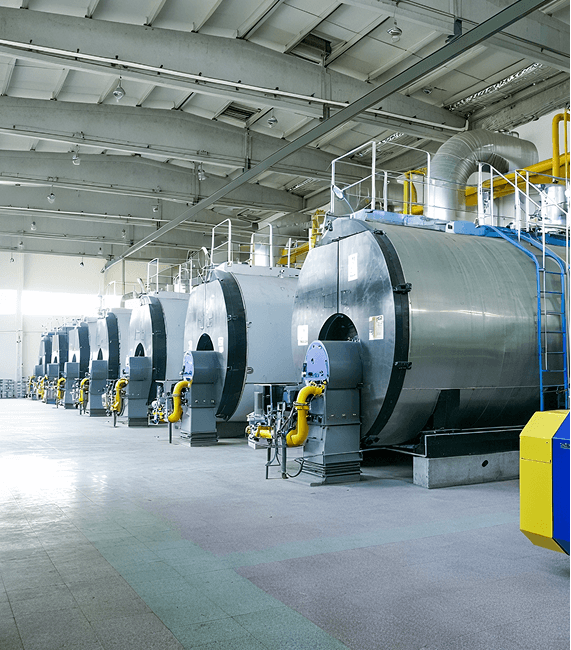

Waste heat boilers recover the waste heat of industrial flue gas, pass the heat to water or steam, and produce process or power steam, which is widely used in the combined cycle of gas turbines.Once it leaks, the high-pressure soda sprayed into the flue will blow the adjacent pipe bundle, and the failure of the shell seal will leak air and smoke, pushing up the load of the induced draft fan.The loss of a continuous unplanned shutdown of the furnace is often hundreds of thousands of dollars, and the steam ejection is even more threatening to personal safety.
The water supply is advanced economizer, which is heated to a near saturation temperature in the low temperature section of the flue gas, and the water outlet temperature is usually 150 to 260 degrees Celsius.The water enters the steam drum or evaporator tube bundle to complete the vaporization, and the saturated steam enters the superheater, which is heated to 400 to 550 degrees Celsius and then goes to the pipe network or turbine.The heating surface of each section distributes the working fluid through the collector box, one end of the collector box is connected to the beam, and the other end is connected to the rising pipe, falling pipe or main steam pipe.
Pressure-bearing and non-pressure-bearing parts must be looked at separately.Pipe bundles, bins, soda pipes, and valve flanges belong to the pressure boundary, and damage means leakage of high-pressure media; the shell, flue, expansion joints, and manhole doors belong to the flue gas side, and failure is manifested as smoke leakage and air leakage. High-pressure water is not sprayed directly, but it will change the temperature distribution and intensify corrosion.The treatment priorities of the two types of problems are completely different.
Corrosion is the most common source of damage.The dissolved oxygen in the feed water is high, and pitting corrosion occurs at the inlet end of the economizer. Although the rust pit is small, it develops extremely quickly; the pH of the furnace water is out of control, the conductivity soars or the concentration ratio is too high, and the inside of the evaporator pipe wall is corroded by scale, and the inner wall thickness can be reduced by more than 1 mm in a few months.Low-temperature corrosion on the flue gas side occurs in areas where the wall temperature is lower than the dew point of sulfuric acid. The higher the sulfur content of the fuel and the lower the exhaust temperature, the more serious the acid condensation.
Erosion occurs at high-speed scouring of working fluid or flue gas, and the local flow rate of the elbow, tee, downstream of the throttle orifice plate and the windward surface of the first row of pipe bundles can reach two to three times the average.Thermal fatigue is directly related to start-stop. The expansion difference generated by each cold start-up forms alternating stress, and fatigue cracks appear in the welds and stress concentration areas; overheating causes the pipe to bulge, the oxide skin to peel off, and burst in severe cases.The vibration comes from the Carmen vortex and the unstable flow of water on the side.The actual leakage is never a single cause, but the result of the superposition of component location, operating conditions, materials, and maintenance history.
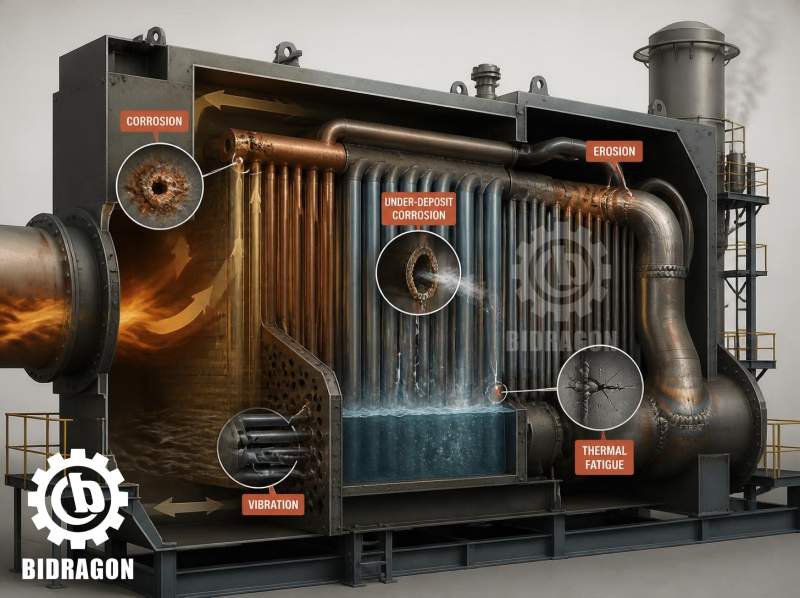
The number of heat transfer pipe bundles is the largest, the exposed surface is the largest, and the leakage incidence is the highest.The wall thickness of commonly used steel pipes is 3 to 6 mm, and the design corrosion margin is 0.5 to 1.5 mm.The inlet end of the economizer is most susceptible to oxygen erosion. If the wall temperature of the low temperature section is lower than the dew point of sulfuric acid, dense acid erosion pits will appear on the outside, and the first row of the windward surface will be eroded by fly ash. The outer wall thickness of the elbow is 0.3 to 0.8mm thinner than the inner side.
Poor local circulation of the evaporator will cause fouling. The thermal conductivity of the scale layer is only a few tenths of that of the metal. The temperature of the pipe wall rises by 50 to 100 degrees Celsius. Corrosion under the scale eats away at the wall thickness from the inside. Leakage is usually caused by blasting after the wall thickness is reduced to less than 1 mm.The wall temperature of the superheater is the highest, and the steam in the pipe is 450 to 580 degrees Celsius. Long-term high temperature produces creep, and the diameter of the pipe is expanded by more than 1.5%. Be vigilant; the annual thinning rate of fuel or ash-containing fuel boilers can reach 0.2 to 0.5 mm, and the suspension pipe and outlet section are the focus of inspection.
Are repeated start-stop thermal cycles generating high stress concentrations and fatigue cracks around your collector box pipe seat welds?
Take total control of your pressure boundary integrity with our advanced industrial waste heat boilers featuring fully welded socket configurations, optimized stress-relief design, and long-term durability.
Request a tailored waste heat project proposal now.

Modern waste heat boilers mostly use fully welded pipe holders, with a weld diameter of 38 to 76 mm, which can withstand the dual effects of high pressure and thermal expansion, and is the location where cracks are most likely to sprout.After hundreds of start-stop thermal cycles for manufacturing remaining defects, microcracks in the heat-affected zone expand along the fusion line.The stress concentration of the corner welds of the container pipe seat can reach two to three times that of the base material, and the probability of repeated damage to the historical repair site is higher.
You can't just look at the metal of the weld when inspecting the weld.The heat-affected zone is 3 to 10 mm wide, the toughness decreases and the hardness increases, and cracks often start here.Penetration and magnetic powder detection are suitable for surface opening defects, and ultrasound can find area-type defects inside the weld.
The wall thickness of the main body of the collection box is large, and the failure of the main body is relatively rare, but the pipe seat, sewage outlet, vent and pressure gauge interface are areas with high stress concentration and fatigue cracks.Accelerated flow corrosion is most obvious at the elbows, tees and reducing pipes. The large-caliber pipes connecting the steam drums withstand the two-phase flow of soda water, and the thinning speed on the outside of the elbow is three to five times faster than that of straight pipes.
It is important to distinguish between body leakage and external connection leakage.The leakage of the body is the cracking of the pipe wall after thinning to the limit, and the pipe needs to be replaced or welded; the leakage of the flange, thread and welded joint is the failure of the sealing surface or weld, which can be treated by fastening, changing the pad or repairing the weld.
Valves are the equipment with the most moving parts.After long-term wear and tear of the valve stem packing, micro-leakage occurs, the flange surface leaks after the preload of the valve cover bolt is relaxed, and the sealing surface of the sewage valve and the exhaust valve is more severely corroded due to frequent action.The failure of the flange gasket is a gradual process. The stress of the wound gasket relaxes after long-term operation above 300 degrees Celsius, and the bolt preload decreases by 20% to 30%.The instrument interface includes a pressure inlet, a temperature sleeve, a liquid level gauge takeover and a sampling valve, and fatigue cracks are prone to occur at the welding of small-caliber pipes.A typical sign of external leakage is the appearance of white salt frost around the interface. Seeing salt frost means that the seal has failed.
The shell, flue and expansion joint belong to the flue gas side, and the leakage does not spray high-pressure water, but it seriously affects the efficiency and corrodes the environment.The welds of the shell crack under the start-stop temperature difference, and the low-temperature corrosion intensifies after the cold air penetrates; the manhole door gasket leaks air after aging, and the air leakage volume increases by 1%. The heat loss of smoke exhaust increases by 0.3 to 0.5 percentage points.Fatigue cracks appear after repeated expansion and contraction of the metal expansion joint bellows, and the flue gas leaks directly after the aging of the non-metallic expansion joint pads.
The judgment method of this kind of problem is completely different from that of pressure leakage.Flue gas leakage is manifested as an abnormal increase in the temperature of the shell and the ejection of soot; air infiltration is manifested as fluctuations in the negative pressure of the furnace and an increase in the oxygen content of the exhaust fume. Don't misjudge the air leakage as a water-cooled wall leakage.
The earliest detection of leaks is often not the inspectors, but the trend of operating parameters.During normal operation, the water supply flow minus the sewage flow should be equal to the steam output, and the deviation is usually within 1% to 2%; after a small leak, the water supply will continue to be higher than the steam output.A leak hole with a diameter of 3 mm loses 0.5 to 1 ton of water per hour at a pressure of 60 bar, and the corresponding deviation can be identified from the trend chart.The water level of the steam drum changes more subtly: the water level rises when the leak is in the outlet steam pipeline, and the water level drops when the leak is in the evaporation section or economizer.
When the fuel volume and water supply volume are not significantly adjusted, the steam pressure continues to be low or the flow rate fluctuates abnormally, the leakage must be included in the investigation list.Steam plumes, traces of stagnant water, and hissing jets can be observed within a safe distance, which usually means that the leakage has reached a medium scale and the shutdown of the furnace needs to be arranged as soon as possible.A single abnormality is not enough to confirm the leakage. The deviation may come from the drift of the flowmeter or the fluctuation of the regulating valve. Multi-parameter cross-verification is required.
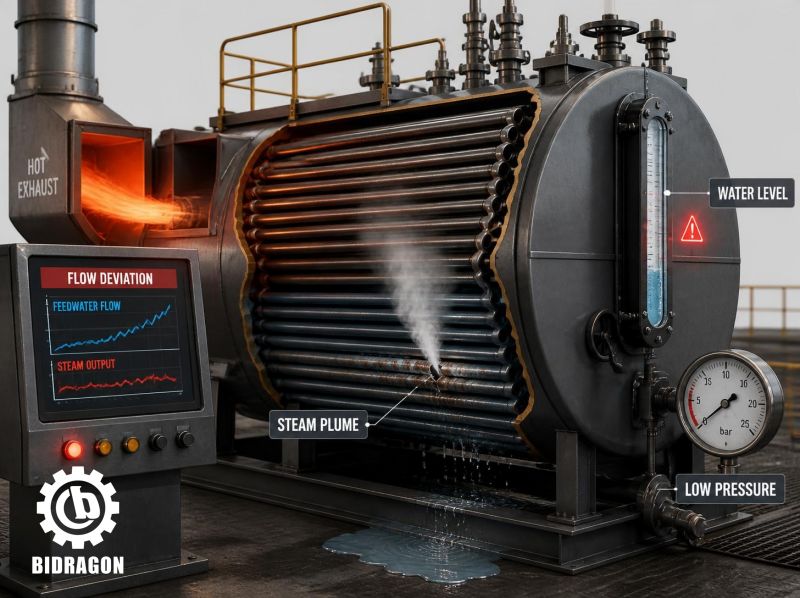
The first step in positioning is always to analyze the operating data, review the trends of water supply, steam, water level, smoke exhaust temperature and oxygen content in the past 24 to 72 hours, and draw a deviation curve.The time point at which the deviation begins helps to determine the nature of the leakage. If it occurs after a start-stop or a significant load adjustment, the probability of thermal fatigue and expansion joint failure is higher.
After the furnace is stopped, the inspection must be carried out after complete cooling, pressure relief, isolation and ventilation.The sequence starts from the outside, first look at the valve packing, flange surface, instrument interface and support hanger for white salt frost and water traces, and then enter the flue to check the pipe bundle one by one, focusing on the windward surface, elbow, suspension pipe and wall pipe, use a flashlight to look in the direction of the flue gas, the leakage hole will appear bright spots when backlit.
Nondestructive testing accurately locates and evaluates wall thickness.Ultrasonic thickness measurement is the most commonly used, with an accuracy of plus or minus 0.1 mm, and a cost of a few dollars per point; penetration testing is suitable for surface opening cracks, simple operation and low cost; magnetic powder detection has higher sensitivity but requires magnetization equipment; ray inspection can find internal volumetric defects, the highest cost, used for sampling of key welds.The detection method depends on the suspected damage mechanism, and the cost of unplanned shutdown caused by a missed inspection far exceeds the cost of testing.
The core of prevention is to incorporate known weak spots into periodic monitoring.Establish fixed thickness measurement points for the windward surface of the economizer, evaporator elbow, superheater suspension pipe and container pipe seat, and repeat the test every 12 to 24 months. If the annual thinning rate exceeds 0.2 mm, the cycle will be shortened and the pipe replacement will be evaluated.
The cost of water quality control is much lower than that of corrosion maintenance.Controlling the dissolved oxygen below 7 micrograms per liter can significantly reduce the oxygen corrosion of the economizer, and maintaining the pH of the furnace water from 9.0 to 10.5 can reduce the corrosion under the scale.The monitoring instrument invests thousands to tens of thousands of dollars, but avoiding a tube bundle replacement may save hundreds of thousands or even millions of dollars.The protection of the furnace shutdown is often ignored, and the inner wall of the pipe will rust if it is out of operation for more than three days without maintenance; dry protection starts faster, and wet protection is more suitable for long-term backup, but it needs to be emptied and rinsed before starting.
Start-stop management directly affects the thermal fatigue life, and the heating rate is limited to within every 5 to 10 degrees Celsius per minute. The weld inspection cycle of the peak-adjusting boiler with frequent start-stop should be shortened to once a year.Pipe plugging is the fastest way to deal with a single leaking pipe. The cost is only a fraction of that of pipe replacement, but more than 5% of the total number of pipes will change the flow field and accelerate the erosion of adjacent pipes.Each repair must record the location, damage pattern and operating conditions, and give priority to reviewing the same location next time.
The first action after discovering an abnormality is to report, not to judge for yourself.The operators record the deviation of the water supply flow, water level trend and on-site observation, and deal with it according to the established abnormal response process of the factory. Do not directly order the furnace to be shut down based on experience, and do not ignore small deviations to continue operation. Pressure leakage from tiny pinholes to large-area cracks may only take a few days to a few weeks.
Strictly follow the manufacturer's manual and on-site emergency response plan.Online fastening of packing bolts or pressure welding is prohibited in most industrial boiler sites. The ejection of high-pressure media will cause burns, and the quality of the welds for pressure welding cannot be guaranteed.Before approaching the leakage point, fuel cut-off, water supply stop, steam isolation, pressure relief, cooling and blind plate isolation must be completed, and maintenance personnel can only enter after confirming that there is no residual pressure.
Complete furnace shutdown maintenance covers all components from the tube bundle to the shell.The heat transfer pipe bundle is inspected row by row, focusing on measuring the wall thickness of the windward surface, elbow, suspension pipe and wall pipe; all the welds connected to the pipe and the collection box are surface inspected, and the historical repair parts are doubled; the collection box and the soda water pipe are inspected. Corner welds, head ring welds and sewage outlets.The valve flange checks the valve stem packing, gasket status and bolt preload, and the shell flue checks the welds, manhole door seals, expansion joint bellows and pipe bundles through the wall seals.
Each anomaly must record the location coordinates, appearance, damage range, measurement data and operating conditions, compare with previous maintenance reports, and mark the location of repeated damage.Thinning or cracks were found in two consecutive inspections at the same location, indicating that the root cause has not been eliminated.
The scope and cycle of inspection are not as long as possible, the denser the better.The direct cost of a complete shutdown and overhaul includes furnace opening, cooling, testing, maintenance and reinstallation. It may cost hundreds of thousands to millions of dollars for medium-sized waste heat steam generators.It is reasonable to determine a hierarchical testing plan based on operating history, injury trends and applicable specifications. High-risk sites are checked every time, and low-risk sites are sampled on a periodic basis.
The leakage of waste heat boiler is the result of the long-term evolution of structure, working conditions and materials.Heat transfer pipe bundles, pipe seat welds, container and soda pipes, valve flanges, and shell expansion joints are the five high-incidence areas of leakage.Deviation of operating data, on-site physical signs, and regular non-destructive testing constitute the three clues to the discovery of leaks.To string these three clues together, the key is to establish a complete equipment file. The location, shape and operating parameters of each leak are recorded on the record, and the next maintenance will give priority to reviewing historical weak points.The investment in daily maintenance is much lower than the loss of an unplanned shutdown of the furnace and pipe bundle replacement.