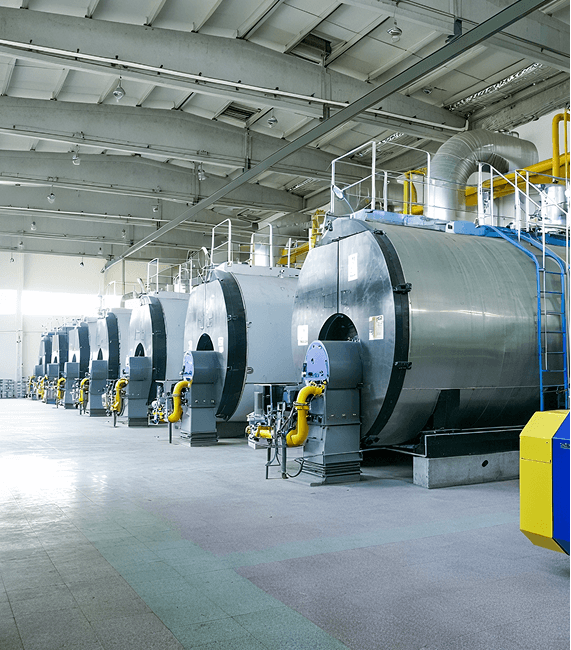

For overseas buyers, factory owners and engineering contractors who are screening Chinese boiler suppliers, quality standards are the core yardstick for evaluating suppliers.Industrial boilers are special pressure-bearing equipment. The manufacturing quality directly affects the operation safety, energy consumption cost and equipment life, and it is also related to whether the project can pass the acceptance of the local regulatory authorities.Many buyers only pay attention to the quotation and the number of certificates, ignoring the applicability of the standard and the details of actual manufacturing control, which can easily bury long-term risks.
The quality standard of the boiler is not a paper requirement, it will directly affect the actual benefits and safety bottom line of the project from multiple dimensions.
Industrial boilers operate in a high temperature and high pressure environment for a long time, and the quality of the pressure-bearing components directly determines the safety boundary.Standardized design, qualified materials, and standard welding can ensure the stable operation of the equipment under rated operating conditions, and there will be no structural failure even during load fluctuations and brief overpressure. If the manufacturing quality is not up to standard, there are internal defects in the welds, insufficient material thickness, leakage and deformation may occur during operation, and explosion accidents may occur in severe cases.For factories with continuous production, the production loss caused by boiler failure and shutdown is often much higher than the value of the equipment itself.
Fuel costs usually account for more than 60% of the operating cost of the boiler throughout its life cycle. Small differences in thermal efficiency accumulate into a considerable cost gap in the long run. According to GB 24500-2020 "Energy Efficiency Limits and Energy Efficiency Levels for Industrial Boilers", the energy efficiency of natural gas industrial boilers at level 1 requires a thermal efficiency of ≥96%, and Level 3 is 92%.Taking a 20t/h gas-fired boiler as an example, with an annual operation of 3,000 hours and a difference in thermal efficiency of 1 percentage point, it consumes about 180,000 cubic meters of natural gas a year, which is equivalent to a cost of more than 700,000 yuan.Industry statistics show that the actual operating thermal efficiency of some old gas-fired boilers in service in China is less than 82%, and the energy consumption gap between the newly built units with higher energy efficiency is very obvious.
The design life of industrial boilers is usually 15-20 years, but the actual service life can vary by up to twice.It is not uncommon for equipment with standard water quality, stable load, and standardized maintenance to operate stably for more than 25 years; for boilers with poor manufacturing quality, the wall thickness of the pressure-bearing parts may be reduced in less than 10 years, and the welds frequently leak. Problems. The gap in maintenance costs is also obvious.The average annual maintenance cost of a boiler with stable quality is about 3%-5% of the original value of the equipment; for equipment with poor manufacturing quality, the annual maintenance cost can be 2-3 times higher due to failures and frequent replacement of accessories, and it will be accompanied by indirect losses from production interruptions.
Different countries and regions have clear regulatory requirements for the production, installation and operation of boilers.ASME certification is required for exports to North America, the European Union requires a CE declaration of conformity that complies with the PED directive, and Southeast Asian countries such as Malaysia require registration and inspection by the local DOSH department. Equipment that does not comply with local regulations cannot complete the installation and acceptance, and may even be ordered to be discontinued, directly causing project delays and economic losses.Confirming that the manufacturer's products meet the standards of the target market before purchasing is a prerequisite for the smooth implementation of the project.
[Ensure 15+ Years of Safe Operation — Partner with a Certified Industrial Boiler Manufacturer.]

Many purchasing associations confuse manufacturer qualification, product certification and single equipment inspection. In fact, the three are requirements at different levels and need to be verified separately.
The positioning and scope of application of different international standards vary greatly, and it is not a single certificate that can be used all over the world.
ASME standard
ASME Boiler and Pressure vessel Specification (BPVC) is a widely recognized technical specification in the field of pressure-bearing equipment worldwide, covering power boilers (Section I), heating boilers (Section IV), non-destructive testing and other parts.For industrial boilers exported to the United States, Canada and other North American regions, it is mandatory to obtain ASME certification and mark the corresponding steel seal, such as the S steel seal for power boilers. It should be noted that ASME certification has a clear scope of authorization, and not all products meet the requirements after obtaining the certificate.Buyers must verify the specific authorization category, allowable pressure and tonnage range held by the manufacturer, and confirm that the boiler model they purchase is within the scope of authorization.The ASME standard is updated every three years, and the requirements for design, materials, welding, and inspection are continuously iterated.
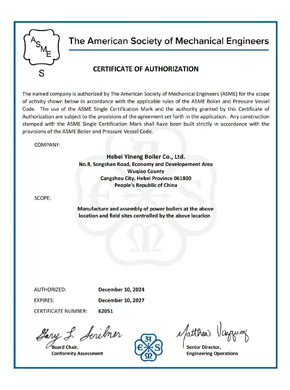
CE certification
The CE mark is an access requirement for the EU market, and boiler equipment mainly corresponds to the pressure equipment Directive (PED).Many buyers mistakenly think that CE is a quality level certification. In fact, it is a declaration of conformity, which means that the product meets the basic requirements of EU safety, health and environmental protection, and does not represent the level of manufacturing quality. There are various evaluation models for CE certification. Some models only require self-declaration by the enterprise, and some require notified bodies to participate in the review.When purchasing, it is necessary to confirm the scope of the product's corresponding instructions, evaluation mode, and whether there is a certificate issued by a formal notified body, so as to avoid only obtaining the manufacturer's self-made CE declaration documents.
DOSH and local boiler regulations
Southeast Asian countries such as Malaysia and Singapore require boilers to be registered with the local Occupational Safety and Health Department (DOSH), and must pass on-site inspections by local authorized inspection agencies after installation.Some countries in the Middle East and Africa also have their own regulatory rules. Some directly adopt ASME or EN standards, while others attach local inspection processes. Before purchasing, it is necessary to clarify the regulatory requirements of the project location, confirm whether the manufacturer has experience in cooperating with local registration and providing inspection documents, and avoid the equipment from being unable to clear customs or accept after arriving in Hong Kong.
Chinese national standard
The design, manufacture and inspection of China's industrial boilers are based on TSG 11-2020 "Boiler Safety Technical Supervision Regulations" as the core, supporting GB/T 16507, GB 24500 and other series of standards.These standards are mandatory requirements that all Chinese manufacturers must comply with, and they are also the basic guarantee of product quality. For export projects, the convergence between Chinese standards and target country standards is very important.For example, the corresponding material grades and differences in test methods require the manufacturer to issue comparative instructions or supplementary tests to ensure that the local acceptance requirements of the project are met.
The scope of application of different standards is not the same.Buyers should confirm one by one according to the boiler type, working pressure, export country and project requirements, and do not default to a certificate that can cover all scenarios.

[Need ASME, CE, or DOSH Compliant Boilers for Overseas Projects? Talk to Our Global Compliance Specialists.]
When screening suppliers, many people are used to competing for the number of certificates. This is a common misunderstanding.The manufacturer's system qualification and the inspection of a single equipment are two different things. The two are indispensable, but they cannot replace each other.
The manufacturer's production license and quality management system are a recognition of the overall capabilities of the factory.For the production of boilers in China, special equipment manufacturing licenses must be obtained, which are divided into A, B, and C grades, corresponding to different pressures and tonnage ranges. This is the bottom line of legal production. In addition, the ISO 9001 quality management system, ASME authorization certificate, etc. can reflect the quality control level of the factory.But pay attention to the validity period of the certificate and whether the scope of certification covers the type and parameters of the boiler you want to purchase.For example, manufacturers with a class B boiler manufacturing license cannot produce high-pressure boilers with Class A parameters.
The inspection document of a single boiler is a direct proof of the qualified quality of this equipment.Each boiler leaving the factory should have a complete set of documents such as corresponding material quality certificates, welding records, non-destructive testing reports, hydrostatic test records, and factory inspection certificates, and the documents correspond to a unique equipment number. Some projects will require third-party inspection agencies to supervise the manufacturing or factory inspection on site, such as inspection reports from SGS, BV and other agencies.Such requirements need to be agreed in advance in the contract to clarify the nodes, projects and eligibility criteria for inspection.
Don't just compare how many certificates the manufacturer has, but verify whether the certificate matches the actual purchased equipment.No matter how complete the qualification is, it will not cover the model of equipment you want to buy, and it is meaningless.
This is the core dimension of horizontal comparison of suppliers. These indicators have corresponding verifiable documents, which are suitable for use in the inquiry and factory audit stages.
|
Quality Dimension |
Core Inspection Items |
Standard Manufacturer's Common Practice |
Ordinary Manufacturer's Common Practice |
|
Material Quality |
Material grade, traceability, incoming inspection |
Uses steel of the grade specified by the standard, provides original mill quality certificates and heat/batch numbers, and performs spectrometric re-inspection for each batch of incoming materials |
Uses ordinary commercial steel, provides only self-issued certificates, and has no incoming re-inspection process |
|
Welding Quality |
Procedure qualification, welder qualification, nondestructive testing |
Conducts welding procedure qualification according to the standard, welders hold corresponding qualification certificates, critical welds undergo 100% RT/UT inspection, and records are complete |
No formal procedure qualification, incomplete welder qualifications, only partial weld sampling inspection, and incomplete inspection records |
|
Pressure Test |
Hydrostatic test, accessory inspection, factory inspection |
Performs pressure testing at 1.5 times the design pressure, holds pressure for a duration compliant with the standard, conducts functional testing of all accessories, and issues a formal report |
Reduces test pressure or shortens pressure-holding time, performs only body testing, and provides no formal test report |
|
Performance Indicators |
Thermal efficiency, operating parameters, actual cases |
Provides third-party energy efficiency test reports, specifies test conditions, and has verifiable project cases with the same parameters |
Only lists advertised thermal efficiency values, gives no explanation of test conditions, and has no specific operating case support |
The material properties of the pressure-bearing components such as the boiler tube, the collection box, and the heating surface pipe are the basis for the safety and life of the boiler.
The material grade must match the working conditions.Different pressures, temperatures, and fuel environments correspond to different material grades.For example, a low-pressure saturated steam boiler can use Q245R steel plate, while a high-pressure and high-temperature boiler requires alloy steel such as 15CrMoG.The heating surface of biomass and coal-fired boilers should also consider wear and corrosion, and choose corresponding wear-resistant materials. Many low-cost suppliers will use low-grade steel instead of high-grade steel, or use non-standard thickness plates, which are difficult to distinguish from the appearance, and the risk of late operation is very high.
Material traceability is a basic requirement of quality management.Each batch of steel and welding materials from regular manufacturers has an original quality certificate, indicating the furnace batch number, chemical composition, and mechanical properties.The source of the material is recorded for each part in the production process, and problems can be traced back to the batch of raw materials. When purchasing, manufacturers can be required to provide a list of materials for the corresponding equipment, as well as the warranty of the main pressure-bearing components, and check whether the grades and specifications are consistent with the design.
The inspection link of entering the factory can also open the gap.Powerful manufacturers will do spectral analysis and hardness testing of each batch of steel plates and steel pipes entering the factory to avoid the flow of unqualified materials into the production link.Small manufacturers usually do not have testing equipment and directly accept the documents provided by the supplier, and the risk of material misuse is higher.
Welding is the most prone to defects in boiler manufacturing, and the quality of the pressure-bearing welds is directly related to the safety of operation.
Welding process evaluation and welder qualification are prerequisites.According to the specification, each material, thickness, and welding method must be evaluated in advance by the welding process (WPS) to verify the feasibility of the process.Welders must also obtain a qualification certificate for the corresponding project before they can take the job. Welding without process evaluation depends on the welder's personal experience, and the quality stability is very poor.When purchasing, you can spot check the manufacturer's process evaluation documents and welder's certificate to confirm that the welding requirements of the purchased boiler are covered.
Non-destructive testing is a key means of discovering internal defects.Commonly used methods are ray detection (RT), ultrasonic detection (UT), magnetic particle detection (MT), and penetration detection (PT).According to the requirements of TSG 11-2020, the ring and longitudinal joints of the boiler barrel, the container, and the butt welds of the pipes on the heating surface must be tested by radiography or ultrasound in accordance with the prescribed proportions. Standardized manufacturers will do RT testing on 100% of the main welds under pressure, and the negatives can be retained for inspection.Ordinary manufacturers may only do 50% or even a lower proportion of sampling inspections, and some even only do visual inspections, and internal defects cannot be discovered in advance.
The processing process of unqualified welds can also reflect the management level.Regular manufacturers have a clear rework system, no more than 2 rework in the same location, and re-do non-destructive testing after rework, leaving traces throughout the process.Manufacturers with chaotic management rework at will, and do not do re-inspections, leaving safety risks.
The hydrostatic test is the last safety verification before the boiler leaves the factory. According to the standard requirements, the test pressure is 1.5 times the design pressure. The holding time is clearly specified according to the different wall thicknesses, usually not less than 20 minutes. In order to save time, some manufacturers will reduce the test pressure, or shorten the holding time, or even directly replace the pressure test pump with tap water pressure, which cannot effectively verify the pressure bearing capacity of the equipment.When purchasing, the manufacturer may be required to notify in advance before the hydrostatic test, or a third party may be entrusted to witness the scene.
In addition to the main body hydrostatic test, the verification of safety accessories and instruments is also important.Safety valves, pressure gauges, water level gauges, and valves must all be verified to ensure accurate and reliable action.The control system must also do functional tests to verify that the interlocking protection and alarm functions are normal. Many manufacturers only do the main body pressure test, and do not test the accessories and control system. The problem is only found after the on-site installation, which delays the debugging progress.
The final factory inspection also includes dimensional inspection, assembly accuracy inspection, appearance inspection, etc.After all items have passed the inspection, a formal factory inspection report and quality certificate will be issued.These documents are necessary materials for subsequent installation, acceptance and inspection.
Thermal efficiency is the indicator that buyers are most concerned about, but it is also the most likely to promote moisture.
According to the energy efficiency classification of GB 24500-2020, the energy efficiency of natural gas boiler level 1 is ≥96%, and the energy efficiency of coal-fired layer combustion furnace level 2 is ≥85%.The measured thermal efficiency of high-quality condensing gas-fired boilers in the industry can reach about 99%, while ordinary products are usually between 92% and 94%. It should be noted that the thermal efficiency value must be combined with the test conditions.The thermal efficiency under rated load is very different from that under 30% low load.Many manufacturers only mark the highest thermal efficiency, not the working conditions and fuel conditions, and the reference significance is very limited.
In addition to thermal efficiency, we should also pay attention to the key parameters of rated evaporation, working pressure, fuel consumption, and exhaust temperature.These parameters should be matched with the actual operating conditions. If the project is often operated under low load, it is necessary to focus on the load adjustment range and low load efficiency of the boiler.
The actual operation case is more valuable for reference than the parameter table.Manufacturers can be required to provide user cases of boilers of the same type and parameters to understand the fuel consumption, failure frequency, and service life in actual operation.If you have conditions, you can contact old users to verify, which is much more reliable than looking at promotional materials.
The thermal efficiency should be compared in combination with test conditions, calculation methods, and fuel characteristics, and the manufacturing quality cannot be judged by a single number in the brochure.
The structure and operating conditions of different boilers are different, and the focus of quality evaluation is different. The same set of standards cannot be used to apply to all furnace types.
This type of boiler has a fast combustion speed and stable pressure. The quality focuses on the matching degree of the burner and the boiler body, the combustion control accuracy, the welding quality of the pressure-bearing components, and the reliability of the safety interlock device. If the burner does not match the furnace, there will be insufficient combustion, black smoke, low thermal efficiency, and increased carbon deposits and corrosion in the furnace.Safety interlock includes overpressure interlock, water shortage interlock, and flameout protection. These are the keys to prevent accidents and must be sensitive and reliable.
The composition of biomass fuels is complex, with a lot of ash, and it is easy to coking and ash accumulation.The quality focuses on fuel adaptability, the reliability of the grate or combustion system, the cleaning design of ash accumulation and slagging, and the wear and corrosion resistance of the heated surface. The biomass boilers of many manufacturers directly copy the structure of coal-fired boilers, and after half a year of operation, the heating surface is severely worn, the grate is stuck, and the coking is stopped.When purchasing, pay attention to the volume of the furnace, the form of the grate, and the design of the soot blowing device, and confirm whether special optimizations have been made for biomass fuels.
The combustion process of coal-fired boilers is complex and the load adjustment range is large.Focus on combustion stability, the rationality of the furnace structure, the wear-resistant design of the heating surface, and the supporting capabilities of the ash treatment system. There are also differences in the quality control points of circulating fluidized bed boilers and layer-fired boilers.The fluidized bed should pay attention to the design of the air distribution plate and separator, and the layer combustion furnace should pay attention to the material and life of the grate sheet.Reasonable design can improve the adaptability of coal species, make the combustion fuller and the maintenance cycle longer.
The thermal oil boiler is heated by liquid phase circulation and has a high operating temperature. Once it leaks, it is easy to cause a fire.The quality focuses on the reliability of the circulation system, the accuracy of hot oil temperature control, the design of the expansion tank and exhaust system, as well as leakage protection and over-temperature protection devices. The welding requirements of the thermal oil boiler are higher, especially the coil welds, so there can be no leakage.The coil welding quality of many low-cost manufacturers is poor, and oil spills occur during operation, which is a high safety risk.In addition, the protection devices such as over-temperature interlocking and differential pressure alarm must be complete and effective.
Compliance with basic manufacturing standards is a prerequisite, and engineering design capabilities for specific fuel and process conditions are equally important.It is difficult for generalized products to adapt to all working conditions, and the actual operating performance of a boiler designed in a targeted manner will be much better.
This list can be directly used in the technical review stage to confirm and request corresponding documents from the supplier item by item to avoid missing key items.
|
Evaluation Item |
Questions to Ask the Manufacturer |
Core Verification Documents |
|
Qualification & Certification |
Are the relevant certificates within their validity period, and are they applicable to this boiler model? |
Special Equipment Manufacturing License, ASME/CE certificates, certification scope description |
|
Material Quality |
Can you provide material quality certificates and traceability records for the main pressure-bearing components? |
Steel quality certificates, welding material quality certificates, material incoming inspection reports |
|
Welding Quality |
What welding process is used, and what are the nondestructive testing methods and proportions? |
Welding Procedure Specification (WPS), welder qualification certificates, nondestructive testing reports |
|
Pressure Test |
Can you provide a hydrostatic test report that complies with standard requirements? |
Hydrostatic test records, safety valve calibration reports, factory inspection certificate |
|
Performance Parameters |
Are the efficiency and output data supported by clearly defined test conditions? |
Third-party energy efficiency test reports, thermal calculation sheets, performance parameter tables |
|
Project Experience |
Can you provide installation cases of similar projects and verifiable user references? |
Project performance list, user contact information, on-site operation photos |
|
After-Sales Service |
Do you provide installation guidance, commissioning, and technical support services? |
Service scope description, spare parts supply commitment, technical response time |
It is recommended that buyers require suppliers to provide relevant documents during the technical review phase, and do not wait until the contract is signed before making up.At the same time, it is necessary to clarify the applicable standards, inspection requirements, acceptance conditions and delivery document lists in the contract to avoid subsequent disputes.
Quality not only stays in the product itself, the manufacturer's comprehensive delivery capabilities and after-sales support are also an important part of the quality system.
Production hardware directly affects manufacturing accuracy and quality stability.For example, CNC cutting machines, automatic welding machines, large-scale rolling machines, flaw detection equipment, etc. are all standard equipment in modern boiler plants.At the same time, it also depends on the annual production capacity and lifting capacity, whether it can meet the delivery cycle and tonnage requirements of the project. The quality control process is also critical.From the entry of materials into the factory to the delivery of finished products, is there a clear inspection node, is there anyone responsible for each link, and whether the records are complete can be checked.Small manufacturers usually have chaotic processes, relying on the self-awareness of their workers, and product quality fluctuates greatly.
Industrial boilers are not standard finished products, and the system design needs to be based on the user's steam requirements, fuel conditions, process temperature, and site restrictions.A good manufacturer will first do the heat load calculation and scheme design, and then match the boiler model, rather than directly marketing ready-made products. For example, some projects have large fluctuations in fuel calorific value, some have small on-site sites, and some have high requirements for steam pressure accuracy. These all require targeted design adjustments.For manufacturers with insufficient design capabilities, various adaptation problems will occur after the equipment arrives at the site.
A complete set of delivery documents, in addition to the inspection report, there should also be design calculations, construction drawings, operation and maintenance manuals, and spare parts lists.These files are the basis for subsequent installation, operation, and maintenance. Many small manufacturers only give a product certificate of conformity, and there is no other information. The later operation and maintenance rely on exploration, and it is difficult to investigate problems.
The installation of industrial boilers is very professional, and the installation quality directly affects the operating performance and safety.Regular manufacturers will provide installation guidance, or send engineers to supervise key nodes, responsible for equipment commissioning and operator training. If the manufacturer does not provide installation guidance and the on-site construction team is not familiar with the equipment, it is easy to leave installation hidden dangers.For example, substandard pipe welding, inadequate thermal insulation, and incorrect installation of safety accessories will all affect later use.
The boiler is a long-term operating equipment, and spare parts and technical support will be required for the next ten years.Powerful manufacturers will have cooperative service points overseas, or can quickly respond to spare parts needs, and provide technical solutions within 48 hours. Small manufacturers may switch production or go out of business in a few years, spare parts cannot be bought, technical support cannot be found, and equipment problems can only be scrapped in advance, with great losses.
When evaluating suppliers, it is necessary to combine actual project cases to see if the manufacturer can form a complete delivery chain of design, production, inspection, installation and after-sales service.Suppliers who are only good at production and not good at service will make the late stage of the project very passive.
Evaluating Chinese industrial boiler manufacturers cannot only look at the price or the number of certificates. Comparing according to this method will be more objective and comprehensive.
First confirm the boiler type, operating parameters and target market regulations.List the basic parameters and compliance requirements, and directly exclude suppliers who do not meet the requirements, so there is no need to waste time for in-depth comparison.This step can screen out most inappropriate manufacturers.
Verify the manufacturer's qualification and the scope of application of the certificate.First confirm the level and scope of the special equipment manufacturing license, and then check the authorization content of the international certification to ensure that the product you want to purchase is within its qualification range.At the same time, check the validity period of the certificate and the issuing institution to avoid expired certificates or false qualifications.
Compare material, welding, non-destructive testing, and pressure test records.These are direct evidence of product quality and are much more reliable than the descriptions in the brochures.Manufacturers can be required to provide a full set of samples of factory documents for products of the same model to see if the specifications are complete.If there are conditions, it is best to visit the factory site to check the production process and quality control.
Evaluate boiler performance data and related project experience.Check the test conditions and calculation methods of thermal efficiency, and confirm whether there is a third-party test report.To ask for cases of similar projects, it is best to be in the same industry and with the same parameters to understand the actual operating performance.
Comprehensively compare equipment prices, operating costs, delivery conditions and after-sales support.Don't just look at the initial purchase price, but the total cost of the whole life cycle.The combined costs of fuel consumption, maintenance costs, downtime risks, and equipment service life are much higher than the price of the equipment itself.
The lowest quotation does not necessarily represent the lowest total cost.Buyers should comprehensively evaluate the initial investment, fuel consumption, maintenance costs, downtime risks and equipment service life.
When evaluating Chinese boiler suppliers, you can't just look at the price, brand promotion, or certification quantity.A more reliable basis for judgment is the compliance of applicable standards, traceable material and manufacturing records, standardized inspection and testing procedures, true operating performance, and engineering and after-sales service capabilities that can meet project requirements.
China's industrial boiler industry chain is complete, with obvious cost-effective advantages and shorter delivery cycles. It is a high-quality choice for many overseas projects.However, the level of manufacturers in the industry is uneven, and there are many phenomena of low-price competition.When purchasing, calm down and check specific quality documents and project cases. Don't be fooled by low prices and fancy publicity in order to find a truly reliable partner.
If you have specific boiler models, fuel parameters, steam requirements and target market requirements, you can request complete technical information and quality documents from the intended manufacturer for targeted technical evaluation.If conditions are met, arranging third-party supervision or factory audits can further reduce procurement risks.