
The waste heat boiler recovers the significant heat of industrial flue gas and converts it into steam, which directly affects the fuel consumption and operating costs of the plant.Ash accumulation during operation, uneven flow field, increased thermal resistance and deviation from operating conditions will gradually decrease the design recovery capacity.The key to optimization is to identify the main performance bottlenecks first, and then take targeted engineering measures.
The heat transfer efficiency of waste heat boilers is affected by four basic factors: flue gas temperature, flue gas flow, dust concentration and operating load.The temperature of the flue gas determines the heat transfer temperature difference, the flow rate determines the total amount of heat recovered, the dust concentration determines the ash accumulation speed, and the load determines the operating section of the equipment.At low loads, the flow rate of flue gas decreases and the heat transfer coefficient decreases, while the risk of ash accumulation in low-speed areas increases.Changes in materials and fluctuations in kiln working conditions in actual production will cause the smoke conditions to deviate from the design point.
Ash accumulation forms an insulating layer on the outer wall of the finned tube, and the thermal conductivity is only 0.1 to 0.5 W per meter per kelvin, which is much lower than the 45 W per meter per kelvin of the steel pipe. 1 mm of ash can reduce the total heat transfer coefficient by 20% to 40%.The thermal resistance of scale is greater, and 1 mm of scale is approximately equivalent to the thermal resistance of 4 mm steel plate.Corrosion thins the pipe wall while making the surface rougher and easier to adhere to fly ash.Uneven flow field accelerates wear in the high flow rate zone, increases ash accumulation in the dead zone, and wastes the effective heat transfer area.
The appearance of the problem is divided into three categories: insufficient heat transfer is manifested as high smoke discharge and low steam.Excessive heat loss from exhaust means that the flue gas takes away too much heat, usually caused by insufficient heating surface or poor cleanliness.The insufficient steam output is also due to the decrease in heat transfer capacity and the mismatch of water supply parameters.
Evaluate the temperature of the import and export flue gas, steam output, water supply status and flue gas side pressure drop, and compare it with the design benchmark.For every 20 degrees Celsius increase in the exhaust temperature, the heat recovery efficiency decreases by about 3 to 5 percentage points, because the apparent heat taken away by the flue gas is approximately proportional to the temperature difference.
Horizontal comparison under similar loads is the key to identifying anomalies.The current steam output is down 10% from the same period and the exhaust temperature has risen by more than 30 degrees Celsius, which can determine that there is a problem with the heat transfer capacity.Comparing the current data with the data under the same load a week ago can exclude the interference of load fluctuations.
The combination of temperature trend, pressure drop and thermal balance locates the root cause.The smoke exhaust rises but the pressure drop does not change much, which points to the thermal resistance of ash accumulation.The pressure drop rises and the smoke exhaust gently points to the blockage of the flow channel.When the thermal balance deviation exceeds 5% of the design value, the instrument should be calibrated and the air leakage and heat dissipation loss should be checked.
The following starts from six engineering directions, each with quantitative indicators and cost trade-offs.
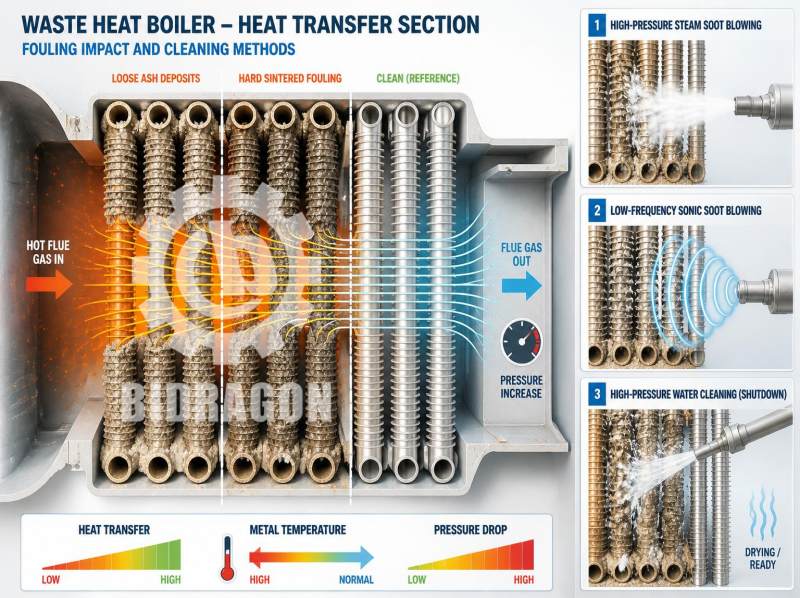
When the ash thickness reaches 1 mm, the total heat transfer coefficient decreases by 15% to 25%, and the heat transfer capacity is lost by more than 40% when it exceeds 3 mm. At the same time, the flow section of the flue gas side decreases and the pressure drop increases.The pressure of steam soot blowing is usually 1.0 to 2.0 MPa, covering a radius of 2 to 3 meters. The cost is to consume the factory's own steam. The system that is already tight on steam consumes the recovered heat every time it blows soot.Sonic soot blowing uses low-frequency sound waves to resonate the ash particles and fall off. It is suitable for loose ash accumulation but has limited effect on sintered ash.The structure of mechanical vibration is simple, but the furnace needs to be stopped or partially isolated, and it is difficult for waste heat boilers running online to use mechanical vibration.
The cleaning cycle should be dynamically formulated based on the operating state, and soot blowing should be started when the exhaust temperature is 15 degrees Celsius higher than the reference after cleaning or the pressure rises by 20% of the design value.Frequent soot blowing will cause the pipe wall to be thinned, especially in high-flow areas where steam jets hit the same location for a long time.Avoid mechanical impact on the fin tube, excessive percussion will damage the fins.The light tube can be cleaned with high-pressure water to clean the hard fouling when the furnace is stopped, but the heated surface needs to be dried before it can be re-ignited.The cleaning method must match the nature of the sediment and the type of pipe.
The flue gas bypass allows part of the high-temperature flue gas to be discharged directly without heat transfer, and this part of the heat is not recovered at all.When the dead zone flow rate is less than half of the design value, the heat transfer coefficient drops significantly and the ash accumulation accelerates.Uneven flow rates also cause local scouring and wear, and the life of the pipe in the high flow rate area may only be one-third of the design value.
The cost of retrofitting the deflector and the current sharing gate is low, and welded structural parts are usually installed during the maintenance of the furnace.After the transformation of waste heat boilers with a flow field deviation of more than 20%, the uniformity can be improved to within 10%, and the heat transfer efficiency can be increased by 5% to 12%.The on-site grid test arranges multi-point temperature and speed measurements in the flue cross-section, which is low in cost but can only give the result data.
The total heat transfer coefficient is composed of the convection thermal resistance on the flue gas side, the thermal resistance of the pipe wall, the convection thermal resistance on the water side and the thermal resistance of the dirt in series.The convection thermal resistance on the flue gas side accounts for 50% to 70%, which is the largest link.The thermal resistance of the dirt increases with the running time to a level comparable to that of the flue gas side.The thermal conductivity of the pipe wall accounts for only 5% to 10%.The thermal resistance of water-side convection accounts for 15% to 25% of the natural circulating waste heat boiler.
Increasing the flue gas flow rate can reduce the thermal resistance on the flue gas side, but it is limited by wear and pressure drop.The finned tube extends the heating surface to reduce the thermal resistance, but in a high-dust environment, the fins are too dense and will be clogged by ash, which will increase the thermal resistance.Water-side fouling is often underestimated. The thermal conductivity of 1 mm silicate scale is only 0.3 to 0.8 W per meter per kelvin, which is two orders of magnitude lower than that of steel pipes.The hardness ions in the feed water precipitate to form scale on the wall of the high temperature pipe. The investment in water treatment is relatively small, but continuous pharmaceutical costs and water quality monitoring are required.The total dissolved solids in the pot water should be controlled below 3000 mg per liter, and the sewage discharge rate is 2% to 5%. The heat taken away by the sewage is recovered through the expansion container, but it is still a net loss.
The thermal resistance link that accounts for the largest proportion should be solved first.If the dirt is dominant, invest in soot blowing, and the water side is dominant to improve water treatment.Rolling out all measures at the same time will dilute the return on investment.
The resistance of the straight tube bundle is small, but it is easy to accumulate ash and bypass, and the heat transfer coefficient of the misplaced tube is 15% to 25% higher but the pressure drop is large.High-dust flue gas should choose a large transverse pitch to avoid ash accumulation and bypass.The outer surface area of the finned tube is 3 to 6 times that of the light tube, but the conduction efficiency of the high fin root decreases and the fin gap is easily clogged by ash.The height of the fins is usually 12 to 25 mm, and the density is 2.5 to 4 pieces per centimeter.In high-dust environments, light tubes or low-finned tubes are used with frequent soot blowing, and high-finned tubes are used in low-dust environments to obtain a larger area.
The choice of pipe diameter affects the temperature of the pipe wall and the heat transfer coefficient. The wall of the small pipe diameter is thin, the thermal conductivity and thermal resistance are small but the unit area is small. The outer diameter of 38 to 51 mm is usually selected to strike a balance between strength and efficiency.A 20% increase in the heat transfer area can reduce the exhaust temperature by 15 to 25 degrees Celsius, but the pressure drop must be recalculated. Insufficient fan margin will prevent investment from landing.
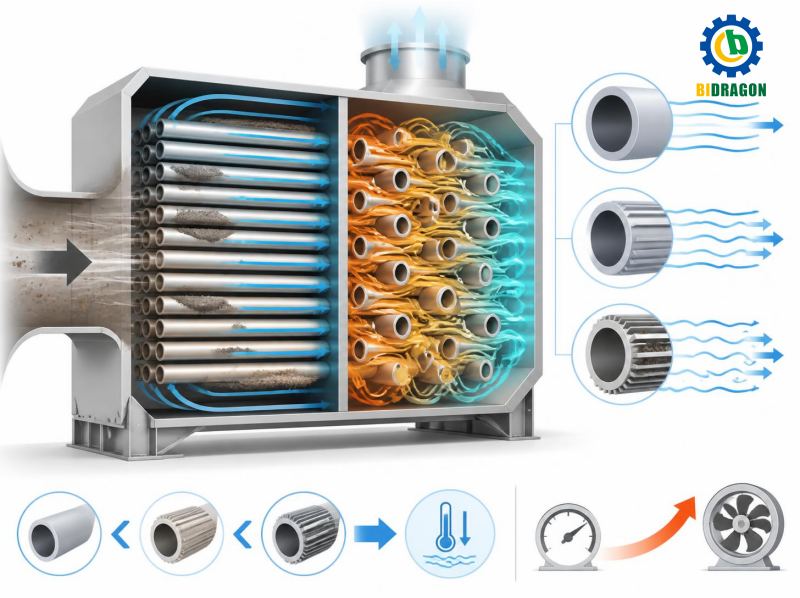
Every 10 degrees Celsius drop in the exhaust temperature of the waste heat boiler can recover 1.5% to 2.5% additional heat, depending on the flue gas flow and specific heat.The economizer reduces the exhaust temperature by heating the water supply, which is the main recovery method.However, the acid dew point is usually 120 to 160 degrees Celsius. If the wall temperature is lower than this value, sulfuric acid will condense and cause low-temperature corrosion. The corrosion rate can rise from 0.05mm per year to more than 0.5mm. The heating surface needs to be replaced within a few years.The dew point of water is higher, usually 50 to 70 degrees Celsius, and the condensation of water vapor also exacerbates corrosion.
Corrosion-resistant materials such as glass tubes, fluoroplastic or enamel tubes are 3 to 5 times more expensive than steel pipes, and have low mechanical strength and poor thermal shock resistance.The target exhaust temperature is not as low as possible. It is necessary to find a balance between recovery income, corrosion risk and investment.When the water supply temperature is already high, the recovery space of the economizer is limited. You can consider heating combustion-assisted air or low-temperature hot water to extend to the lower temperature end.
The heat transfer Q is equal to the total heat transfer coefficient K multiplied by the area A multiplied by the logarithmic average temperature difference ΔTm.The difficulty of upgrading the three varies greatly.The convection thermal resistance on the flue gas side is the largest, followed by the dirt thermal resistance and the water side convection thermal resistance.The cost of increasing the flow rate and reducing the thermal resistance is pressure drop and wear, the cost of cleaning and reducing the thermal resistance of dirt is the energy consumption of soot blowing and pipe wear, and the cost of improving water treatment and reducing the thermal resistance of the water side is the loss of medicine and sewage discharge.
If the problem with the waste heat boiler is that the thermal resistance caused by ash accumulation increases, increasing the pipe will only accumulate more ash, and the decrease in the K value will offset the new area.The correct path is for the engineer to calculate the actual total heat transfer coefficient of the waste heat boiler through the thermal balance, stop the furnace to check and measure the thickness of ash and scale, test the flue gas distribution to evaluate the uniformity of the flow field, and find the leading link to reinvest.Diagnostic investment usually accounts for 5% to 10% of the renovation investment, but it determines a 90% return.