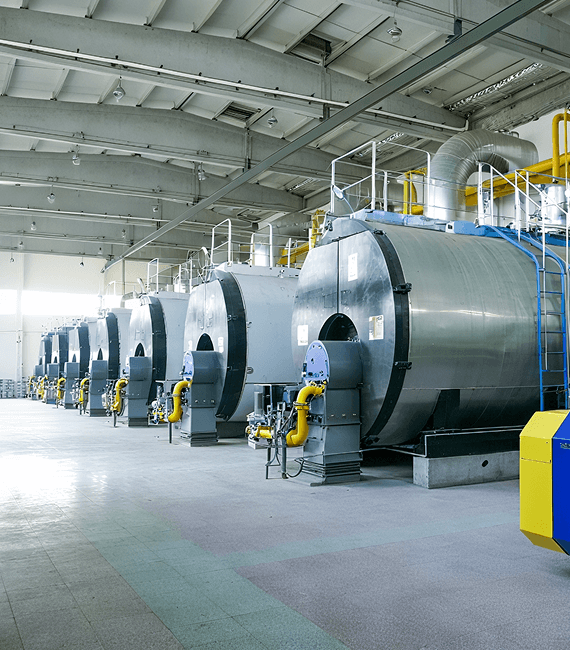

In the procurement of industrial boilers, the first step for many people to screen suppliers is to glance at the certification mark on the homepage of the official website.Seeing that the logos of ASME, CE, and ISO are all complete, the manufacturer's qualification is up to standard by default, and it directly enters the price comparison link.
However, in actual projects, it is not uncommon for projects to get stuck, fail acceptance, and even safety hazards due to inconsistent certification scope, expired certificates, inconsistencies between the licensee and the production plant.Boilers belong to special pressure-bearing equipment, and the regulatory requirements of various countries are very strict. Certification is not a medal of honor that adorns the facade. It has a clear correspondence with specific product types, pressure levels, manufacturing sites, and implementation standards.
The manufacturer has certification and the boiler you purchased meets the certification requirements, which are completely two concepts.
Many buyers are accustomed to asking for a copy of the certificate after the contract is signed and before delivery. If problems are found at this time, the cost of return, exchange and transformation will be very high.The correct approach is to use certification verification as the entry threshold during the inquiry and initial screening of suppliers.
ASME, CE, and ISO are the three most common types of certifications in the boiler industry, but the nature, coverage, and verification methods of the three are very different.Next, we will disassemble the verification points of each type of certification separately, as well as the complete verification steps and risk signals.
Many people's understanding of certification stays at the level that certification is qualified, but in fact, the focus of the three types of certification is completely different, and it is easy to step on the pit when they are confused.
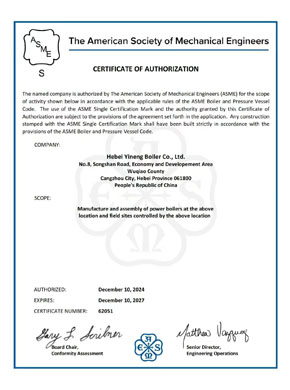
The full name of ASME certification is the boiler and pressure vessel specification certification of the American Society of Mechanical Engineers. The core is the whole process of design, manufacturing, and inspection of boilers and pressure components.It is not a general qualification of the manufacturer, but clearly delineates the type of boiler, pressure range and corresponding specification chapters that the manufacturer can produce.
The CE mark is the compliance mark for products to enter the EU and European Economic Area markets, which means that the products meet the basic safety, health and environmental protection requirements of relevant EU directives.Many people regard CE as a European quality certification, which is a typical misunderstanding.CE is essentially a compliance statement for market access, not a quality level certification. The EU directives applicable to different products are completely different.
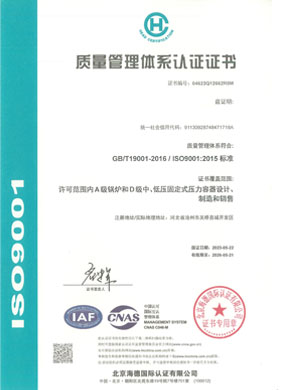
The most common ISO 9001 belongs to the quality management system certification. It reviews whether the factory's organizational structure, process documents, and quality control system meet the standards, and proves that the factory's management capabilities, not a specific boiler product, have passed the ISO certification.
In simple terms, ASME governs whether the pressure-bearing product of the boiler itself can be manufactured according to specifications, CE governs whether the product can enter the EU market, and ISO governs whether the factory's quality management system has regulations.
Many suppliers will put these three types of certifications together in their publicity, giving people the impression that complete certification equals reliable products.However, for the purchaser, the most important thing is not the number of certificates, but the holder, effective scope, and validity period of each certificate, and whether it corresponds to the equipment purchased by itself.Skip the step of checking the scope, and subsequent audits may be in form.
ASME is one of the most recognized pressure-bearing equipment specifications in the field of industrial boilers, and it is also the most easily generalized certification.Many manufacturers say that they have ASME certification, but when they really check the details, there are often many problems.
ASME BPVC certification is divided into many different specification chapters, corresponding to different equipment types.The most common contacts in industrial boiler procurement are Section I power boilers and Section IV heating boilers.
Power boiler generally refers to a steam boiler with a design pressure of more than 15 psi, or a hot water boiler with a design pressure of more than 160 psi and a water temperature of more than 250°F. It is mostly used in industrial production, power stations and other scenarios. The pressure and temperature limits of heating boilers are lower, and they are mainly used in civil or commercial scenarios such as heating and hot water supply.
Each certification scope has a corresponding designer, such as S for power boiler, A for pressure vessel, E for electric heating boiler, H for heating boiler and so on.These codes will be clearly marked on the certificate, instead of just writing ASME certification.
When purchasing, you can't just ask if you have an ASME certificate, but first clarify whether your boiler belongs to Section I or Section IV, and then check whether the Designer on the manufacturer's certificate is covered.For example, if you purchase an industrial-powered steam boiler, and the manufacturer only has H-level heating boiler certification, then the certificate is invalid for your project.
According to ASME's official BPVC certification project description, different Designators correspond to different design, manufacturing, and inspection requirements. Cross-range production is not allowed, nor can the group company's certificate cover different products in different factories.
Don't just accept scanned copies of PDF certificates from suppliers.It is not uncommon in the industry to modify the certificate and apply the certificate number. The most reliable way is to go directly to the Certificate Holder Search system on the ASME official website to check.
Focus on these items of information when checking:
There is a common pit here: many group companies and trading companies will bid for the certificate of the head office or associated factory, but the factory that actually produces your boiler is not within the scope of certification. Therefore, it is necessary to check whether the address of the manufacturing site on the certificate is consistent with the production plant mentioned by the manufacturer.For example, the group headquarters has ASME certification, but the branch responsible for production does not, which does not meet the requirements.
Even if the manufacturer has a real and valid ASME certificate, it does not mean that all his boilers belong to the scope of certification.Certification has clear boundaries, and products that exceed the boundaries, even if they are produced in the same factory, are not considered to have passed ASME certification.
When checking, at least these dimensions must be covered: boiler type, design pressure level, design temperature range, manufacturing location, and applicable specification chapters.
For example, if your project clearly requires the construction of a power steam boiler according to ASME Section I, then you must confirm that the supplier's certification not only has an S code, but also covers the range of pressure and temperature parameters you need.The ASME certification of some manufacturers only covers low-pressure boilers, and the high-pressure parameters you want are not within the range.
In addition, if pressure-bearing components such as heads and valves are outsourced, it is necessary to confirm whether these components also meet the corresponding ASME requirements. You can't just look at the certificate of the whole machine assembly plant.
The CE mark is a mandatory requirement in boiler projects exported to the European Union, but many people have a biased understanding of CE, and it is easy to get the wrong focus during verification.
Many people think that CE is a European quality certification when they mention it, but it is not.The CE mark is a kind of safety compliance mark. The core is to prove that the product does not endanger the basic safety requirements of users and the environment. It does not assess the quality level and performance of the product.
The nature of CE and ASME is completely different.ASME is a professional specification certification for the design and manufacture of pressure-bearing equipment, with clear product technical requirements; CE is a market access requirement, depending on the product category, the applicable EU regulations are also different.
For pressure equipment such as boilers, the main applicable is the EU pressure equipment Directive PED 2014/68/EU. The corresponding evaluation processes and requirements vary greatly for different pressures, volumes, and media levels.If you can't see the CE mark, the boiler meets the EU pressure equipment requirements by default. Some manufacturers may take the CE of the low voltage directive or the machinery Directive, which has nothing to do with the pressure bearing part.
The core document of CE certification is the EU declaration of conformity, not a certificate with the CE logo printed on it.The CE certificate that many suppliers show you may be a test certificate issued by a third-party organization, not a statutory declaration of conformity.
A formal declaration of conformity should contain these contents:
Be sure to check that the product model on the statement is exactly the same as the boiler model you purchased.Some manufacturers will deal with a series of general declarations, but the specific parameter model you want is not within the scope of the declaration, which is not in compliance.
Not all CE certifications require the intervention of a third-party notified body.According to the classification of the Pressure equipment Directive PED, Category I pressure equipment can be self-declared by the manufacturer, and Category II and above pressure equipment must be evaluated for compliance by the EU notified body.
Most of the boilers belong to Category II and above pressure equipment, and under normal circumstances they will involve notified bodies.At this time, it is necessary to check the name of the notified body and the four-digit announcement number. This number can be found in the EU NANDO database. The scope of authorization of the organization.
It should also be noted that the CE mark, the test certificate of a third-party organization, and the manufacturer's declaration of conformity are three different documents and cannot be replaced by each other.Some manufacturers only put the CE logo on the product, and cannot provide a complete statement and notified body documents. This does not meet the requirements of EU regulations, and the product may be detained by the customs after arriving in Hong Kong.
ISO certification is a qualification that almost all manufacturers will mention, but it is also the most misunderstood type of certification.
The most common in the industry is ISO 9001 quality management system certification. Many buyers regard it as a kind of product certification. This is the most common misunderstanding.
ISO 9001 audits the factory's quality management system, such as whether there is a documented process, whether there is an internal audit mechanism, whether there are corrective and preventive measures, whether there is systematic training of personnel, and so on.It proves that the factory has the management ability to stably provide products that meet the requirements, but it does not mean that a specific boiler meets the ISO product standards.
For special pressure-bearing equipment such as boilers, ISO 9001 is the basic management system requirement and cannot replace special product regulatory certifications such as ASME and PED.When purchasing, the verification of special boiler certifications cannot be relaxed because the manufacturer has ISO 9001.
Although ISO 9001 is a system certification, it is also necessary to verify the authenticity and scope of the certificate. You can't just look at the logo and let it go.
The information to be checked includes:
The ISO certificates of some manufacturers are for sales companies, not for production factories. This kind of quality control of boiler products is not proven, so attention should be paid to the distinction.
This is the core process of the entire certification verification.It's not that many people don't want to verify, or don't know where to start. By following these six steps, they can basically avoid most pits.
The first step is to directly ask for the official documents of the certificate. Do not accept screenshots of the official website, the logo on the brochure, or the sales verbal certification.
Formal certificates are official documents with numbers, official seals, and detailed scope. Scanned PDF copies are the basic requirements.If the other party keeps pushing and only shows you the logo on the promotional page, there is a high probability that there is a problem.
Don't think that the certificate is too strict at the beginning. Certification is the entry threshold for boiler procurement. Suppliers who can't even get the certificate do not need to enter the next round of price comparison.
Which four?The company name on the certificate, the company name of the quotation, the subject of the contract, and the name of the factory that actually manufactured the boiler.
Many buyers only look at the existence of the certificate, ignoring the problem of inconsistent names.For example, the certificate is from Factory A, the quotation is from trading company B, the contract is from Group C, and the actual production is from Branch D. If the four entities are different, the other party must explain the relationship between them clearly, and prove that the production plant is indeed within the scope of certification.
Especially under the group company structure, the certifications of subsidiaries and branches cannot be automatically shared.Certifications such as ASME and PED are all bound to specific manufacturing sites. Even if a factory belongs to the same group, it is not considered a certification.
After you get the certificate, first find the three basic information of the certificate number, the date of issuance, and the validity period.
The validity period of different certifications is different. ASME is generally 3 years, ISO 9001 is generally 3 years, and CE's declaration of conformity has no fixed validity period, but it will correspond to product series and regulatory versions.
If the certificate has expired, or is about to expire, the manufacturer must provide a certificate of approval for renewal.Some manufacturers will use certificates that have expired for several years to promote, and it is easy to step on the pit if you don't look at the date carefully.
In addition, pay attention to the status of the certificate, whether it has been suspended, revoked, or cancelled.Although some certificates are within the validity period, they have been suspended because the manufacturer does not meet the requirements, and they are also invalid.
A copy of the certificate can be faked, and the most reliable way is to verify it in the official database of the issuing agency.
Don't just skip it when you hear the manufacturer say that the official website can be checked. It won't take a few minutes to check it yourself, but you can avoid most fake certificates.
This is the most overlooked and critical step in the entire verification process.Many buyers find that the certificate is genuine and within the validity period, and they think it is no problem, but in fact, there are many cases where the scope of certification does not match.
It is recommended to list the boiler parameters of your project and correspond to the certification scope item by item:
As long as there is a mismatch, this certificate will have no effect on your project.For example, the manufacturer's ASME certification only covers boilers below 10bar, and what you want is 25bar, even if the certificate is true, it is useless.
Certification is not enough for a piece of paper. Behind it is a complete set of technical documents for design, manufacturing, and inspection.Especially standard certifications such as ASME have strict requirements for the inspection of the entire production process.
According to the project requirements, you can further request the manufacturer to provide these technical documents:
Taking Bidragon boilers as an example, when each ASME standard boiler leaves the factory, it will be accompanied by a complete manufacturing inspection document package, from material re-inspection, welding process evaluation, ray flaw detection report to hydrostatic test records, every step has a traceable record.This is a complete certification document that meets the requirements of the specification, not just a lone certificate.
Many manufacturers say that they have ASME certification, but they cannot get a complete process inspection document. At this time, they must be vigilant. It is likely that they just got the certificate, but the actual production is not strictly implemented in accordance with the specifications.
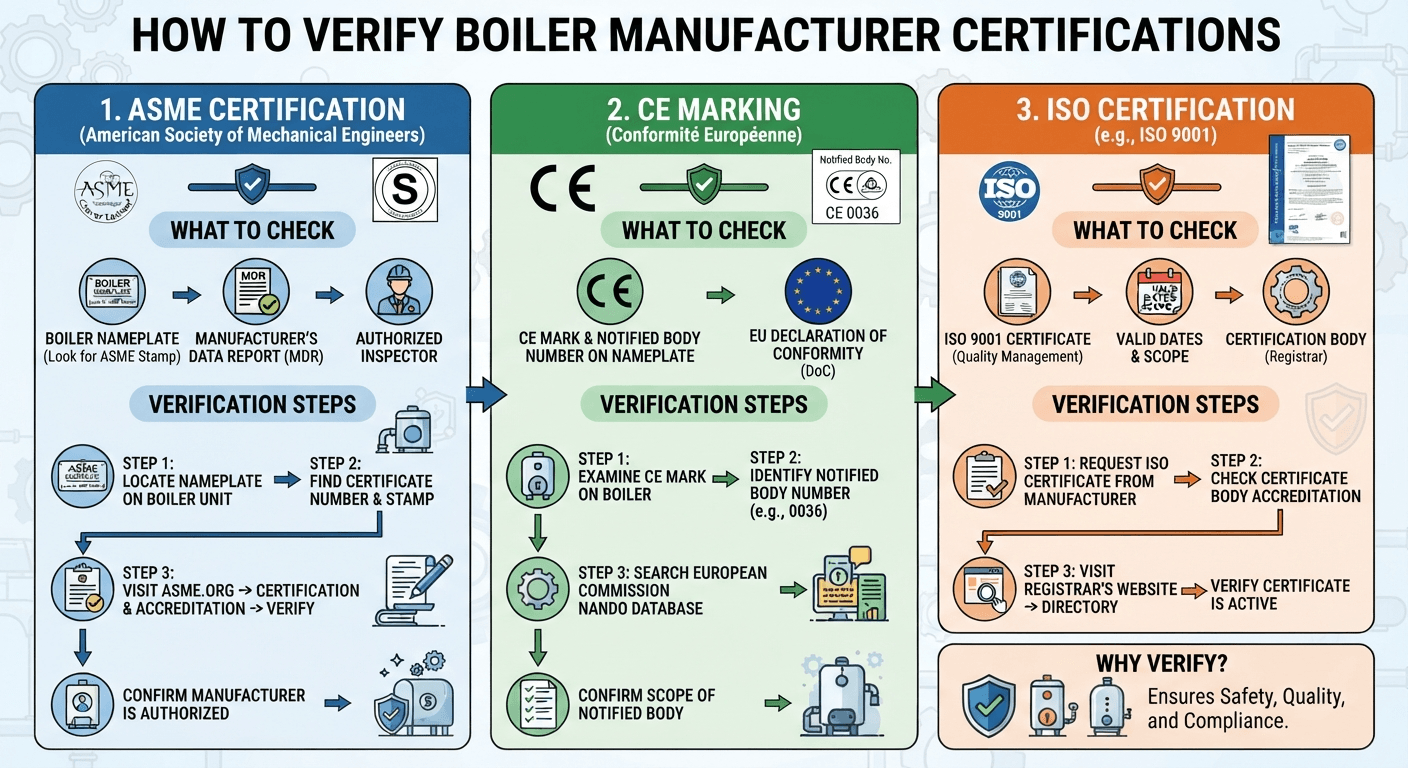
The nature of the three types of certifications is different, and the focus of verification is different.The comparison table below can help you quickly sort out the boundaries and avoid confusion.
|
Certification / Document |
Core Function |
What to Verify |
What It Does Not Automatically Prove |
|
ASME |
Certification for the design and manufacturing code of boilers and pressure equipment |
Certification scope, Designator code, certificate holder status, validity period |
That all products from the manufacturer are ASME-certified |
|
CE |
Regulatory compliance requirements for the EU market |
Declaration of Conformity, applicable regulations, Notified Body information when necessary |
That it is a general quality certificate |
|
ISO 9001 |
Certification of a factory's quality management system |
Certification scope, issuing body, validity period, accreditation qualifications |
That the design and product of a specific boiler meet the requirements |
In actual procurement, don't blindly pursue as many certifications as possible, but check the corresponding certification documents according to your project destination, usage scenarios, and regulatory requirements. For example, if a product is to be exported to the United States, ASME is the core; if it is to be exported to the European Union, CE compliance under the PED directive is a must; ISO 9001 can be used as a reference for factory management capabilities, but it cannot replace the first two.
We have organized the entire verification points into a list that can be checked. You can save it and send it directly to the supplier when inquiring, so that they can provide information according to the list, which can not only improve communication efficiency, but also avoid the other party using vague expressions to get away with it.
Company Entity
□ Manufacturer's legal name □ Actual production address □ Certificate holder's name
Asme Certification
□ Certificate number □ Designator certification Code □ Applicable BPVC specification chapter □ Validity Period □ Official database verified
Ce Certification
□ EU Declaration of Conformity □ Applicable EU regulations/directives □ Applicable harmonized standards □ Notified body information (if required)
Iso Certification
□ Applicable ISO standards (such as ISO 9001) □ certificate number □ scope of certification □ Issuing authority □ validity period
Technical Documents
□ Boiler design drawings □ Material quality certificate □ Welding process and welder qualification documents □ Non-destructive testing report □ hydrostatic test report □ Process inspection record
You don't need to put the verification on your own side, you can also test the professionalism of the manufacturer by asking questions.The following issues are all very practical issues in the procurement process, which can be gradually confirmed at different stages of communication.
1.Are your boilers manufactured in accordance with ASME BPVC specifications?
2.What kind of ASME certification certificate do you hold, and what is the corresponding Designator?
3.What is your ASME authorization certificate number?
4.What types of boilers are covered by the certification, and what is the pressure and temperature range?
5.Can the certificate be verified by querying the official database of the issuing authority?
6.Is the certificate directly issued to the actual production factory, and is the manufacturing address consistent with the certificate?
7.If CE compliance is required, can you provide a formal EU declaration of conformity?
8.Which ISO system certification does your factory hold, does the scope of certification include boiler manufacturing?
9.What inspection and test documents will be provided when shipping?
10.Can your documents meet the acceptance requirements of our local regulatory authorities?
Professional boiler manufacturers will be very clear about their certification scope and document system, and can answer these questions accurately and clearly.If the other party cannot answer, or the answers given are inconsistent, it is necessary to consider carefully.
When many buyers evaluate suppliers, they only stare at the technical parameters, price, delivery time, and after-sales service, and regard certification as an optional qualification. Just take a look.
But in fact, certification compliance is the bottom line requirement of boiler projects.If there is a problem with the certification, the acceptance of the light project cannot be passed, and the documents must be rectified, and the heavy equipment cannot be put into use, or even violate the local special equipment regulations and face fines.
A qualified certificate cannot replace the audit of boiler design and manufacturing capabilities, but it is the basic threshold.In addition to certification, buyers must also comprehensively inspect the manufacturer's manufacturing capabilities, quality control level, inspection and testing capabilities, installation and commissioning capabilities, spare parts supply and after-sales service.
The ultimate evaluation goal is to confirm the four core points: the certificate is true and valid, the scope of the certification matches the project, the technical documents are complete and traceable, and the product actually meets the project requirements.
Professional manufacturers like Bidragon boiler will actively open up all the information verified by the certification to customers for inquiries. At the same time, the factory has a complete quality control process, from the entry of materials into the factory to the delivery of finished products, there are inspection records at every step.Customers can not only see the certificate, but also the actual implementation behind the certificate.
The three types of ASME, CE and ISO certifications correspond to three different levels of product specification, market access, and management system, respectively, and solve compliance and quality problems in different dimensions.
To verify the certification of the boiler manufacturer, you can't just look at the logo of the official website or a PDF certificate.The most reliable process is: first confirm that the certificate itself is true and valid, then check that the scope of certification and the project parameters match, then verify that the licensed subject and the production plant are consistent, and finally check whether the supporting technical documents are complete.
For industrial boiler procurement, certification verification must be done in front, and it should be closed at the inquiry and initial screening stages. Don't wait for the contract to be signed and the equipment to be inspected after production. At that time, the cost of rectification will be much higher.
Taking a little more time to do a good job of certification verification may seem troublesome, but it is actually the most cost-effective way to avoid project risks and ensure equipment safety.