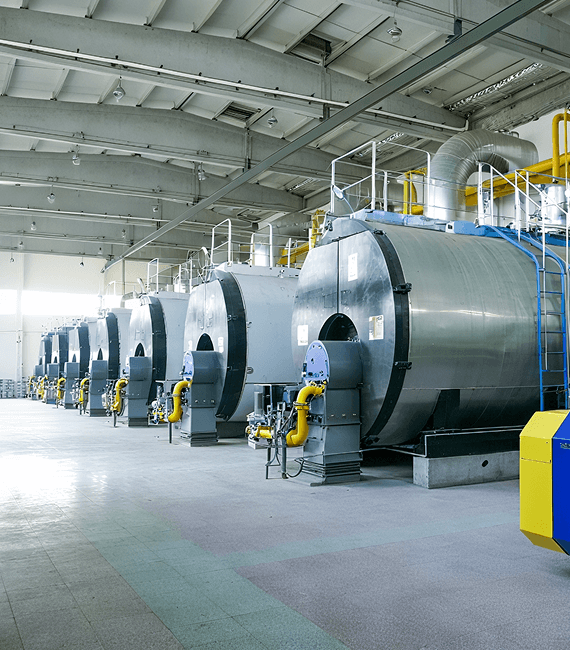

Steam boilers serve as core heat source equipment in industrial production. Stable steam pressure is a direct determinant of production line continuity and product quality. While minor pressure fluctuations may not disrupt production, persistent, abnormal fluctuations pose significant risks. Unstable pressure leads to deviations in steam temperature, resulting in inconsistent product quality. Furthermore, fluctuating pressure accelerates the aging of boiler drums, piping, and valves, potentially leading to serious equipment safety issues.
Pressure fluctuation refers to the phenomenon where the actual steam pressure of an industrial boiler deviates from the set operating pressure and frequently rises and falls during operation. Minor pressure variations are inherent to boiler operation; such slight changes are part of normal working conditions and require no intervention. These normal fluctuations occur within a narrow range and change gradually. Pressure deviations caused by minor load adjustments or slight changes in ambient temperature quickly stabilize on their own. In contrast, abnormal pressure fluctuations involve significant deviations and high-frequency oscillations; the pressure readings are erratic and fail to stabilize spontaneously.
On-site operators can identify these abnormalities through observable signs. Indicators include frequent fluctuations in pressure gauge or control system readings, with the needle swinging back and forth; frequent burner cycling (start-stop) and water replenishment; inconsistent steam supply to workshop equipment; and fluctuating temperatures in production processes. These phenomena indicate that the boiler is experiencing abnormal pressure fluctuations.
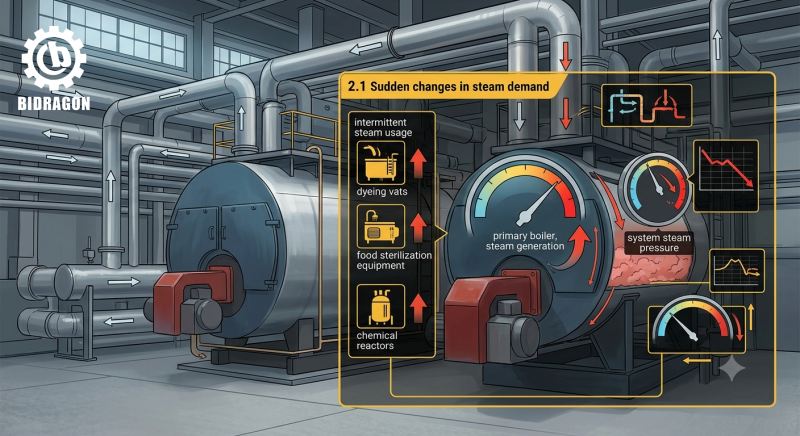
Boiler pressure balance is essentially a matter of dynamically matching steam generation with steam consumption. If generation exceeds consumption, pressure rises gradually; conversely, if consumption suddenly exceeds generation, pressure drops rapidly. In most factories, the initial trigger for pressure fluctuations is a sudden change in the external steam load.
Many industrial processes involve intermittent steam usage. Activities such as the opening and closing of dyeing and printing vats, the starting and stopping of food sterilization equipment, the staged heating of chemical reactors, or the simultaneous activation or deactivation of multiple steam-consuming units in a workshop can instantly alter steam consumption rates.
When multiple high-capacity steam-consuming units start up simultaneously, a large volume of steam is instantly drawn from the piping network. If the boiler's steam generation rate cannot keep pace with the consumption rate, the pressure plummets rapidly. If operators blindly increase the firing rate, the excess steam cannot be vented quickly enough once the equipment stops consuming steam; consequently, the boiler pressure surges, resulting in significant fluctuations.
The combustion system is the core of the boiler's steam generation process, and the combustion state directly determines the evaporation rate. When combustion conditions are unstable, steam output fluctuates, making it impossible to maintain steady pressure. Aside from load variations, this is the most common internal cause of operational instability.
Abnormal burner operation is a primary issue. Frequent flameouts, delayed ignition, and flame instability cause intermittent heat supply to the furnace. Fluctuations in heat absorption by the boiler's heating surfaces lead to varying evaporation rates, directly causing steam pressure to fluctuate.
Imbalances in the air-fuel ratio are also common. Excessive airflow dilutes the furnace temperature and results in incomplete combustion. Conversely, insufficient airflow prevents complete fuel combustion, leading to inadequate heat output and carbon buildup. Both scenarios result in unstable steam generation efficiency.
Fluctuations in fuel supply pressure have a similarly significant impact. In gas-fired boilers, fluctuating gas pressure, and in oil-fired boilers, uneven oil pump delivery or clogged filter elements, cause instability in the rate of fuel supply. As the calorific value of combustion varies, the boiler's steam output cannot remain constant.
Anomalies in fan and damper controls also trigger fluctuations. Unstable speeds in induced-draft or forced-draft fans, as well as damper actuator sticking or inaccurate feedback, cause continuous variations in intake airflow and exhaust volume, disrupting stable combustion conditions within the furnace.
Fluctuations in feedwater temperature and flow rate directly alter heat exchange conditions within the boiler drum and indirectly affect steam pressure. When troubleshooting pressure issues, the feedwater system is often overlooked, delaying the resolution of the problem.
Unstable feedwater flow is a common issue. Insufficient feed pump pressure, pump cavitation, or pipeline blockages can result in intermittent water supply. The frequent influx of large quantities of cold water into the high-temperature boiler drum causes an instantaneous drop in boiler water temperature, briefly suppressing evaporation and leading to a slight dip in pressure. As the water temperature recovers, the evaporation rate rises again, causing the pressure to rebound.
Malfunctions of the feedwater regulating valve are the most frequent cause. Issues such as valve plug wear, sticking due to scaling, or poor sealing prevent accurate control of the valve opening. Consequently, the actual feedwater flow fails to match operating requirements following control signals; the resulting continuous fluctuations in drum water level drive corresponding fluctuations in steam pressure.
Fluctuations in drum water level and the phenomenon of "false water level" are significant triggers for pressure instability. Sudden load changes cause rapid variations in the volume of steam bubbles within the boiler water. The apparent rise or fall in water level does not reflect an actual change in water quantity—a condition known as false water level. The control system adjusts the feedwater supply based on these erroneous signals, leading to incorrect feed or cutoff actions, which ultimately results in sustained pressure oscillation.
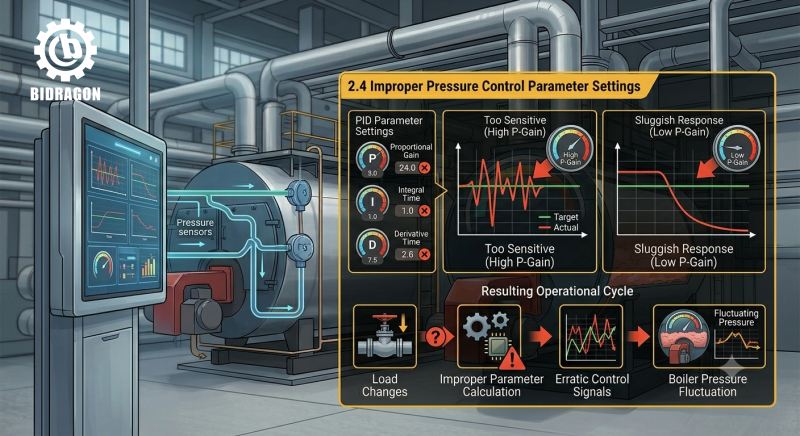
Fully automatic boilers rely on pressure control loops to regulate combustion and steam generation. The control system automatically adjusts combustion load and feedwater flow based on the difference between real-time and set pressures to maintain pressure balance. If parameters are set improperly, stable operating conditions cannot be achieved.
PID parameters are central to pressure control. Improper matching of proportional, integral, and derivative parameters leads to various control issues. If the proportional value is too high, the system becomes overly sensitive; even slight pressure deviations trigger drastic adjustments to combustion, causing the pressure to oscillate. Conversely, if the proportional value is too low, the system responds sluggishly, failing to correct pressure deviations in a timely manner and resulting in prolonged deviation from the setpoint.
Improper integral parameter settings lead to persistent pressure drift, preventing the pressure from returning to the target range. Incorrect derivative parameter settings prevent the system from anticipating pressure trends or intervening early; consequently, the control loop enters a state of continuous oscillation, and pressure stability cannot be maintained.
In the pursuit of production efficiency, some facilities indiscriminately alter pressure limits and start/stop load parameters. If the parameter range is set too narrowly, the equipment undergoes frequent start-stop cycles. If the range is set too widely, adjustments occur only after significant pressure deviations arise, resulting in continuous, large-scale pressure fluctuations.
Pressure instruments serve as the sensing terminals of the control system. Instrument malfunctions that transmit erroneous signals can cause apparent pressure fluctuations and mislead operators regarding the actual operating conditions. Many issues involving abnormal pressure readings stem not from equipment failure, but from instrument measurement errors.
After prolonged use, pressure transmitters may experience zero-point drift or span shift. Even when the actual equipment pressure is stable, the transmitter's output values may fluctuate erratically or read consistently high or low. The control system, responding to this erroneous data, may repeatedly adjust combustion and feedwater flow, thereby artificially inducing pressure fluctuations.
Clogging of impulse lines is a common issue in the field. Blockages caused by accumulated water, scale, or oil—or leaks resulting from bent or damaged piping—can impede the timely and accurate transmission of pressure signals. This leads to instrument readings that lag or fluctuate, failing to reflect the true boiler drum pressure.
Local mechanical pressure gauges may also exhibit inaccurate readings or needle oscillation due to aging, loose needles, or internal spring fatigue. If operators rely on such erroneous data, they may make incorrect adjustments, further exacerbating pressure fluctuation issues.
Malfunctions in steam valves and pressure relief devices are common proximate causes of pressure fluctuations. Valve sticking, abnormal opening/closing, or seal failure can lead to steam leakage and impaired flow, disrupting the system's pressure balance. Safety valves, in particular, are prone to insidious internal leakage; wear on their sealing surfaces causes a gradual drop in pressure, and even after the system restores pressure through supplementary firing, the ongoing leak causes the pressure to fall again, creating a cycle of fluctuation. Sticking or actuator failure in main steam valves or branch control valves leads to unstable valve positioning and inconsistent steam output, causing continuous pressure instability between the boiler drum and the piping network. Additionally, persistent steam leakage caused by improperly sealed steam traps or bypass valves can prevent the boiler's steam generation from keeping pace with pressure losses, ultimately resulting in frequent pressure fluctuations.
Unstable steam pressure primarily affects steam quality. Since pressure and temperature are directly correlated, pressure fluctuations cause constant variations in steam temperature.For temperature-sensitive processes such as constant-temperature drying, material reactions, and sterilization this can lead to quality issues like color discrepancies in finished products, substandard moisture content, and incomplete sterilization, thereby directly increasing the rate of defective products.
Pressure fluctuations increase a plant's fuel consumption. Frequent pressure changes require the combustion system to constantly adjust its load and cycle through start-stop operations. Boilers operating under frequently varying loads exhibit significantly lower combustion efficiency compared to stable operating conditions. Incomplete fuel combustion and substantial heat loss occur, leading to a significant rise in production costs over the long term.
The rate of equipment wear and aging accelerates markedly. Components such as steam drums, steam piping, valves, and pressure gauges are subjected to prolonged cyclic pressure loads, causing fatigue damage in metal parts. Seals undergo repeated compression and expansion, significantly increasing the likelihood of aging and leakage, while the frequency of equipment malfunctions continues to rise.
Pressure fluctuations in high-pressure boilers also pose serious safety risks. Sudden spikes or drops in pressure create excessive temperature differentials across the steam drum walls, generating thermal stress. In extreme cases, this can trigger pipeline vibrations and flange leaks. Severe pressure overshoots can cause safety valves to actuate frequently, thereby increasing the operational risk of the boiler.
Are you tired of constant production losses and soaring fuel costs caused by unstable steam boiler pressure?
Stop letting erratic pressure drain your factory's profits—[Contact our engineering team today] for a high-performance steam boiler solution tailored to your exact industrial needs!

Troubleshooting boiler pressure fluctuations does not require blind disassembly. By following a logical troubleshooting sequence moving from the outside in and from simple to complex you can rapidly pinpoint the cause and minimize downtime for repairs. Prioritize checking external loads and basic operating conditions before inspecting the boiler unit itself, along with its instruments and valves.
First, verify the steam load in the workshop and observe whether pressure fluctuations correlate with the startup or shutdown of steam-consuming equipment; this helps distinguish whether the fault stems from sudden changes in external load or an anomaly within the boiler itself. Next, examine the combustion system's operating conditions: observe burner flame stability and startup/shutdown status, and check fuel pressure, fan speed, and damper opening to rule out issues such as air-fuel ratio imbalances or unstable fuel supply.
Then, verify the operation of the feedwater system and observe whether the boiler drum water level fluctuates in sync with the pressure. Check the feedwater pump for stable operating pressure and conditions. Inspect the feedwater control valve for sticking or deviations in opening position, and troubleshoot common issues such as false water levels or control valve failure. Finally, verify the status of equipment and valves by comparing readings from the remote monitoring system with those from local pressure gauges. Clear and inspect impulse lines and calibrate transmitters; simultaneously, check the sealing integrity and operational stability of safety valves, main steam valves, and bypass valves to rule out pressure fluctuations caused by leaks or sticking.
Stabilizing external steam consumption patterns can address load fluctuations. Strategies include staggering the startup and shutdown of high-power, intermittent steam-consuming equipment and installing steam accumulators to buffer against instantaneous load shocks. Additionally, optimizing the steam piping network helps reduce pressure losses and balance steam demand.
Combustion system instability requires optimizing combustion conditions. Regularly clean carbon deposits and debris from burners, adjust dampers to maintain an optimal air-fuel ratio, and ensure complete fuel combustion. Inspect and maintain fuel delivery and pressure-stabilizing equipment, fans, and actuators to ensure a stable fuel supply and consistent airflow regulation.
Feedwater system issues should be addressed by stabilizing the water level and restoring regulation accuracy. Inspect and replace clogged or worn water pumps, piping, and filter elements; clean or replace faulty feedwater control valves. Optimize water level control logic to prevent issues such as "false water levels" and erroneous makeup water supply caused by load fluctuations.
Abnormal control parameters require re-tuning PID settings. Fine-tune parameters based on boiler capacity and actual load, gradually adapting to operating conditions to avoid system oscillation. Simultaneously adjust pressure limits and load-switching parameters to ensure the control system's regulation aligns closely with the equipment's operational status.
Instrument malfunctions are primarily addressed through calibration, maintenance, and replacement. Regularly verify pressure instruments, clear impulse lines, and repair damaged or leaking piping. Replace aging instruments that exhibit significant drift or measurement inaccuracies to ensure data precision.
Valve and pressure relief device anomalies require timely inspection and maintenance. Refinish safety valve sealing surfaces, reset opening pressures, and address minor leaks. Repair or replace stuck or malfunctioning steam valves, seal bypass leaks, and replace aging sealing components to eliminate hidden steam leakage.
Most issues involving boiler pressure fluctuations stem from shortcomings in day-to-day operation and maintenance. Implementing routine preventive controls can eliminate the vast majority of fluctuation-related faults at the source, ensuring the boiler maintains stable and safe long-term operation while preventing recurring operational anomalies.
Routine operation and maintenance must prioritize standardized inspections and operational control. Core operating data—such as boiler pressure, water level, combustion status, and fuel pressure—should be recorded during every shift, alongside checks on instrument readings, valve seals, and the operational status of pumps and machinery, allowing for the timely resolution of minor issues. Additionally, production schedules should be rationally planned to avoid the simultaneous startup or shutdown of high-capacity steam-consuming equipment; this minimizes instantaneous load shocks and prevents prolonged low-load operation or frequent cycling of the boiler.
Furthermore, key indicators must be monitored continuously, and equipment calibrated regularly. Fluctuations in pressure—both in magnitude and frequency—should be tracked consistently; any instability in operating conditions warrants an immediate shutdown for troubleshooting to prevent the equipment from operating with unresolved defects. Pressure and water level instruments should be calibrated quarterly, and the performance of safety valves, control valves, and actuators tested regularly to ensure the precision of actions and the reliability of data across all monitoring and control components.
There is no single, fixed value for permissible boiler pressure fluctuations; the range is determined primarily by the boiler's rated pressure, equipment type, and specific production process requirements. Tolerance standards vary significantly depending on operating conditions.
For low-pressure steam boilers (typically with a rated pressure below 1.6 MPa), maintaining daily operating pressure fluctuations within ±0.05 MPa is considered normal. Fluctuations exceeding this range can impact standard production processes; for production lines with strict process requirements, fluctuations must be controlled within ±0.03 MPa.
High-pressure steam boilers have a rated pressure exceeding 1.6 MPa. While these units possess greater pressure-bearing capacity, they are subject to more rigorous process requirements. The standard permissible fluctuation range is ±3% of the rated operating pressure. Although the absolute value of minor fluctuations in high-pressure boilers may appear small, they can significantly affect steam quality and equipment safety; large-scale oscillations are not permitted.
During daily operation, the boiler should ideally operate stably within its rated load range. Avoid prolonged operation at full or overload capacity, and refrain from frequent, drastic load adjustments. Operating the equipment in accordance with its design specifications helps control pressure fluctuations and extends the boiler's service life.
Key boiler components require periodic, targeted maintenance to ensure long-term operational stability. Burners undergo monthly maintenance, involving the removal of carbon deposits and oil residue from nozzles, as well as checks on ignition and flame detection components. Air dampers and control valves are tested for responsiveness, and the air-fuel ratio is fine-tuned seasonally to maintain stable combustion. Feedwater systems undergo quarterly inspections to identify issues such as pump cavitation and seal degradation; pipelines and filters are cleared of debris, and control valve precision is verified to eliminate fluctuations in feedwater flow.
Instruments and valves are critical for monitoring and controlling pressure, requiring routine inspection and calibration. Professional calibration of plant-wide pressure, water level, and temperature instruments is conducted annually. Daily cross-checks of readings during each shift allow for the timely detection of instrument drift or signal distortion. Various steam valves, steam traps, and safety valves undergo comprehensive semi-annual inspections; components that are sticking or have failed seals are repaired or replaced to prevent hidden leaks and control malfunctions.
The core of boiler operation and maintenance is preventive care. Regular, standardized maintenance, equipment calibration, and hazard identification are superior to ad-hoc emergency repairs following a breakdown. Routine maintenance ensures stable boiler operation, significantly reduces pressure fluctuations and the likelihood of equipment failure, and guarantees the continuous, smooth operation of the production line.
Pressure fluctuations in steam boilers are never caused by a single factor. Addressing these fluctuations requires more than just temporary parameter tweaks or manual pressure adjustments; it demands a systematic troubleshooting approach and targeted corrective measures. Maintaining stable operating conditions during routine use can significantly reduce pressure fluctuations, thereby ensuring consistent product quality while lowering plant maintenance and energy costs.