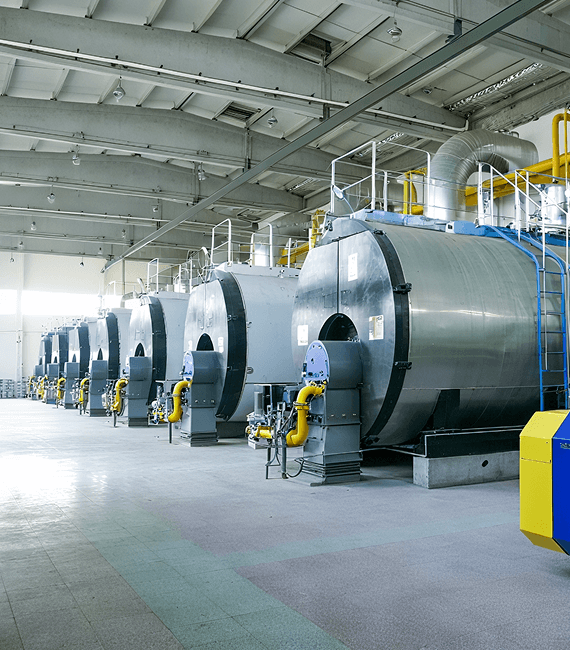

The chemical industry serves as a foundational sector of modern manufacturing, with downstream applications spanning petroleum refining, petrochemical processing, pharmaceutical production, and food chemical processing; indeed, the production of almost all industrial goods relies on chemical processing.
Key stages of chemical production typically require a stable and continuous supply of high-temperature thermal energy. From raw material pretreatment and reaction control to product separation and post-processing, temperature stability directly impacts reaction rates, product purity, and operational safety.
Steam boilers are among the most critical thermal energy supply units in chemical plants, providing a reliable heat source for diverse processes such as chemical reactions, heating and cooling cycles, distillation and separation, sterilization, and material processing. A well-suited industrial steam boiler enables chemical enterprises to control energy consumption and reduce pollutant emissions during long-term operations while ensuring the stable functioning of production lines.
The chemical industry relies far more heavily on thermal energy than most manufacturing sectors; the fact that steam boilers are the mainstream choice is directly linked to the specific characteristics of chemical production.
The vast majority of chemical reactions must take place within specific temperature ranges; temperature deviations can lead to reduced reaction rates, increased by-products, and even safety risks.
Compared to other heating methods, steam heating offers more uniform heat transfer, and temperature levels can be precisely controlled by adjusting pressure. As long as the boiler operates stably, it delivers a continuous supply of steam with consistent parameters, keeping reaction conditions constant across the entire production line—ultimately ensuring consistent product quality across batches.
The chemical industry is a major industrial energy consumer, with energy costs accounting for a significant portion of total production expenses; consequently, companies are highly sensitive to fuel utilization efficiency.
Modern industrial steam boiler combustion systems have undergone continuous improvement. When combined with supporting technologies such as waste heat recovery and condensate recycling, they maximize the conversion of fuel heat into usable steam, thereby minimizing thermal energy waste. This aligns perfectly with the chemical industry's current, widespread need to conserve energy, reduce emissions, and control operating costs.
In chemical production, abnormal fluctuations in temperature and pressure are common triggers for safety hazards. For certain exothermic reactions, a failure to dissipate heat promptly can even lead to the risk of a runaway reaction.
Steam heating systems allow for rapid adjustment of steam supply via control valves; when integrated with reactor temperature control loops, they maintain the system temperature within a safe range. Stable steam pressure also prevents equipment fatigue caused by thermal shock, thereby extending the service life of the plant's installations.

In a chemical plant, the steam produced by boilers is utilized throughout the entire production process, ranging from core reaction stages to the plant's utility systems.
Process heating is the primary function of boilers in chemical plants. The majority of the steam generated is piped directly to production units to provide heat for various types of process equipment.
High-temperature steam is typically fed into the jackets or coils of chemical reactors, the reboilers of distillation columns, or various heat exchangers to provide indirect heating to the process materials. This indirect heating method avoids direct contact with the materials, thereby eliminating contamination risks. It also offers high-precision temperature control, meeting the requirements of most fine chemical and petrochemical processes.
Many chemical reactions are not simple isothermal processes; instead, they require a complete cycle involving heat-up for startup, isothermal reaction, and cool-down for discharge.
During the heat-up phase, steam rapidly supplies heat to the reactor contents, shortening the startup time. In the isothermal phase, a low flow of steam maintains the system temperature. Some processes also utilize a corresponding steam condensation system to remove excess heat during exothermic reaction stages. Precise steam flow control ensures consistent reaction curves across batches, minimizing product quality fluctuations.
Large-scale chemical plants are typically equipped with high-pressure steam boilers. The high-pressure steam produced is first fed into a steam turbine to generate electricity, and the resulting low-pressure steam is then used in production processes, creating a combined heat and power (CHP) system.
This model reduces the plant's reliance on the external power grid; self-generated power capabilities ensure uninterrupted continuous production, particularly in regions with unstable power supplies. Furthermore, the steam's energy undergoes cascaded utilization, resulting in higher overall energy efficiency compared to systems used solely for heating.
Before entering core equipment such as reactors or distillation columns, chemical raw materials usually require preheating to a specific temperature to prevent thermal shock to the system caused by the introduction of cold feedstocks.
Thermal energy from steam boilers can be transferred to raw materials via heat exchangers, ensuring the materials are close to the required process temperature upon entering the reaction stage. This not only accelerates reaction startup and improves overall processing efficiency but also reduces the heating load in the reaction section, lowering energy consumption per unit of product. Such applications are particularly common in petroleum refining and the processing of bulk petrochemical feedstocks.
Distillation is a primary method for material separation in the chemical industry. Processes ranging from solvent recovery and product refining to crude oil fractionation rely on distillation to separate components based on their differing boiling points.
Steam primarily supplies heat to the distillation column's reboiler, causing the material at the column base to vaporize continuously and maintaining the vapor-liquid equilibrium within the column. The distillation process places high demands on the stability of steam pressure; pressure fluctuations directly affect the temperature distribution within the column, thereby altering separation performance and resulting in product purity that fails to meet specifications.
Post-processing of chemical products often requires the removal of moisture or solvents from materials to obtain finished products or intermediates.
Steam supplies heat to materials via drying equipment and evaporators, facilitating solvent evaporation, solution concentration, and product drying. Steam heating ensures uniform heat distribution, avoiding localized overheating; this preserves product quality and shortens overall processing times, making it widely used in fine chemicals and food processing.
Saturated steam possesses potent high-temperature sterilization capabilities and is one of the most common disinfection methods in the chemical industry.
In pharmaceutical and biochemical production, equipment, piping, and certain materials require rigorous sterilization to prevent contamination by unwanted microorganisms that could compromise product quality. High-temperature steam penetrates equipment crevices and pipe interiors to ensure thorough sterilization without leaving chemical disinfectant residues, thereby meeting regulatory compliance standards for pharmaceutical manufacturing.
Beyond direct involvement in production processes, steam boilers also meet the heating needs of the chemical plant's utility infrastructure.
Examples include space heating for workshops and office buildings, steam cleaning of production equipment, humidity control in cleanrooms, and heating for other auxiliary facilities. A comprehensive steam system addresses both production and logistical requirements, supporting the daily operations of the entire plant.
A well-configured steam boiler system does more than just provide a heat source; it impacts the plant's overall operations across multiple dimensions, including production, energy consumption, and regulatory compliance.
A stable steam supply is the foundation of continuous production. Insufficient boiler output or significant parameter fluctuations can force production lines to frequently reduce loads or even shut down temporarily; this not only hampers production capacity but also increases raw material waste and equipment wear and tear due to repeated start-stop cycles. Industrial steam boilers that maintain stable parameters reduce the likelihood of unplanned downtime, leading to smoother production rhythms and greater process consistency.
Regarding energy consumption, energy-efficient steam boilers paired with condensate recovery systems can significantly boost thermal energy utilization. High-temperature condensate generated during production can be returned to the boiler for reuse, thereby recovering residual heat and saving on water treatment costs. Over the long term, reduced fuel consumption translates directly into lower operating costs.
Environmental compliance is another key priority for chemical enterprises. Regulations regarding waste gas emissions are becoming increasingly strict, and older boiler models often struggle to meet limits for nitrogen oxides (NOx) and particulate matter. Modern boilers equipped with low-NOx burners, flue gas treatment systems, and waste heat recovery units can keep emissions within regulatory limits, helping companies meet environmental standards and avoid the risk of production halts for rectification.
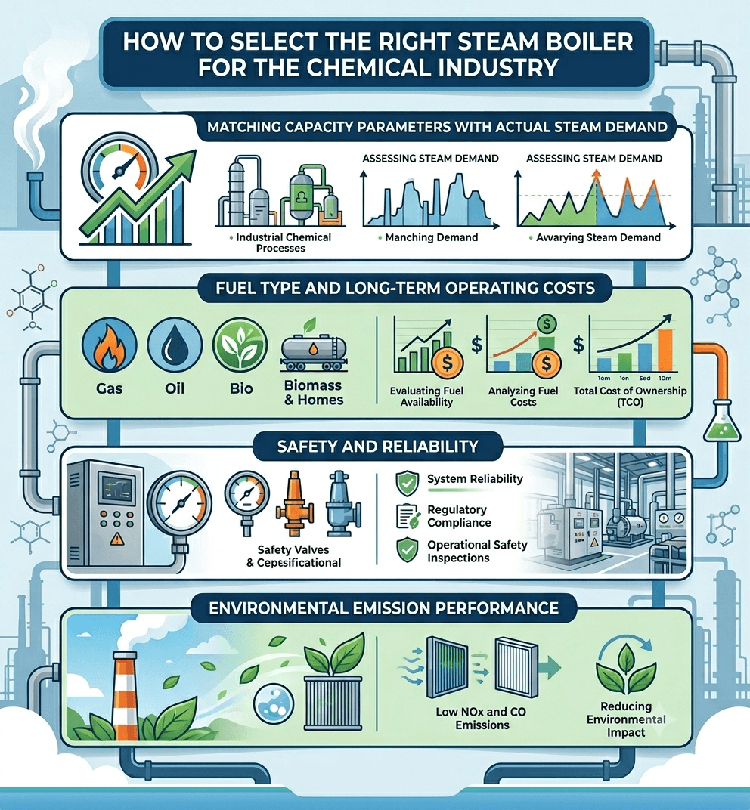
Production processes vary significantly across different chemical industry sub-sectors, each with unique requirements for steam pressure, temperature, and purity; therefore, boiler selection requires a comprehensive assessment based on specific operational needs.
First, it is essential to accurately calculate the plant's total steam demand and the pressure levels required for various processes. Planning should account not only for current production scale but also for a margin of excess capacity to accommodate future production increases.
Beyond total evaporation capacity, factors such as operating duration and load fluctuation ranges must be considered. For facilities operating continuously around the clock, boiler reliability and long-term stability are top priorities; conversely, if production lines experience significant load fluctuations, a boiler model with excellent load-adjustment capabilities should be selected.
Fuel costs represent a major portion of boiler operating expenses; the choice of fuel type should be based on local resource availability and environmental regulations. Natural gas boilers offer clean combustion and a high degree of automation, making them the mainstream choice for most chemical industrial parks. Biomass boilers are suitable for regions with local biomass fuel resources and offer superior carbon emission performance. Oil-fired boilers provide flexible installation options, making them ideal for scenarios where gas supply infrastructure is inadequate. Coal-fired boilers entail lower costs but face significant restrictions due to environmental regulations, limiting their use to specific regions.
When selecting equipment, one should not focus solely on procurement costs; instead, it is essential to calculate the total long-term fuel cost by factoring in fuel prices and boiler thermal efficiency before making a comparison.
Chemical production inherently involves certain risks; as boilers are pressure-bearing equipment, safety performance is a fundamental requirement.
Attention should be paid to safety features—such as pressure protection, water level monitoring, and flame-out protection—as well as the maturity of the automatic control system. Boilers with high levels of automation minimize human error and can rapidly trigger protective actions during abnormal operating conditions, thereby reducing safety risks. For chemical plants requiring continuous operation, the boiler's mean time between failures (MTBF) is also a critical performance indicator.
As environmental standards become increasingly stringent, a boiler's emission levels directly impact the plant's regulatory compliance.
Priority should be given to emission parameters regarding pollutants such as nitrogen oxides (NOx), particulate matter, and sulfur dioxide (SO2), favoring models equipped with low-NOx combustion technology and waste heat recovery systems. In regions with specific carbon emission requirements, one should also evaluate the overall carbon footprint—considering boiler energy efficiency and fuel type—to ensure alignment with future regulatory trends.
As the chemical industry transitions toward green and intelligent operations, the technological direction of steam boilers is evolving accordingly.
Intelligent control systems are becoming increasingly widespread. Next-generation boilers utilize sensors to collect real-time operational data—such as combustion status, water levels, pressure, and emissions—and automatically adjust combustion conditions, eliminating the need for frequent manual intervention. Some systems also support remote monitoring and fault early-warning capabilities, allowing maintenance personnel to identify potential issues in advance and reducing the workload associated with on-site inspections.
Technologies for energy conservation and low emissions will continue to advance. Waste heat recovery capabilities will be further enhanced; beyond conventional flue gas waste heat recovery, condensing boilers can capture the latent heat of water vapor within the flue gas, thereby further boosting thermal efficiency. Simultaneously, technologies adapting boilers for clean fuels—such as hydrogen and biomass—are being developed to help chemical enterprises reduce carbon emissions.
From an industry-wide perspective, steam boilers will become more deeply integrated into sustainable chemical production systems. Future boiler systems will not operate merely as standalone heat sources; instead, they will interface with plant-wide energy management systems to enable the coordinated dispatch of steam, electricity, and waste heat. This integration helps chemical plants reduce their overall carbon footprint and transition toward greener production.
Steam boilers are indispensable core energy assets in chemical production. From reaction heating and distillation separation to sterilization and utility support, virtually every stage of chemical processing relies on a stable supply of steam.
For chemical enterprises, selecting an industrial steam boiler that is process-compatible, reliable, energy-efficient, and compliant with emission standards ensures smooth production operations. It also allows for the control of energy costs over the long term while meeting increasingly stringent environmental regulations.
Choosing the right industrial steam boiler effectively enhances the efficiency and sustainability of chemical production processes, providing a solid foundation for the enterprise's long-term, stable operation.