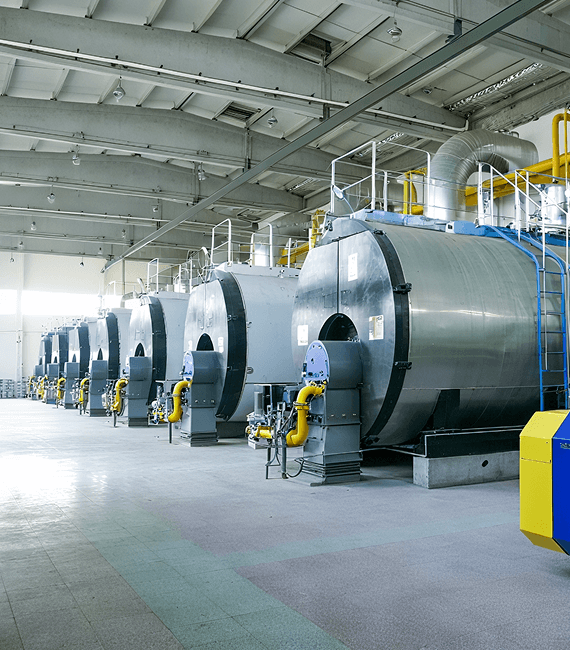

Steam serves as a core heat source and motive medium in industrial production, finding widespread application in sectors such as chemicals, food processing, textiles, and thermal power generation. Stable steam quality is directly linked to production efficiency, equipment lifespan, and product quality. While most factories closely monitor boiler pressure and temperature, they often overlook the steam's moisture content. Although excessive moisture does not immediately trigger a system shutdown, long-term operation with high moisture levels reduces heat transfer efficiency, thereby indirectly increasing production costs.
Industrial steam inevitably carries small amounts of liquid water droplets. Steam quality is typically evaluated using moisture content and dryness fraction. Moisture content represents the proportion of liquid water, while dryness fraction represents the proportion of pure steam; the sum of the two is 100%. A higher dryness fraction indicates purer steam and more stable operating conditions.
Dry steam contains minimal moisture and ensures uniform heat transfer, making it ideal for standard industrial heating, drying, and heat exchange processes. Conversely, wet steam has high moisture content, resulting in poor heat transfer and a tendency for condensate to accumulate during transport. Wet steam can lead to inaccurate temperature control, reduced production efficiency, and inconsistent product quality. Operational issues caused by excessive moisture can often be identified through direct observation: cloudy condensate discharge, slow equipment warm-up, abnormal pipeline noise, and frequent condensate accumulation in valves are all common indicators of this problem.
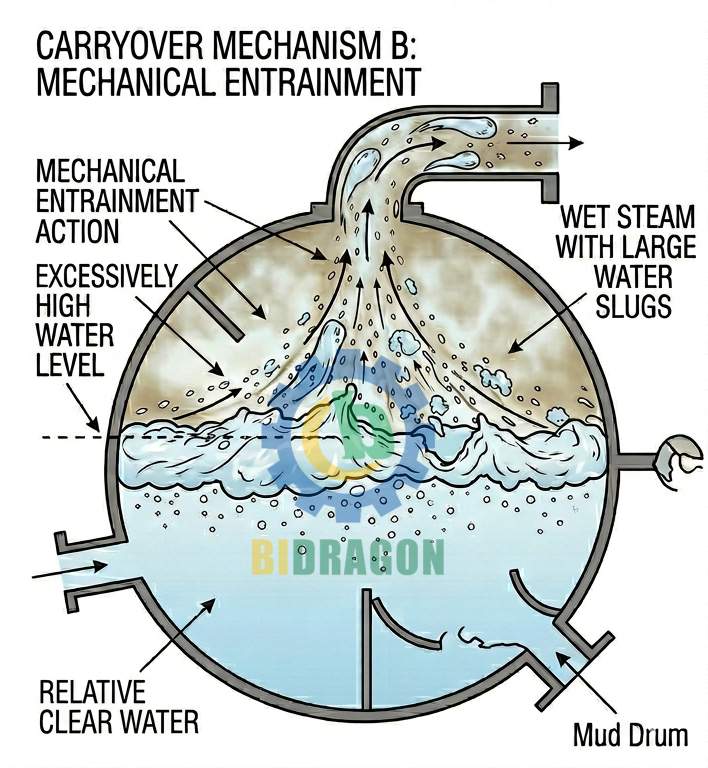
An excessively high water level in the steam drum is the primary cause of steam carrying water. Exceeding the water level limit compresses the space available for steam-water separation. Water droplets generated by boiling are directly entrained by the airflow into the steam piping, resulting in mechanical carryover. Abnormal water levels exhibit distinct operational characteristics: the water level gauge consistently reads at the maximum limit, the automatic make-up water valve cycles frequently, and steam discharge is accompanied by abnormal noises caused by water spraying. These signs indicate deviations in water level control. During routine operation and maintenance, the water level should be stabilized within the middle of the standard range; intentionally raising the water level is prohibited. Make-up water flow should be fine-tuned prior to load adjustments to prevent sudden water level fluctuations, thereby minimizing steam carryover at the source.
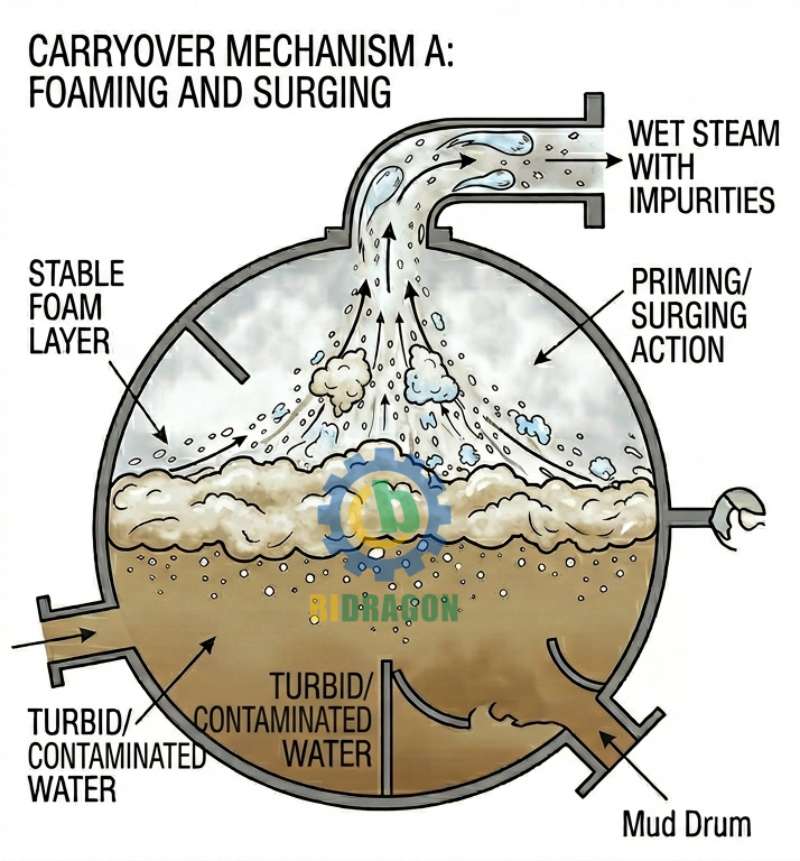
Excessive Total Dissolved Solids (TDS) in the boiler water is a critical, underlying factor in persistent steam carryover. High dissolved solid content alters the water's surface tension, causing the formation of a dense foam layer on the water surface during boiling. This foam layer compresses the steam-water separation space, making it highly likely for steam to entrain water droplets. Fluctuations in operating conditions can trigger "priming" (or foaming/surging), where large quantities of boiler water are carried out with the steam, drastically increasing moisture content. Proper blowdown is the key method for improving water quality; continuous blowdown can steadily reduce TDS concentrations, while periodic bottom blowdown removes scale and accumulated impurities. Most recurring steam carryover issues stem from inadequate blowdown and the accumulation of impurities in the boiler water.
The steam-water separator is a critical component for ensuring steam purity. It captures liquid water droplets from the steam, facilitating secondary separation. Prolonged operation can lead to issues such as clogged filter screens, deformed baffle plates, loose bolts, and degraded gaskets, all of which directly compromise separation efficiency. If the equipment fails, water droplets can enter the piping network, resulting in persistent wet steam problems. Routine inspections should cover the condition of the separator housing, connections, and blowdown outlets. Internal debris must be cleared and worn parts replaced according to the maintenance schedule to ensure consistent separation performance.
Frequent fluctuations in steam consumption directly impact steam quality. A sudden increase in steam demand on the production line causes a surge in the boiler's steam outflow velocity, entraining boiler water droplets into the steam. Simultaneously, a rapid load increase leads to a sharp drop in steam pressure and intensified boiling of the boiler water, further exacerbating the issue of water carryover. Production scheduling should aim to avoid abrupt load adjustments. When increasing steam consumption, a stepped approach is recommended; this allows sufficient time for the boiler's operating conditions to stabilize, maintaining a steady steam-water state within the boiler and effectively reducing wet steam generation.
Prolonged boiler overload operation is a major cause of high moisture content in steam. When the evaporation rate exceeds the equipment's design specifications, steam velocity rises significantly, greatly increasing the potential for water entrainment. Even with normal water levels and quality, the steam will carry substantial amounts of liquid water. Typical symptoms of overload operation include persistently low steam pressure, abnormally high flue gas temperatures, and an inability to meet steam demand despite running at full capacity. Operations must strictly adhere to rated load standards, and prolonged overloading is prohibited. In facilities with multiple boilers operating in parallel, loads should be distributed rationally to prevent any single unit from running in an overloaded state.
Frequent fluctuations in steam pressure disrupt the water-steam balance within the boiler. A rapid drop in pressure lowers the saturation temperature of the boiler water, causing the water to flash and generate a large number of fine water droplets. Conversely, a rapid rise in pressure causes abrupt changes in steam flow dynamics, making the piping network prone to condensate accumulation and increasing the overall moisture content. Operations and maintenance personnel must maintain stable pressure and avoid drastic, rapid pressure adjustments. When adjusting pressure, the pace of operation should be moderated, pressure changes monitored in real-time, and operating conditions anticipated based on production needs to minimize steam quality issues caused by pressure fluctuations.
Carry-over (water entrained from the boiler) and pipeline condensate are distinct issues, yet both compromise the quality of steam delivered to the end-use equipment. Boiler carry-over involves water droplets entrained in the steam flow due to abnormal internal boiler conditions, whereas pipeline condensate forms naturally as steam cools during transport; these issues require separate investigation and remediation. Steam traps are critical components of the drainage system, automatically discharging condensate while preventing steam leakage. Clogging, sticking, or failure of steam traps leads to condensate accumulation in the pipelines; this condensate can enter production equipment with the steam, thereby reducing heat transfer efficiency. Issues such as insufficient pipeline slope, excessive dead zones, and the absence of terminal drainage devices further exacerbate condensate accumulation. Regular inspections of drainage equipment and the clearing of pipeline dead zones are essential to ensure unobstructed drainage.
Steam carrying water is typically caused by a combination of factors, which can be categorized into four main types to facilitate precise on-site troubleshooting. The first category is mechanical carryover, which is the most common issue. Excessive water levels, steam velocities exceeding limits, or steam-water separator failure can cause the steam flow to entrain water droplets; such problems can be quickly resolved through operational adjustments and equipment maintenance. The second category is chemical carryover, resulting from substandard boiler water quality. High levels of TDS (Total Dissolved Solids), alkalinity, or impurities trigger persistent foaming, where stable foam layers continuously trap moisture, leading to recurring issues.
The third category is the phenomenon of priming (or surging). Long-term accumulation of impurities within the boiler, combined with the effects of load changes and pressure fluctuations, prevents proper steam-water separation and causes turbulent, cloudy boiling, resulting in steam that carries significant amounts of moisture and impurities. The fourth category involves operational factors. Frequent, drastic load adjustments, improper pressure regulation, or delayed blowdown can disrupt the steam-water balance, generating persistent wet steam. It is important to distinguish between abnormal steam carryover and normal pipeline condensate; condensate volume remains relatively stable, whereas carryover involves fluctuating water volumes and is accompanied by distinct anomalies in steam quality.
Wet steam causes ongoing wear and tear on steam systems and production equipment, driving up maintenance and production costs. Its heat transfer efficiency is far lower than that of dry steam; condensate accumulation on inner equipment walls increases thermal resistance, slows heating rates, and raises energy consumption. Water hammer is the primary safety hazard associated with wet steam; high-velocity mixtures of steam and water striking pipes, valves, and pressure vessels generate violent shocks and vibrations, leading to irreversible damage such as weld cracking and equipment deformation over time.
Continuous impingement by water droplets containing impurities causes wear and sticking in precision components like valves and pressure gauges, thereby shortening their service life. In steam turbine units, wet steam causes persistent erosion of the blades, resulting in pitting and wear that reduce operational efficiency. In processes such as precision machining and food drying, inconsistent moisture content leads to temperature fluctuations, resulting in uneven product quality and higher defect rates. Furthermore, moisture-laden steam accelerates corrosion in piping and equipment, necessitating more frequent component replacements and increasing the workload for routine maintenance.
Wet steam is a silent profit killer driving up your fuel bills.
Stop wasting energy—switch to our high-efficiency industrial boilers built to maximize heat transfer.
Get a custom boiler quote here.

Operations and maintenance personnel can identify issues with excessive steam moisture content through a combination of on-site observations and professional testing. During routine inspections, intuitive warning signs include turbid condensate discharge, unstable temperature, an abnormal rise in energy consumption, and unusual noises (such as water hammer) in the piping. Professional testing can be performed using a portable steam dryness tester connected directly to the piping network to measure steam dryness and moisture content, thereby accurately determining whether the steam quality meets standards.
Monitoring the relationship between pressure and temperature serves as a simple yet effective supplementary method; the temperature of high-quality dry steam should correspond to the standard value for the prevailing saturation pressure. If the pressure is normal but the temperature is low, it indicates excessive moisture content. Routine procedures should include periodically opening pipeline blowdown valves to observe the discharge, tracking condensate removal, and maintaining long-term records of operating conditions; this enables the timely detection of steam quality anomalies and the elimination of potential equipment hazards.
Proper boiler water treatment is the fundamental method for addressing steam carryover at its source. Feedwater pretreatment filters out impurities such as silt, suspended solids, and colloids, while softening equipment reduces water hardness and prevents scale formation, thereby ensuring the cleanliness of the boiler water. Impurities in the boiler water continuously concentrate; excessive Total Dissolved Solids (TDS) levels can trigger foaming and priming (steam-water surging). Stable control of dissolved solids maintains a balanced steam-water state within the boiler.
Meeting water quality standards prevents the accumulation of foam layers, ensures proper steam-water separation, and reduces the likelihood of moisture entrainment in the steam. Industrial boilers are subject to strict water quality control standards covering key parameters such as hardness, alkalinity, TDS, and pH; facilities must regularly submit water samples for testing and adjust water treatment processes to comply with these standards. Continuous blowdown ensures stable removal of concentrated impurities. Regular blowdown frequency is adjusted based on water quality and load to prevent impurity buildup and potential operational anomalies.
Steam-water separators mitigate steam quality issues caused by fluctuations in boiler operating conditions, effectively purifying the steam. Common industrial types include baffle-type and cyclone-type separators, each suited to different production scenarios. Baffle-type separators achieve separation by forcing the steam flow to change direction; water droplets collide with the baffle plates, coalesce, and drain away. Featuring a simple structure and low failure rate, they are ideal for standard production lines with stable operating conditions.
Cyclone-type separators utilize centrifugal force to separate moisture; high-speed steam rotation flings water droplets against the vessel walls, where they collect and are discharged. Offering higher separation efficiency, they are suitable for operations characterized by significant load fluctuations and pronounced moisture carryover issues. Proper installation requires vertical positioning, sufficient straight pipe sections upstream and downstream, and the inclusion of steam traps to prevent condensate backflow. Regularly clean scale and impurities, check sealing performance, and replace aging parts to ensure stable equipment operation.
Excessive steam moisture content is primarily an operational and maintenance issue; it can be effectively prevented through routine management rather than complex equipment modifications. Daily operations require standardized water level management, maintaining levels within the standard range; fine-tuning the water level before and after load adjustments is essential, as is verifying the status of water level gauges and feedwater equipment during inspections. During production, steam loads should be regulated smoothly to avoid sudden changes in steam demand; loads should be reasonably distributed among multiple boilers to prevent any single unit from operating beyond its rated capacity.
A regular equipment inspection system should be established, involving monthly checks of separators, steam traps, and drainage piping to clear blockages and replace aging components promptly. Water treatment processes must be standardized, with regular water quality testing, adjustments to blowdown and chemical dosages, and the recording of operational data. A comprehensive maintenance plan should be implemented to regularly clear condensate from piping networks and calibrate monitoring instruments. Additionally, operator training must be strengthened to standardize procedures, thereby minimizing human-induced operational anomalies and preventing the recurrence of steam moisture issues.
The stable operation of a steam system relies on proactive daily management rather than reactive remediation. Regular equipment inspections, routine water quality monitoring, and standardized unit operation can prevent most malfunctions caused by water carryover at the source. Diligent basic operation and maintenance not only avert issues such as water hammer, equipment wear, and product quality fluctuations but also ensure the boiler maintains high operational efficiency over the long term, effectively controlling the plant's operating costs.