
Many industrial users of biomass boilers encounter the issue of black smoke emissions from the furnace. This is the most immediate, visible sign of abnormal combustion in biomass boilers. Biomass fuel inherently contains a high level of volatile matter; if combustion conditions are not properly controlled, visible black smoke is easily produced. Such issues rarely stem from equipment failure itself; rather, they are closely linked to fuel characteristics, furnace temperature, the air-to-fuel ratio, feeding rates, and flue gas flow dynamics.
Black smoke issuing from the boiler stack fundamentally indicates incomplete fuel combustion. Under conditions of complete combustion, biomass fuel breaks down entirely into carbon dioxide and water vapor, resulting in clean, impurity-free exhaust. If combustion conditions are suboptimal, significant amounts of unburnt material remain, ultimately resulting in the emission of black smoke.
The primary components of black smoke include carbon black particles, solid unburnt carbon, and combustible volatile matter that failed to combust in time. These fine particulates suspended in the flue gas give the exhaust its distinct black or dark gray appearance.
For industrial operations and maintenance personnel, black smoke serves as the simplest and most direct early warning signal regarding combustion status. Persistent black smoke indicates an imbalance among fuel, air, and temperature within the boiler. Timely inspection and adjustment are required to prevent prolonged abnormal operation from leading to further equipment issues or emission problems.
Biomass fuels—such as wood chips, sawdust, pellets, and straw—readily absorb moisture from the air. Storing fuel outdoors at plant sites often leads to a significant increase in moisture content, a frequent cause of black smoke emissions.
When fuel with high moisture content enters the furnace, it does not burn immediately. A large portion of the heat within the furnace is consumed to evaporate the moisture, which lowers the overall furnace temperature and disrupts stable combustion conditions. At lower temperatures, the volatile components in the fuel cannot burn off quickly; instead, they are released as combustible flue gases. These gases exit through the flue without fully burning, resulting in black smoke.
Furthermore, high-moisture fuel reduces the boiler's overall combustion efficiency. To maintain the required temperature under a given load, the equipment must consume more fuel; this leads to an accumulation of unburned residue and recurring black smoke issues. Manufacturers specify the optimal moisture content for their biomass boilers, and exceeding these limits almost invariably leads to combustion irregularities.
Complete combustion of any fuel requires an adequate supply of oxygen. Biomass fuels have a high volatile content; consequently, the combustion process demands far more oxygen than traditional coal-based fuels, requiring precise air distribution.
Primary air is responsible for supplying oxygen to the solid fuel on the grate. If the primary air volume is insufficient, fuel at both the surface and the bottom of the grate suffers from oxygen starvation. The solid fuel merely smolders, generating large quantities of carbon particles. Secondary air serves to mix with the combustible volatiles released in the furnace, ensuring the complete combustion of gaseous combustibles. If secondary air is absent or the volume is too low, these volatiles escape directly, creating dense black smoke.
Insufficient air supply is not solely a matter of fan power. During daily operation, issues such as improper damper settings, dust accumulation or aging of fan impellers, and blockages or leaks in the air ducts can all result in inadequate actual air intake, triggering incomplete combustion and the emission of black smoke.
The ignition of volatile components in biomass fuel requires a specific temperature threshold. Complete combustion of these volatiles occurs only when the furnace temperature meets the required standard and combustible gases remain in the high-temperature zone for a sufficient duration. A low furnace temperature is a primary cause of black smoke generation.
During the boiler startup and warm-up phase, the furnace temperature has not yet reached the level required for stable combustion; brief emissions of black smoke are likely and considered normal. However, if the boiler continues to emit black smoke due to low temperatures after entering a state of stable operation, this indicates an abnormality. Factors such as excessive fuel moisture content, prolonged low-load operation, and excessive airflow (which carries away furnace heat) can all lead to persistently low furnace temperatures.
Low-temperature combustion not only generates significant amounts of carbon black particulate matter but also causes a sharp rise in carbon monoxide concentrations within the flue gas. This signifies a substantial drop in combustion efficiency and a failure to fully utilize the fuel's thermal energy.
To boost boiler output, many users indiscriminately increase the fuel feeding rate and quantity. Such practices easily disrupt the internal combustion balance, triggering black smoke issues.
The furnace's air supply capacity and heat storage capability per unit of time are finite. When large quantities of fuel rapidly enter the furnace and accumulate on the grate, the fuel at the surface quickly depletes the surrounding oxygen, leaving the fuel at the bottom in an oxygen-starved environment. The accumulated fuel cannot combust fully; instead, it undergoes slow carbonization and smoldering, continuously producing black smoke.
Excessive feeding also destabilizes the combustion process. Fluctuations in furnace temperature and turbulent flue gas flow lead to the frequent, intermittent appearance of black smoke. During routine operation, the fuel feed rate must be aligned with the boiler's actual load, air supply capacity, and furnace temperature; it should not be increased indiscriminately.
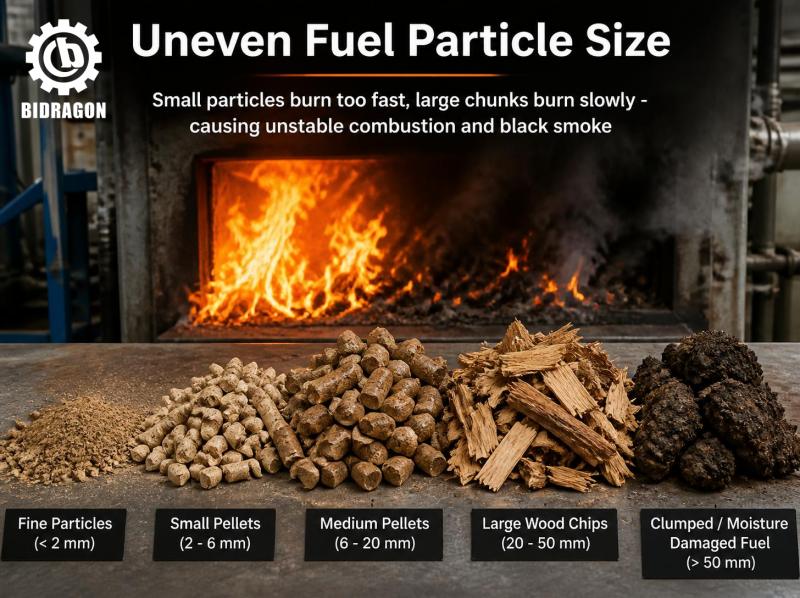
A stable fuel form is the foundation for uniform combustion. If the biomass fuel particles are irregular in shape—or worse, damp and clumped—the combustion process can quickly spiral out of control.
Fine, lightweight particles burn up rapidly upon entering the furnace, whereas large fuel clumps burn slowly, requiring longer high-temperature residence times and more oxygen. When these two types of fuel burn simultaneously, it becomes difficult to precisely balance the air-to-fuel ratio.
Fine particles may be carried away by flue gases before fully combusting, while large fuel clumps accumulate and smolder; this combination of issues leads to the continuous emission of black smoke. Inconsistent fuel quality also complicates the task of adjusting combustion parameters for operations and maintenance personnel, thereby affecting the boiler's long-term operational performance.
The combustion of biomass fuel generates significant amounts of fine ash and slag. Failure to clear these deposits during prolonged operation leads to blockages in equipment passages, indirectly causing the emission of black smoke.
When ash and slag accumulate in the grate openings, primary air cannot penetrate the fuel bed evenly. This results in oxygen-rich zones alongside areas of complete oxygen starvation; localized smoldering in these oxygen-deprived areas continuously produces black smoke. Dust accumulation and blockage in the air ducts and air chambers will directly reduce the overall air intake efficiency. Even if the fan is running normally, the actual oxygen delivered into the furnace cannot meet the combustion requirements.
Ash blockages in flue gas passages increase exhaust resistance, preventing the timely discharge of flue gas from the furnace. Poor internal airflow causes combustion conditions to deteriorate progressively, leading not only to black smoke emissions but also to issues such as abnormal furnace pressure and insufficient boiler output. Such problems generally stem from inadequate routine maintenance and represent causes of failure that can be avoided through proactive measures.
Biomass fuels have a very high volatile matter content, and the combustion efficiency of gaseous combustibles is largely determined by the secondary air distribution. The velocity, volume, and injection location of the secondary air directly affect how well the volatile matter mixes with the air.
If the secondary air ports are poorly positioned, or if the air volume or velocity is too low, combustible flue gases within the furnace cannot mix adequately with the air. Large amounts of volatile matter accumulate in the upper part of the furnace without contacting sufficient oxygen for combustion, ultimately being discharged directly as black smoke.
High-volatile fuels—such as straw and wood chips—have particularly stringent requirements for secondary air matching. Imbalanced secondary air distribution is a common cause of black smoke emissions when burning high-volatile fuels, yet it is an operational detail often overlooked by plant personnel.
Is high fuel moisture eating away at your furnace temperatures and quietly skyrocketing your daily operational costs?
Secure your custom industrial boiler solution here.

When black smoke appears, avoid making blind adjustments to boiler parameters. Haphazard operation can disrupt established combustion conditions and exacerbate the problem. Following a troubleshooting logic that proceeds from the outside in and from simple to complex allows for the quick and accurate identification of the root cause. Begin by verifying fuel quality and feeding conditions; check for dampness, clumping, or uneven pellet sizes. Simultaneously, observe the feeder's operation to rule out common issues such as jamming, material buildup, or unstable feed rates; many minor black smoke problems can be resolved through these checks alone.
Next, focus on the air supply system. Confirm that the primary and secondary air fans are operating correctly and that damper openings are appropriate for the current boiler load. Check for issues that could cause insufficient oxygen supply, such as ash accumulation, blockages, or air leaks in the air ducts and vents. Also, observe conditions within the furnace; a flame that appears dim or unstable usually indicates insufficient furnace temperature or an air supply imbalance.
Finally, clean and inspect the grate, air chambers, and flue gas passages to remove accumulated ash and deposits. Ensure unobstructed airflow and exhaust, and verify the induced draft fan's operation and furnace negative pressure levels to confirm that resistance within the flue gas system is within normal limits.
Visual observation of black smoke only reveals surface-level conditions; accurately determining the combustion state requires a comprehensive analysis of multiple operating parameters. The fuel feed rate indicates whether the fuel supply is overloaded; excessive feeding can exceed the furnace's combustion capacity, leading to incomplete combustion. Fuel moisture content is a fundamental indicator; high moisture levels lower the furnace temperature and are a major cause of frequent black smoke emissions. Flue gas oxygen content helps assess the adequacy of air distribution; low oxygen levels indicate insufficient air supply, while excessively high levels carry away heat from the furnace, resulting in lower temperatures. Flue gas CO concentration is a key metric for determining combustion completeness; high readings directly indicate incomplete combustion. Furnace temperature directly determines whether volatile matter burns off completely; insufficient temperatures lead to persistent black smoke. Furnace negative pressure reflects the stability of internal airflow and the induced draft system, while abnormal flue gas exit temperatures signal irregularities in combustion and heat transfer.
The probability of abnormal smoke emissions from biomass boilers can be significantly reduced through standardized daily operation and maintenance. First, ensure stable fuel quality by protecting fuel from rain and moisture during storage. Maintain moisture content within the manufacturer's specified range, prioritize the use of uniform, non-clumped fuel, and avoid mixing in low-quality fuel. At the same time, the feeding speed is adjusted according to the real-time load of the boiler. Reduce feed appropriately under low load conditions to prevent fuel accumulation and smoldering, and ensure that the feed rate matches the combustion capacity of the furnace. Optimize the ratio and injection points of primary and secondary air: use primary air to supply oxygen to solid fuel, and use secondary air to thoroughly mix combustible volatiles, ensuring complete fuel combustion. During operation, minimize prolonged low-load conditions and frequent start-stop cycles to stabilize the furnace temperature, thereby providing sufficient high-temperature residence time for the combustion of volatile matter. Finally, fine-tune operating parameters based on real-time data—such as flue gas oxygen content and CO concentration—to maintain stable, complete combustion and minimize black smoke generation at the source.
Not all instances of black smoke require urgent intervention. Brief puffs of black smoke occurring during boiler startup, warm-up, or rapid load adjustments are considered normal operating conditions and will dissipate once operations stabilize. However, if black smoke persists and is accompanied by abnormal operating parameters, the boiler must be shut down immediately for inspection.
Consistently high flue gas CO concentrations indicate severe incomplete combustion; this not only generates significant black smoke but also poses safety risks. A continuous drop in furnace temperature, frequent and drastic fluctuations in negative pressure, and significant fuel accumulation on the grate are all critical indicators of abnormal equipment operation.
Prolonged, persistent black smoke suggests fundamental issues with fuel feeding, air distribution, flue gas exhaust, or the boiler unit itself. Continued abnormal operation accelerates equipment wear and leads to excessive particulate emissions, violating environmental compliance standards.
When such abnormalities occur, it is recommended to troubleshoot and rectify the issue by comparing current performance against the operating parameters specified by the manufacturer. Compliance with local environmental regulations regarding industrial boiler emissions is also mandatory to ensure the equipment meets all legal standards.
The root cause of black smoke emissions from biomass boilers is invariably incomplete fuel combustion. All issues involving black smoke stem from an imbalance among the four key factors: fuel, air, temperature, and residence time. For industrial boiler operators, resolving black smoke issues does not require blind equipment modification. Identifying the specific cause and making targeted adjustments can eliminate abnormal emissions, improve combustion efficiency, and reduce both maintenance and energy costs.