
The grate is the core combustion component of an industrial biomass boiler. It directly influences the equipment's combustion stability, fuel utilization efficiency, and operational reliability. Many users select grates based solely on the boiler's capacity rating, which is a primary cause of equipment malfunctions.
There is no universal grate suitable for all operating conditions; the key to selecting the right grate lies in aligning it with the specific fuel characteristics and operational parameters of the site.
The grate serves as the central platform for combustion within a biomass boiler. It supports the fuel bed, maintaining a stable fuel pile and ensuring orderly, stratified combustion. This prevents combustion interruptions caused by fuel collapse or uneven fuel distribution. Furthermore, through its structural design and movement, the grate gradually advances the fuel, facilitating the sequential stages of drying, ignition, and burnout, thereby ensuring more consistent combustion conditions within the furnace.
The gaps in the grate serve as the primary pathways for primary air to enter the fuel bed. A well-designed grate structure ensures uniform airflow distribution, allowing air to permeate the fuel bed evenly. This prevents localized oxygen-deficient combustion while avoiding excessive airflow that could scatter the fuel. Consequently, fuel burnout rates improve, and the carbon content in the ash and slag is reduced. Additionally, the grate performs ash transport and discharge functions, smoothly conveying combustion residues out of the furnace. This prevents ash accumulation from blocking air ducts or encapsulating the fuel, lowers the risk of slagging and furnace blockages, and ensures the boiler's continuous, stable operation.
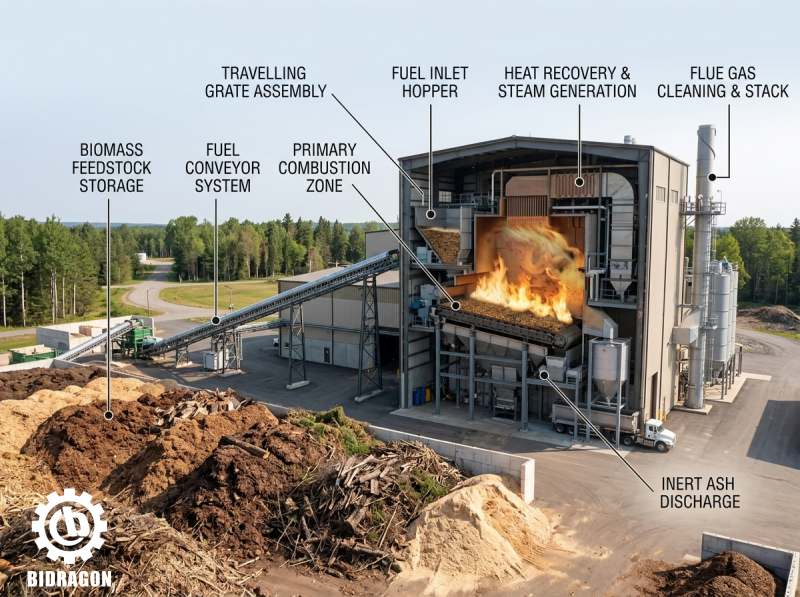
While the grate hardware determines the upper limits of operational capability, operating parameters directly influence combustion stability and burnout efficiency. Equipment selection requires not only choosing the right grate model but also establishing appropriate operating parameters. Improper parameter settings can lead to issues such as unstable combustion, poor burnout, and furnace slagging.
Grate travel speed is a critical control variable, as it directly dictates the fuel's residence time within the furnace. Excessive speed results in incomplete combustion and high carbon content in the ash residue. Conversely, insufficient speed causes fuel accumulation, poor airflow, and delayed combustion, potentially leading to overheating, coking, and furnace blockages.
Biomass fuel undergoes staged combustion on the grate, sequentially proceeding through drying, volatile matter combustion, and char burnout. A steady grate speed helps regulate combustion zones and prevents operational instability. Furthermore, grate operation must be coordinated with primary and secondary airflow; air distribution should be adjusted based on fuel bed thickness and combustion intensity to ensure optimal combustion efficiency.
The core principle of grate selection remains consistent: the grate's structure, type, dimensions, and operating parameters must be highly compatible with the specific fuel characteristics, combustion method, boiler capacity, and year-round operating conditions. Any selection made without regard for actual operating conditions will fail to meet production requirements.
Combustion characteristics vary significantly among different types of biomass fuels; therefore, grate selection must be tailored to the specific fuel category. Wood-based fuels, finely processed/densified fuels, and agricultural wastes each require different grate structures.
Wood-based fuels—such as wood chips and bark—are dense, burn stably, and are unlikely to form slag; they place fewer demands on grate performance, making standard structures suitable. Finely processed fuels like biomass pellets and sawdust burn evenly and rapidly but are prone to falling through grate gaps; consequently, grates with narrow gaps and good sealing properties, combined with uniform air distribution structures, are required. Agricultural wastes—such as straw, rice husks, and palm shells—have low calorific values and high volatile content. They are prone to bridging and generating fly ash during combustion, necessitating grates with superior agitation, pushing, and ash-discharge capabilities.
If the fuel type is consistent and uniform, a specialized grate can be selected. However, if the fuel is mixed, variable, or inconsistent in type, a grate with greater compatibility and adjustability is required.
The moisture content of biomass fuel is a critical factor influencing combustion conditions, yet it is a parameter often overlooked during equipment selection. Fuel with excessive moisture content cannot ignite quickly after entering the furnace. It needs to consume the furnace heat to dry, which directly reduces the overall furnace temperature and prolongs the fuel combustion cycle.
High-moisture fuel requires a longer residence time within the furnace to burn out completely. If the grate moves too quickly, discharging fuel before it has fully dried and burned, the carbon content in the ash will spike, resulting in fuel wastage. To handle fuels with significant moisture fluctuations, the grate must feature a variable-speed drive mechanism that allows the feeding speed to be adjusted based on the fuel's moisture level.
Furthermore, the combustion of high-moisture fuel generates substantial water vapor, which can easily cause localized dampness and the adhesion of ash deposits on the grate. Consequently, grates operating under such conditions require a design that ensures effective ventilation and drying. It is essential to ensure uniform drying and ignition of the fuel bed from top to bottom, preventing localized dampness, clumping, or discontinuities in the combustion layer.
When selecting fuels, it is not enough to design them solely based on standard dry-based fuels. It is necessary to consider the fluctuation range of fuel moisture caused by the rainy season and storage conditions on site, and to reserve sufficient room for adaptability to different operating conditions.
Fuel ash content and ash fusion temperature directly affect the grate's resistance to ash accumulation and slagging, as well as its high-temperature durability. Fuels with high ash content produce significant combustion residue, which can easily cover the grate's ventilation gaps, impairing airflow and degrading combustion performance. Fuels with low ash fusion temperatures produce ash and slag that soften and become sticky during combustion, forming hard clumps on the grate surface. These slag clumps can block air holes, obstruct ash discharge, and cause sustained high-temperature scorching of the grate, accelerating equipment wear and deformation.
When burning fuels with high ash content and low ash fusion temperatures, water-cooled or enhanced air-cooled grates are preferred. These systems stabilize the grate surface temperature, preventing ash and slag from sticking or coking. Additionally, the grate requires effective pushing and agitation capabilities to promptly discharge loose ash and slag, thereby minimizing accumulation and clumping. Conversely, if the fuel has low ash content and a high ash fusion temperature—resulting in loose, non-coking residue—standard air-cooled grates are sufficient for long-term operation.
Fuel particle size, shape uniformity, and bulk density directly influence feeding uniformity and the stability of the fuel bed on the grate; these factors serve as critical criteria for selecting grate gap dimensions, structural design, and mechanical drive systems.
Materials such as fine sawdust and crushed rice husks have low bulk density and offer good air permeability through gaps, but they are prone to leaking through the grate openings. Excessive gap width leads to continuous leakage, resulting in fuel loss and ash accumulation at the furnace bottom. Such fine fuels require grates designed with narrow gaps and a tightly spaced structure.
Larger, irregularly shaped materials—such as wood chunks, coarse bark, and chopped straw—are prone to "bridging" or arching on the grate. Loose fuel packing can cause airflow short-circuiting, leading to localized high temperatures and oxygen-deficient zones. These fuels require grates with robust mechanical pushing and agitation capabilities to break up fuel arches and level the fuel bed.
Operating conditions involving significant fluctuations in particle size or mixtures of large and small materials place higher demands on the grate's overall adaptability. The grate requires gap control to minimize the loss of fines, while also needing stable pushing force to handle large material chunks and prevent uneven combustion.
A boiler's rated capacity determines the fuel consumption rate per unit of time and directly dictates the grate's effective combustion area and maximum thermal load. Higher-tonnage boilers require greater fuel combustion per unit of time; consequently, the effective grate area must be increased proportionally to ensure optimal combustion.
Thermal load—defined as the heat generated by fuel combustion per unit of grate area—is a key reference metric. Small-capacity boilers have lower thermal loads and are suitable for small, compact grates. Large-capacity boilers, characterized by high thermal loads, significant fuel accumulation, and intense combustion, require large-area, high-strength, and high-temperature-resistant grate structures to prevent deformation or damage caused by overloading.
It is important to note that while boiler capacity determines the grate's dimensions, area, and load specifications, it does not dictate the fundamental grate type. Boilers of the same tonnage may require completely different grate types depending on the fuel used; therefore, a grate model cannot be selected based solely on boiler tonnage.
Common grates for biomass boilers fall into four categories: fixed, chain, reciprocating, and vibrating. They can also be classified by cooling method—air-cooled or water-cooled—with each type suited to distinct operating conditions.
Fixed grates feature a simple structure with no moving parts and low maintenance costs, though they require manual feeding and ash removal; they are suitable only for small boilers and intermittent production scenarios. Chain grates operate via continuous, uniform circulation, ensuring even fuel distribution and stable combustion; they are compatible with uniform fuels like wood chips and biomass pellets and are widely used in large- and medium-sized boilers for continuous operation.
Reciprocating grates turn and agitate the fuel bed, preventing fuel bridging; they offer strong compatibility with mixed, irregular, and high-ash fuels, making them suitable for complex industrial operating conditions. Vibrating grates have a simple structure and rely on micro-vibrations to transport fuel and discharge ash; however, they offer poor operational stability and are prone to fine-material leakage, making them suitable only for small- to medium-sized boilers using lightweight fuels.
Air-cooled grates rely on primary air for cooling and offer low energy consumption, making them suitable for standard fuels that are not prone to slagging. Water-cooled grates offer superior high-temperature and deformation resistance, specifically designed to handle harsh combustion conditions characterized by high loads, high ash content, and a tendency for slagging.
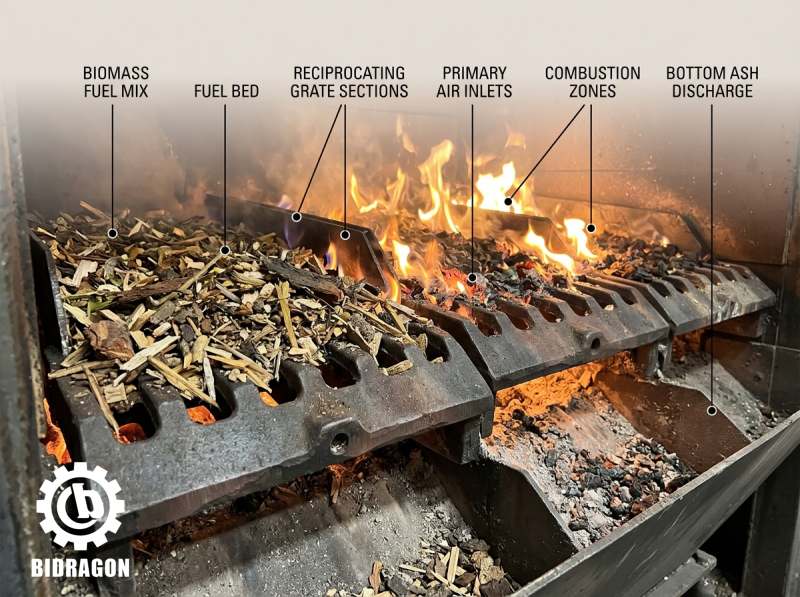
Chain grates and reciprocating grates are the mainstream grate types for biomass boilers, yet they are suited to vastly different operating conditions. Chain grates operate smoothly at a constant speed; the fuel bed remains level without agitation, resulting in distinct combustion zones and stable operating conditions. They are ideal for uniform, single-type fuels and suit continuous, high-volume industrial production. However, this type lacks fuel agitation capabilities, making it prone to issues like bridging and incomplete combustion when using mixed fuels. Additionally, its complex structure and numerous components demand higher standards for installation and routine maintenance.
Reciprocating grates rely on the interlocking movement of grate bars to agitate the fuel, breaking up bridges and leveling the fuel bed. Repeatedly turning the fuel ensures contact with oxygen and high-temperature flue gases, leading to superior burnout rates. They are well-suited for irregular, high-ash, and slag-prone mixed fuels—such as bark, straw, and waste materials—offering excellent ash discharge and anti-clogging performance. The only drawback is that fuel agitation causes slight flame fluctuations, making combustion stability marginally lower than that of chain grates. Selection can be based on a simple rule: choose chain grates for stable, uniform fuels, and reciprocating grates for complex, variable, or mixed materials.
Combustion performance is never determined by a single piece of equipment; it requires seamless coordination with the entire fuel feeding system. Many instances of combustion instability stem not from an incorrect choice of grate, but from a mismatch between the feeding/distribution process and the grate's operating rhythm.
The hopper, feeder, and fuel distribution device are responsible for delivering fuel evenly onto the grate surface. If the feeding system causes skewed distribution, localized piling, or uneven flow, problems will arise—even if the grate design is perfectly suited to the fuel. These issues include localized fuel beds that are too thick (leading to oxygen-starved combustion) or too thin (causing burnout gaps and air leakage), ultimately resulting in furnace temperature imbalances and reduced burnout rates.
The grate's operating speed must be precisely matched to the fuel feeding rate. Excessive feeding combined with slow grate speeds leads to fuel accumulation, obstructing airflow and delaying combustion. Conversely, insufficient feeding combined with high grate speeds results in a fuel bed that is too thin; this causes inadequate furnace temperatures and ignition difficulties, while also exacerbating air leakage issues. Under normal operating conditions, it is essential to ensure a uniform fuel bed thickness across the entire grate area and a continuous, stable fuel feed. During the equipment selection and commissioning phases, the compatibility of the feeding system's conveying capacity and distribution range with the grate area and operating parameters must be verified to ensure the coordinated operation of the entire combustion system.
Biomass fuel combustion generates large volumes of ash with complex properties; consequently, slagging and poor ash discharge are frequent causes of boiler failure. The grate's structural design, movement mechanism, and cooling performance directly determine the equipment's ability to prevent slagging and ensure effective ash discharge.
An appropriate grate movement rhythm enables the steady pushing and automatic discharge of ash and slag. Reciprocating grates agitate the fuel, breaking up minor slag formations and preventing the ash from caking or accumulating. In contrast, fixed grates lack agitation capabilities, making them prone to ash retention and coking, which necessitates frequent manual cleaning.
High surface temperatures on the grate are a primary cause of slagging. When burning fuels with low ash-fusion temperatures, high heat causes the ash to soften and adhere to surfaces. Water-cooled or enhanced air-cooled grates stabilize the temperature of the grate material, thereby addressing the root causes of slagging and adhesion issues.
During daily operation, the thickness of the fuel bed must be carefully controlled. If the fuel bed is too thick, poor ventilation at the bottom leads to localized high temperatures and slag accumulation. Conversely, if the bed is too thin, the grate is directly exposed to high-temperature flue gases, accelerating wear. Combining this with uniform primary air distribution ensures smooth ventilation and prevents slag accumulation over the long term.
First, identify the core grate type—specifically, whether it is a fixed, chain, reciprocating, or vibrating grate. Confirm the cooling method (air-cooled or water-cooled) to ensure compatibility with the slagging characteristics of the specific fuel used. Next, verify the effective combustion area of the grate to ensure it matches the boiler's rated load and specific fuel consumption, thereby preventing thermal overload.
The material of the grate directly determines its resistance to high temperatures, wear, and deformation. Confirm the base material grade and heat treatment process to ensure suitability for long-term, continuous high-temperature operation. Additionally, check the grate's drive mechanism and speed adjustment range to determine if the operating speed can be flexibly adjusted based on fuel moisture content and fluctuations in calorific value.
Grate gap size is a critical parameter that is easily overlooked; it must be determined based on fuel particle size to balance the risk of fuel leakage against ventilation efficiency. Furthermore, clarify the design fuel parameters—including fuel type, moisture content, ash content, and particle size range—to assess their alignment with actual on-site fuel conditions.
Finally, confirm the ash discharge method, the permissible range of fuel fluctuations, and the standard fuel bed thickness for normal operation. All parameters must be comprehensively verified against on-site fuel analysis data, long-term operating loads, and potential fluctuations in operating conditions, rather than relying solely on the manufacturer's standard specifications.
Selecting a grate for a biomass boiler is a systematic matching process centered on fuel characteristics and operational conditions; it is by no means a simple matter of selecting a model based solely on boiler tonnage. Fuel type, moisture content, ash content, particle size, and fluctuation range are the core factors determining the grate type. Boiler capacity and operating load serve only to determine the grate dimensions, thermal load, and operational parameters. Proper grate selection is a crucial step that cannot be overlooked when selecting industrial biomass boiler equipment.