
While 320℃ is a relatively high industrial operating temperature, achieving it does not necessarily require a high-pressure system. Unlike steam boilers that rely on pressurized steam for heat transfer, thermal oil heaters use liquid thermal oil as the heat transfer medium, operating entirely without the phase-change process of steam generation.
The key to achieving high temperatures at low pressures lies in the physicochemical properties of the thermal oil itself, the design of the closed-loop circulation system, and the rational configuration of the entire setup. We will now explain the system's operating logic by examining the principles of temperature and pressure, and by breaking down the circulation process, pressure control, safety design, and key selection criteria.
At atmospheric pressure, the boiling point of water is 100℃. To obtain saturated steam at higher temperatures, the operating pressure within the system must be increased; temperature and pressure are directly correlated.
According to saturated steam tables, the pressure corresponding to saturated steam at 320℃ is approximately 13.58 MPa (gauge pressure of about 134.7 bar), representing a typical high-pressure operating condition. This is the fundamental reason why high-temperature steam systems require high-pressure vessels, thick-walled piping, and strict pressure-bearing regulations.
The key characteristic of thermal oil is its ability to remain in a liquid state at temperatures far exceeding the boiling point of water.
Heat is transferred through the flow of high-temperature liquid oil; the process does not require the medium to vaporize, and consequently, there is no need to maintain high pressure to generate high-temperature steam. When operating at the same temperature of 320℃, the pressure levels of a thermal oil system and a steam boiler are on completely different orders of magnitude.
The boiling range of thermal oil is far higher than that of water, with different grades of oil corresponding to different maximum operating temperatures. According to the national standard GB/T 23971, L-QC grade thermal oil has a maximum permissible operating temperature of 320℃, while synthetic oils can withstand even higher temperatures.
At an operating temperature of 320℃, qualified thermal oil remains in a liquid state, transporting heat via its own sensible heat without undergoing the violent phase change seen when water turns into steam. This is the physical basis that allows the entire system to operate at low pressure.
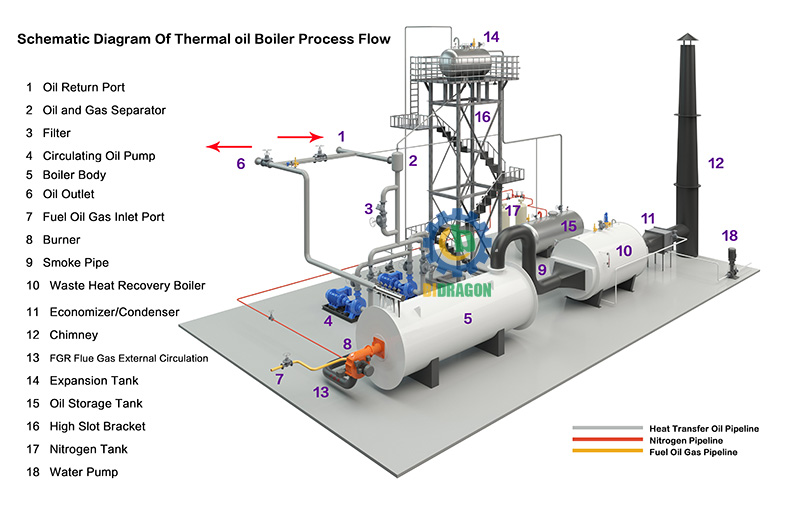
The thermal oil heating system operates as a closed-loop circuit; the basic flow path is: heater unit → circulation pump → heat-consuming process equipment → return oil piping → heater unit.
Heating surfaces within the heater transfer heat to the thermal oil, while the circulation pump provides the motive force to keep the hot oil flowing continuously. Upon reaching the heat-consuming equipment, the hot oil releases its heat; the cooled oil then returns to the heater via the return line for reheating, creating a continuous cycle of heat supply.
Raising the oil temperature to 320℃ is not difficult; the challenge lies in maintaining this temperature range stably over the long term.
The system collects real-time data via temperature sensors at the oil outlet and inlet and automatically adjusts heating power by regulating the burner's fuel supply. Additionally, the system is equipped with over-temperature alarms and safety interlocks; if the oil temperature exceeds the set threshold, the system automatically reduces the load or cuts off the fuel supply to prevent a thermal runaway.
High temperature does not necessarily equate to high pressure; pressure generation depends on phase changes in the medium.
The high pressure in steam boilers arises from the continuous boiling and vaporization of water, where large volumes of steam are trapped within the vessel. In contrast, in a liquid-phase thermal oil system, the medium remains liquid throughout the process. There is no large-scale vaporization or steam generation, so the system naturally does not generate the high pressures associated with steam. The pressure within a thermal oil system primarily stems from the circulation pump's head, frictional resistance along the piping, and thermal expansion resulting from rising oil temperatures. Standard industrial liquid-phase thermal oil heaters operating at 320℃ typically run at pressures between 0.3 and 1.0 MPa—levels far lower than those of steam systems operating at the same temperature.
It is important to clarify that a thermal oil heater is not a zero-pressure system; rather, it is a high-temperature, relatively low-pressure heat transfer system. "Low pressure" does not imply an absence of pressure-related risks; it simply means the pressure rating is significantly lower than that of a steam boiler operating at the same temperature.

Thermal expansion of thermal oil: Thermal oil expands significantly when heated; its volume can increase by over 10% when rising from ambient temperature to 320℃. If the system lacks sufficient expansion space, the rise in oil temperature will cause a rapid increase in pressure.
Therefore, system design must account for the total volume of the oil and the expansion volume at operating temperatures, ensuring adequate buffer space is reserved.
Expansion tank: The expansion tank is the core component for controlling thermal expansion pressure, serving to accommodate the excess volume generated as the oil heats up. In accordance with regulatory standards, the expansion tank's working volume should be at least 1.3 times the system's total expansion volume.
It also stabilizes system pressure and buffers pressure fluctuations, preventing thermal expansion forces from acting directly on furnace tubes and process piping, thereby mitigating the risk of overpressure.
Pressure protection: In addition to the expansion tank, the system is equipped with pressure gauges for real-time monitoring and safety valves that act as a final safeguard for overpressure relief. Combined with appropriate pipe sizing and layout to keep circulation resistance within reasonable limits, the system's pressure can be maintained stably within the design range.
For a compliant 320℃ thermal oil heater, safety design extends beyond pressure control to encompass multiple dimensions, including circulation, temperature, and the state of the heat transfer medium.
Core safety components include: thermal oil circulation pumps, flow monitoring devices, multi-point temperature sensors, over-temperature protection interlocks, burner interlock shutdown mechanisms, expansion tank liquid level and temperature monitoring, pressure monitoring instruments, and emergency shutdown systems.
The safety of a 320℃ thermal oil heater relies not primarily on pressure-bearing capacity, but on ensuring continuous, stable circulation and controllable temperatures, as well as a system design suited to high-temperature operating conditions. Pressure is merely one of the parameters monitored.
Many mistakenly assume that low pressure equates to low risk; in reality, high-temperature thermal oil systems have their own specific failure triggers—most of which are unrelated to pressure yet can still lead to serious problems.
Insufficient circulation flow: Inadequate flow results in low oil velocity within the furnace tubes, causing the oil in the boundary layer to remain in contact with the high-temperature tube walls for extended periods. This leads to localized overheating and excessive oil film temperatures. Over time, this causes thermal cracking and coking of the oil, potentially even burning out the furnace tubes.
Incorrect heat transfer oil selection: If an oil with a maximum allowable temperature of 300℃ is used and the system is forced to operate at 320℃, the oil will rapidly undergo thermal degradation, producing residual carbon and gum that deposit on the pipe walls, reducing heat transfer efficiency and clogging the pipes.
Improper expansion system design: Insufficient expansion tank volume or poor piping layout causes system pressure to fluctuate significantly with temperature changes. In severe cases, this leads to oil overflow and cavitation, drastically compromising the operational stability of the entire system.
Inadequate installation or maintenance: Poor sealing during installation allows air to enter the system, accelerating oil oxidation and aging. A lack of routine maintenance can lead to issues such as pump failure, valve sticking, and oil leaks; leaks involving high-temperature oil pose a significant fire risk.
No. Operation at 320℃ is a capability of the entire system, not just the heater itself.
First, one must consider the parameters of the thermal oil: maximum allowable operating temperature, maximum film temperature, and long-term thermal stability. These determine whether the medium can withstand 320℃ operating conditions.
Second, the heater's design is critical: the arrangement of heating surfaces, heat flux density on tube walls, oil velocity within the tubes, the head and flow rate of the circulation pump, and the precision and response speed of the control system. If any of these factors are mismatched, long-term, stable operation at 320℃ cannot be achieved.
320℃ should be viewed as a design specification for the complete system, rather than merely a temperature rating on the heater's nameplate. Relying solely on the heater's nominal temperature while ignoring the oil properties and system configuration can easily lead to a short service life and frequent malfunctions.
|
Comparison Dimension |
Thermal Oil Heater |
Steam Boiler |
|
Heat Transfer Medium |
Liquid thermal oil |
Water / saturated steam |
|
Operating Conditions at 320℃ |
Achievable with appropriate grade of thermal oil and system design |
Requires saturated steam at approx. 13.58 MPa (high pressure) |
|
Phase Change |
None — liquid-phase heat transfer throughout |
Yes — continuous water vaporization to generate steam |
|
Operating Pressure |
Relatively low, typically 0.3–1.0 MPa |
High pressure, above 10 MPa |
|
Temperature Control |
Stable and precise; directly adjusts oil temperature |
Tightly coupled with pressure; temperature control = pressure control |
|
Water Treatment Requirements |
Thermal oil circuit does not require water treatment |
Requires strict feedwater and boiler water treatment |
|
Suitability for High-Temperature Processes |
Highly adaptable, suitable for uniform high-temperature heating |
Suitable for specific processes; high-temperature operation comes with high pressure-related costs |
In which scenarios is thermal oil heating most suitable?
Thermal oil heating offers distinct advantages for processes requiring stable high temperatures and high temperature uniformity. Common applications include textile printing and dyeing, chemical reaction vessels, food processing, edible oil refining, asphalt heating, wood hot-pressing, pharmaceutical production, and industrial drying.
Select the appropriate grade of thermal oil; do not attempt to operate at high temperatures using oil intended for lower temperatures. Regularly monitor the oil's acid value, carbon residue, and viscosity, and replace the oil promptly if it degrades or exceeds specified limits.
Ensure sufficient circulation flow; do not arbitrarily throttle valves or reduce pump speed, as low flow velocities within the heater tubes can lead to localized overheating. Monitor outlet and return oil temperatures daily, and investigate immediately if the temperature difference increases abnormally.
Regularly check the expansion tank's liquid level and temperature, ensure the expansion line remains unobstructed, and do not install valves on the expansion line. Manage heating and cooling gradually to avoid thermal shock to the system caused by rapid temperature fluctuations.
Conduct regular inspections of pumps, valves, flanges, and piping, addressing any leaks promptly. Periodically vent the system to prevent air accumulation, which accelerates oil oxidation.
First, determine the actual operating temperature required by the process; common high-temperature settings include 200℃, 250℃, 280℃, 300℃, and 320℃. Higher temperatures are not necessarily better; selecting a unit that closely matches actual needs ensures optimal cost-effectiveness and service life.
Calculate the required heating capacity based on the process heat load (common units include kW, kcal/h, and MW). Include a reasonable safety margin when selecting the unit, but avoid excessive margins, as these can increase energy consumption and lead to temperature control fluctuations.
Focus on four key parameters: maximum allowable operating temperature, maximum film temperature, thermal stability grade, and recommended long-term operating temperature range. For operating conditions at 320℃, it is recommended to select heat transfer fluids of grade L-QC or higher; synthetic fluids generally offer superior long-term stability compared to mineral-based ones.
Select the fuel based on available on-site energy sources; common options include natural gas, diesel, biomass, coal, and electric heating. Heating furnace designs, operating costs, and environmental compliance requirements vary significantly depending on the fuel used.
Verify that the flow rate and head of the circulation pump match the system resistance, and ensure the expansion tank volume complies with specifications. Also, check that safety features such as temperature control accuracy, flow protection, over-temperature interlock, and pressure protection are fully implemented. Do not omit safety components to reduce costs.
The reason thermal oil heaters can achieve high temperatures of around 320℃ is that the thermal oil remains in a liquid state at these temperatures, transferring heat through liquid-phase circulation; unlike steam boilers, they do not require pressure elevation to generate high-temperature steam.
Low operating pressure does not equate to an absence of risk; the safe operation of a 320℃ system still relies on the proper selection of thermal oil, continuous and stable circulation, effective expansion control, precise temperature monitoring, and the compliant design, operation, and maintenance of the entire system.
Frequently Asked Questions
Q: Can a thermal oil heater really reach 320℃?
A: Yes. Provided the appropriate grade of thermal oil is selected and the heater and circulation system are designed for 320℃ operation, the system can stably reach and maintain this temperature for long periods.
Q: Does the thermal oil heater require high pressure to operate at 320℃?
A: No, high pressure is not required. When operating at 320℃, the pressure in a liquid-phase thermal oil system is typically between 0.3 and 1.0 MPa—falling within the low-to-medium pressure range—which is far lower than that of a steam boiler operating at the same temperature.
Q: Is a 320℃ thermal oil heating system safe?
A: It is safe, provided the equipment is correctly selected, designed according to standards, and properly operated and maintained. The primary risks involve leakage of high-temperature oil or localized overheating leading to coking, rather than high-pressure explosions; consequently, safety management focuses on different areas compared to steam boilers.
Q: What type of thermal oil is suitable for 320℃?
A: According to national standards, L-QC grade thermal oil has a maximum operating temperature of 320℃, and certain synthetic thermal oils can operate stably at this temperature for extended periods. Specific selection depends on whether the system is open or closed.
Q: Why does thermal oil expand when heated?
A: This is due to the thermal expansion and contraction properties of liquids; as the temperature rises, the spacing between molecules increases, causing the volume to expand. Thermal oil has a higher coefficient of volumetric expansion than water, resulting in significant expansion at 320℃, so an expansion tank is required to accommodate the volume change.
Q: What happens if thermal oil circulation stops suddenly?
A: If circulation stops, the oil inside the heater tubes ceases to flow and continues to be heated, leading to rapid overheating. This can quickly cause oil cracking and coking; in severe cases, it may burn out the heater tubes or even trigger a fire. Therefore, systems are equipped with flow interlocks that automatically shut down the heater if the flow rate is insufficient.
Q: Which is better for high-temperature heating: a thermal oil heater or a steam boiler?
A: If the process requires stable high temperatures exceeding 250℃ and demands high temperature uniformity, a thermal oil heater offers distinct advantages. Its low-pressure characteristics also reduce costs and regulatory requirements associated with pressure-bearing equipment. If the process itself requires steam or involves numerous steam-consuming points, a steam boiler is the more suitable choice.