
Industrial plants often spend a large share of their energy budget producing steam and process heat. At the same time, a considerable amount of thermal energy leaves the plant through exhaust gases.
The U.S. Department of Energy estimates that 20% to 50% of industrial energy input can be lost as waste heat, including heat carried away by hot exhaust gases, cooling water, hot equipment surfaces, and products.
A waste heat recovery boiler provides a practical way to recover part of this energy. Instead of allowing hot process gas to leave directly through the stack, the gas passes through heat-transfer surfaces and generates steam or preheats boiler feedwater.
For plants with a suitable waste heat source, this can reduce the amount of fuel required by the existing steam system. In some projects, the resulting energy-cost reduction can approach 40%, although this should never be treated as a guaranteed saving. Actual performance depends heavily on exhaust-gas temperature, flow rate, operating hours, steam demand, and the existing boiler system.
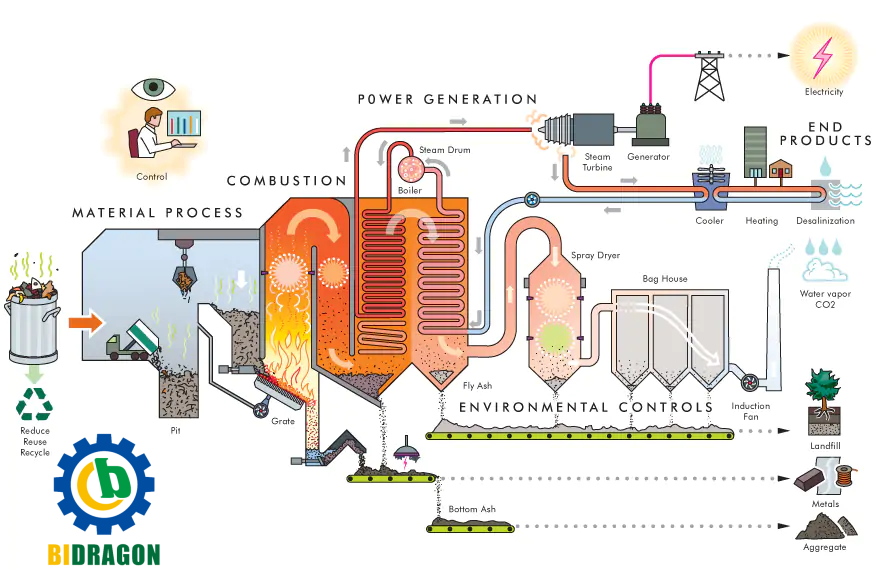
A Waste Heat Recovery Boiler (WHRB) is a boiler that uses heat from a hot process gas or exhaust stream instead of relying primarily on a separate fuel burner.
The basic process is straightforward. Hot exhaust gas enters the boiler and flows across heat-transfer surfaces containing water or steam. Heat moves from the gas into the boiler water, producing steam that can then be supplied to the plant's process steam network.
The U.S. Department of Energy describes waste heat boilers as water-tube boilers that use medium- to high-temperature exhaust gases to generate steam. Depending on the application, the recovered steam can be used for process heating or power generation. Auxiliary firing can also be added when the available waste heat alone is not enough to meet the required steam output.
This is an important distinction from a conventional steam boiler.
A conventional boiler burns natural gas, oil, coal, biomass, or another fuel to create heat. A WHRB primarily uses heat that has already been generated by another industrial process.
That means the value of a WHRB does not come from producing heat more cheaply through combustion. Its value comes from avoiding the need to generate some of that heat again.
The economic logic is easier to understand when you look at where the energy goes.
Imagine a factory operating a furnace continuously. The furnace needs fuel to maintain its process temperature, and its exhaust gas may still contain a large amount of usable thermal energy when it leaves the furnace.
Without heat recovery, that energy is discharged to the atmosphere.
With a WHRB, part of that heat is transferred to water and converted into steam. The plant can then obtain part of its steam requirement without burning the same amount of additional fuel in a conventional boiler.
Waste heat is not a single type of energy source. Its usefulness depends on temperature, flow rate, gas composition, and how continuously it is available.
For example, a high-temperature furnace exhaust stream can contain considerably more useful thermal energy than a small, intermittent low-temperature exhaust stream.
The DOE estimates that industrial facilities lose 20%–50% of their energy input as waste heat, which illustrates why heat recovery deserves attention during plant energy assessments.
The important question is therefore not simply:
“Does my factory have hot exhaust gas?”
A better question is:
“How much recoverable heat is available, at what temperature and flow rate, and can my plant use it?”
Suppose a plant normally produces all of its process steam with a natural-gas-fired boiler.
If a WHRB can provide part of that steam using recovered process heat, the conventional boiler no longer needs to supply the full steam load.
The gas consumption falls accordingly.
The actual saving depends on how much steam the WHRB can generate and how much of that steam can be used by the process. A plant with continuous high-temperature exhaust and a steady steam demand is generally a much better candidate than a facility where the waste heat source operates only occasionally.
It is useful to distinguish between boiler efficiency and overall plant energy efficiency.
A WHRB does not necessarily make the upstream furnace itself more efficient. Instead, it allows the plant to extract additional useful energy from heat that would otherwise leave the process.
This is why waste heat recovery is often evaluated as part of the entire plant energy balance rather than as an isolated boiler upgrade.
The DOE identifies waste heat recovery as an important industrial efficiency opportunity because recovering these losses can reduce energy demand and operating costs.

It can in the right application, but 40% should be treated as an upper-end project target rather than a standard WHRB performance guarantee.
This distinction matters.
A waste heat boiler manufacturer cannot determine the expected fuel saving simply from the boiler's rated capacity. The available waste heat has to be measured first.
Several factors have a direct influence on the result:
The DOE notes that waste heat characteristics such as temperature, flow rate, and contaminants need to be evaluated before developing a recovery project.
The basic recoverable heat relationship can be expressed as:
Q = m × Cp × ΔT
Where:
In a real WHRB project, the calculation is more complicated than this simple equation. Engineers also need to consider heat-transfer efficiency, pressure drop, gas-side fouling, boiler-water conditions, steam pressure, and the minimum practical exhaust temperature.
Once the recoverable heat is estimated, it can be converted into an expected steam generation rate.
The fuel saving can then be estimated from the amount of conventional boiler steam production that the recovered steam replaces.
This is why a serious WHRB quotation should be based on actual process data, rather than simply offering a boiler based on a customer's desired steam capacity.
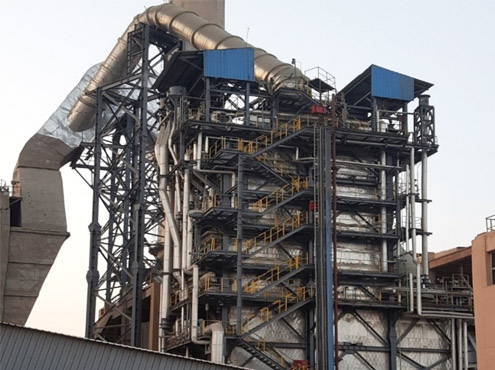
Waste heat recovery boilers are most attractive where a process produces a relatively large and stable stream of hot gas.
The technology is used across several energy-intensive industries, although the exact boiler design varies considerably from one application to another.
Cement production is a good example because clinker production involves high-temperature process heating.
Kiln and preheater exhaust gases can provide a potential heat source for steam generation or other forms of energy recovery.
The correct design depends on gas temperature, flow rate, dust loading, and the characteristics of the process gas. High dust concentrations are particularly important because ash accumulation can reduce heat-transfer performance and increase maintenance requirements.
Steel and metallurgical processes can generate high-temperature exhaust gases from furnaces and other thermal equipment.
Rather than allowing all of this heat to leave through the exhaust system, part of it can be transferred to water or steam.
The choice between steam generation, feedwater heating, combustion-air preheating, and other recovery methods depends on how the plant uses thermal energy.
For example, the U.S. DOE documents industrial heat-recovery applications where very high-temperature furnace exhaust is used to reduce energy requirements elsewhere in the process.
Chemical and petrochemical facilities often operate furnaces and other continuous process equipment that release hot exhaust gases.
A WHRB can recover this heat for process steam generation.
Because chemical gases may contain corrosive or reactive components, gas composition becomes particularly important when selecting tube materials, heat-transfer surfaces, and the allowable gas outlet temperature.
Gas turbine and engine exhaust can also be used as a heat source for steam generation.
This is one reason heat recovery steam generators are commonly associated with combined heat and power systems. The upstream equipment produces electricity while the exhaust heat is recovered for useful thermal energy.
The DOE describes combined heat and power as sequentially producing electricity and then using the resulting waste heat for steam or hot-water applications.
A WHRB should be designed around the waste heat source, not simply around the customer's desired boiler capacity.
Two factories may both request a 10-ton-per-hour steam boiler, for example, but their WHRB designs could be completely different if one has clean turbine exhaust while the other has dusty furnace gas.
The engineering process normally starts with several basic operating parameters:
The exhaust-gas outlet temperature deserves particular attention.
Cooling the gas too much can increase heat recovery, but it may also create condensation and corrosion problems depending on the gas composition. On the other hand, leaving the gas too hot means some recoverable energy is still being discharged.
The design therefore needs to balance heat recovery, equipment reliability, pressure drop, and operating conditions.
A typical WHRB may contain an economizer, evaporator/boiler heating surfaces, steam drum, and, when required, a superheater.
An economizer uses recovered heat to raise feedwater temperature before the water enters the main evaporation section.
The evaporator transfers heat into the water and generates steam, while the steam drum separates steam from water in drum-type designs.
A superheater can be added when the process requires superheated steam rather than saturated steam.
Gas-side cleaning equipment may also be required when the exhaust contains significant dust or ash.
The DOE notes that material limitations and maintenance requirements are among the factors that can restrict wider adoption of waste heat recovery systems.
A WHRB and a conventional boiler solve different parts of the plant's energy problem.
|
Factor |
Waste Heat Recovery Boiler |
Conventional Fuel-Fired Boiler |
|
Main heat source |
Process waste heat |
Fuel combustion |
|
Additional fuel |
Little or none in a pure WHRB |
Required |
|
Steam generation |
Depends on available waste heat |
Controlled by fuel input |
|
Operating cost |
Potentially lower |
Closely linked to fuel price |
|
Heat-source stability |
Depends on upstream process |
Independently controllable |
|
Best suited for |
Plants with usable waste heat |
Plants without sufficient waste heat |
A WHRB does not always replace a conventional boiler.
In many industrial plants, the more practical arrangement is to use both.
The WHRB supplies as much steam as the available waste heat can support, while the conventional boiler handles peak demand, startup conditions, or periods when the process producing waste heat is shut down.
This arrangement can also make the steam system easier to operate because the plant does not become completely dependent on the waste heat source.
For plants where the waste heat is insufficient to meet the required steam output, an auxiliary burner or afterburner can also be incorporated. The DOE's industrial waste heat recovery assessment specifically identifies auxiliary firing as an option when waste heat alone cannot provide the desired steam production.
There is no useful universal price for a waste heat recovery boiler.
A small unit handling clean exhaust gas from an engine is very different from a large boiler handling high-temperature, dust-laden furnace gas.
The main factors affecting project cost include:
Material selection can have a particularly large impact on the final quotation when the exhaust gas is corrosive or contains high concentrations of dust.
A cheaper heat-transfer surface is not necessarily the better choice if it results in rapid fouling, corrosion, or frequent shutdowns.
A simple preliminary calculation is:
Payback Period = Total Project Investment ÷ Annual Energy Cost Savings
For example, if a WHRB project costs $1 million and the calculated annual fuel saving is $250,000, the simple payback period would be approximately 4 years.
This is only a screening calculation. A proper project evaluation should also consider maintenance, downtime, auxiliary electricity consumption, financing, and changes in fuel prices.
The California Energy Commission makes the same general point in its evaluation of an industrial boiler heat-recovery technology: expected savings and payback depend on equipment configuration, installation requirements, and operating conditions.
The most important step is to collect reliable operating data before selecting the boiler.
A manufacturer should normally request the following information:
Measure the temperature under normal operating conditions rather than relying only on the maximum design temperature.
Flow rate determines how much thermal energy is actually available. A very hot gas stream with a small flow rate may contain less recoverable energy than a moderately hot stream with a much larger flow.
CO₂, O₂, water vapor, SOx, NOx, chlorides, and other components can affect material selection and the allowable outlet temperature.
This is particularly important for cement, biomass, metallurgy, and other processes that generate particulate-laden exhaust.
The WHRB needs to match the actual process steam requirement. Steam pressure affects the required heat-transfer conditions and equipment design.
A waste heat source that operates 8,000 hours per year has a very different economic value from one that operates only 2,000 hours.
This provides a useful baseline for estimating how much conventional fuel the WHRB could replace.
Available space, gas-duct arrangement, chimney position, steam pipeline location, and maintenance access all influence the final configuration.
Once these parameters are available, the manufacturer can calculate the expected heat recovery, steam production, pressure drop, equipment dimensions, and estimated fuel savings.
That is a much more reliable way to select a waste heat recovery boiler than choosing a model from a standard capacity table.
A waste heat recovery boiler makes sense when a plant is already producing a useful quantity of hot exhaust gas and has a demand for steam or other thermal energy.
The basic idea is simple: recover heat that has already been paid for instead of generating the same heat again with additional fuel.
The opportunity can be substantial. The U.S. Department of Energy estimates that 20%–50% of industrial energy input may be lost as waste heat, although the amount that can actually be recovered depends on the specific process.
A claim such as “reduce energy bills by up to 40%” should therefore be understood as a potential project outcome, not a standard performance figure for every WHRB installation.
For a preliminary assessment, the most useful information is the waste-gas temperature, gas flow rate, gas composition, dust content, required steam capacity, steam pressure, operating hours, and current fuel consumption.
With these figures, a waste heat recovery boiler manufacturer can estimate how much heat is recoverable, how much steam can be produced, and whether the expected fuel savings justify the investment.