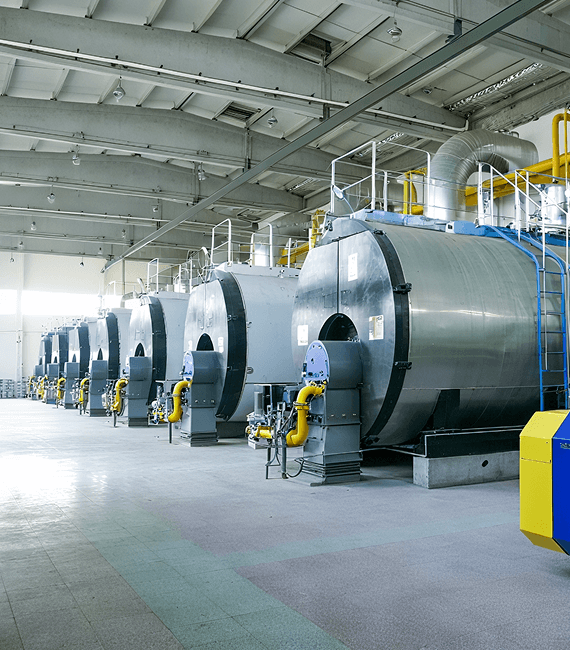

Incomplete combustion in biomass boilers simply means that the fuel is not fully burned. Some combustibles are discharged with the slag and flue gas, which is a common operational problem in industrial boilers. This is a common operational issue in industrial boilers that directly reduces thermal efficiency and increases fuel costs. Furthermore, it leads to excessive exhaust emissions, unstable boiler operating conditions, accelerated equipment wear, and a higher likelihood of breakdowns requiring repair.
Such issues are easily identified during routine operation. Typical indicators include black smoke from the chimney, elevated carbon monoxide (CO) levels in the flue gas, and unburnt carbon particles mixed into the slag. Additionally, a dim, flickering flame within the furnace and an unstable combustion state serve as clear visual signs of incomplete combustion.
Black smoke and excessive carbon monoxide levels are the two most typical indicators of incomplete combustion. When the load spikes suddenly, air supply is insufficient, or the fuel is excessively moist, the fuel fails to burn completely, resulting in the production of soot and large amounts of carbon monoxide. Slag containing black carbon particles indicates that the fuel has not burned through, directly leading to fuel waste. Poor combustion also significantly reduces boiler efficiency.
Excessive moisture content in the fuel is the primary cause of incomplete combustion in small and medium-sized biomass boilers, as well as an issue frequently overlooked on-site. Many enterprises store biomass fuel outdoors; moisture infiltration causes the fuel's water content to far exceed acceptable limits. When high-moisture fuel enters the furnace, it does not ignite immediately. A significant amount of heat within the furnace is first consumed to evaporate the moisture inside the fuel. This process continuously depletes the furnace's stored heat, directly causing the furnace temperature to drop rapidly.
Biomass fuel combustion relies on the initial release and burning of volatiles, followed by the combustion of fixed carbon. If the furnace temperature is insufficient, the released volatiles cannot ignite quickly and instead accumulate within the furnace. Ultimately, this results in smoldering and the emission of black smoke, making it impossible to establish stable combustion conditions.
Based on industrial operational experience, the moisture content of biomass fuel should be kept below 12% to ensure optimal boiler combustion. Once the moisture content exceeds 20%, combustion efficiency plummets drastically, and incomplete combustion becomes almost inevitable.
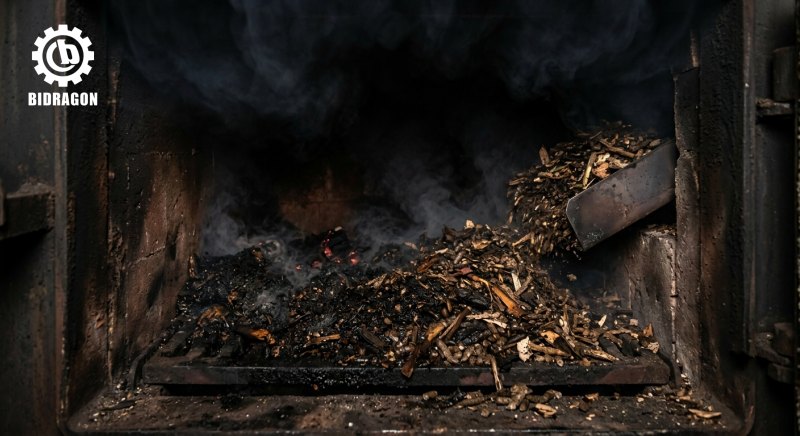
Air distribution is a critical factor in biomass combustion. Excessive or insufficient airflow, or an imbalance in the air-fuel ratio, will directly disrupt the combustion balance. Primary and secondary air serve distinct functions and play completely different roles.
The primary function of primary air is to penetrate the fuel bed from beneath the grate, supplying oxygen for the combustion of the fuel at the bottom layer. It also serves to suspend fine fuel particles, preventing them from settling directly and forming clinkers. If the primary airflow is too low, the fuel bed suffers from severe oxygen deficiency, causing the fuel to merely smolder. Conversely, if the primary airflow is too high, it strips heat from the furnace, lowers the furnace temperature, and carries unburnt fine fuel particles into the flue.
Secondary air is introduced into the upper section of the furnace, primarily to supply the oxygen needed for combustion in the upper zone. As volatile matter rises within the furnace, secondary air is required to ensure complete combustion. Insufficient secondary air prevents the complete burning of volatile matter, leading to the formation of significant amounts of carbon monoxide and soot. Excessive secondary air introduces a large volume of cold air, thereby lowering the overall furnace temperature.
In most cases where combustion irregularities occur, the issue is not a lack of total airflow but rather an improper ratio between primary and secondary air. If the air-to-fuel balance is incorrect, incomplete combustion will persist even if the total airflow meets requirements.
Temperature is a fundamental condition for sustaining combustion. Both the ignition and complete combustion of biomass fuel require specific temperature thresholds. If the furnace temperature fails to meet the required standard, proper combustion cannot be achieved, regardless of how well the air supply and fuel are managed.
In a high-temperature environment, volatiles released from the fuel ignite instantly, and fixed carbon reacts rapidly with oxygen. Conversely, when the furnace temperature is low, the rate of oxidation reactions slows significantly. The fuel undergoes only incomplete oxidation, leading to a sharp spike in CO levels within the flue gas. Low-temperature combustion also promotes fuel caking (slagging), which further hinders subsequent combustion.
There are many reasons for low furnace temperatures. Common causes in industrial settings include the continuous feeding of wet fuel, excessive air supply, prolonged boiler operation at low loads, and significant air leakage into the furnace. Often, when a boiler repeatedly emits black smoke or exceeds CO limits, the root cause is not the fuel or airflow itself, but the failure of the furnace temperature to reach the levels required for proper combustion.
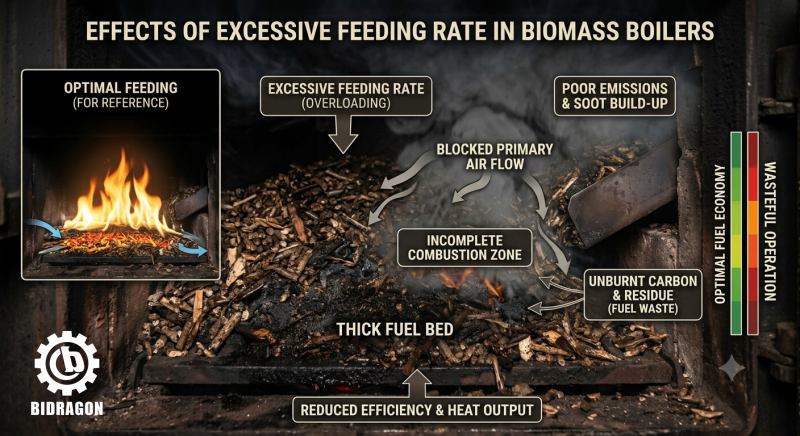
The feeding rate directly determines the thickness of the fuel bed within the furnace and is a critical operational parameter affecting combustion efficiency. To increase boiler load, many operators mistakenly accelerate the feeding rate, often with counterproductive results.
If the feeding rate is too high, fuel accumulates rapidly on the grate, resulting in an excessively thick fuel bed. Primary air struggles to penetrate this thick layer, leaving the fuel in the bottom and middle sections oxygen-starved. Without sufficient contact between oxygen and fuel, the combustion reaction cannot proceed to completion.
Meanwhile, as the grate moves at a fixed speed, excessive fuel accumulation reduces the residence time available for combustion. Consequently, large quantities of fuel are discharged from the furnace by the grate before combustion is complete. The ultimate result is black ash with high carbon content, significant fuel waste, and a failure to achieve the required boiler output.
Unlike coal, which typically has a uniform particle size, biomass fuels often consist of a mixture of materials such as sawdust, straw, pellets, and wood chips. Such variations in particle size significantly affect combustion stability.
Large fuel particles have a large volume and heat up slowly. Upon entering the furnace, their outer layers burn rapidly, but the interior remains isolated from oxygen and high temperatures, often resulting in a phenomenon where the exterior burns while the core merely smolders. This ultimately leads to the formation of hollow char fragments that are discharged along with the slag. Fine, powdery fuel behaves differently; being lightweight and fast-burning, these particles are easily carried away by the flue gas and discharged from the furnace before they can fully combust.
Inconsistent fuel particle sizes lead to highly uneven combustion within the furnace. Areas with thin fuel layers experience excessively rapid combustion, while areas with thick layers suffer from smoldering. This imbalance in combustion conditions throughout the furnace inevitably causes a continuous decline in thermal efficiency. Using fuel with uniform particle size specifications ensures consistent combustion rates and oxygen demand, serving as the foundation for stable combustion.
Faults within the equipment itself are often latent issues in long-running boilers and represent a frequently overlooked cause of combustion irregularities. Abnormal grate operation and furnace air leakage are the most common issues in this category.
Abnormal grate speed directly disrupts the combustion rhythm. If the grate moves too fast, fuel residence time is insufficient, resulting in incomplete combustion before discharge. Conversely, if the grate moves too slowly, fuel accumulates excessively, leading to oxygen-starved smoldering. Long-term operation can also lead to grate binding or localized blockages, causing uneven air distribution—resulting in areas with no airflow alongside others with excessive airflow.
Blockages in air ducts, as well as the accumulation of ash and fuel, disrupt primary air distribution and lead to uneven combustion across the fuel bed. Air leakage through the furnace, flue, or access doors poses an even greater risk. The continuous ingress of cold external air significantly lowers the furnace temperature and dilutes oxygen concentration. Even with adjustments to airflow and fuel feeding, maintaining stable combustion conditions becomes difficult, ultimately resulting in persistent incomplete combustion.
Are you losing massive amounts of fuel and driving up factory emissions due to incomplete combustion in your biomass boiler?
Stop letting unburned profits go up in black smoke.
Contact our boiler engineering experts today.

Fuel moisture content directly determines the ignition rate and combustion stability. When dry biomass fuel enters the furnace, it rapidly releases volatiles upon heating and ignites quickly, resulting in a continuous and stable combustion process.
In contrast, fuel with high moisture content initially absorbs heat to evaporate the water rather than igniting quickly. This significantly delays the ignition process and compresses the active combustion zone within the furnace. Once the moisture has evaporated, insufficient time remains for the remaining fuel to burn, making complete combustion impossible.
High-moisture fuel also severely compromises flame stability. Boiler load fluctuates, the flame intensity varies, and flameout frequently occurs. Such frequent operational instability not only reduces combustion efficiency but also increases safety risks during boiler operation.
To avoid these issues, effective fuel storage management is crucial. Fuel storage yards should be equipped with rain shelters and moisture-proof flooring to prevent exposure to rain. Before feeding the fuel into the furnace, wet fuel can be air-dried or blended with dry fuel to ensure the moisture content meets standards and to prevent the bulk feeding of excessively wet material.
The key to the air-to-fuel ratio is ensuring a sufficient and appropriate supply of oxygen throughout the combustion process. Imbalanced fuel composition can be divided into two main types: oxygen deficiency and excess air. Both types of imbalances can disrupt combustion.
Insufficient airflow leads to oxygen-deficient combustion. When the oxygen level in the furnace cannot meet the requirements for burning all the fuel, the fuel undergoes incomplete oxidation. The immediate consequences are the production of black smoke, a spike in CO concentrations, and the loss of significant combustible material through flue gas and slag. Many mistakenly believe that higher airflow improves combustion, but this is not the case. Excess air introduces large volumes of cold ambient air, continuously extracting heat from the furnace and lowering the temperature. In a low-temperature environment, fuel cannot burn completely, even if oxygen is abundant. Furthermore, excess air increases the volume of flue gas and heat loss through the exhaust, thereby reducing the boiler's thermal efficiency.
In industrial practice, there is no need to adhere to a rigid, fixed ratio; instead, adjustments based on real-time monitoring data are recommended. For a properly operating biomass boiler, maintaining an oxygen content of 6% to 9% at the furnace outlet is ideal. Operators can fine-tune the airflow by monitoring oxygen and CO levels in real time; this approach is more precise and better suited to actual on-site operating conditions than relying on fixed ratio parameters.
A consistently low furnace temperature is usually the result of multiple compounding factors. Excessively wet fuel is the most common cause. When large quantities of high-moisture fuel are fed into the furnace, the continuous heat absorption required for moisture evaporation rapidly lowers the overall furnace temperature—a low-temperature state that is difficult to reverse quickly.
Excessive airflow is another major trigger. If primary and secondary airflow rates exceed optimal levels, large volumes of cold air enter the furnace and continuously carry away the heat generated by combustion. When the rate of heat generation within the furnace falls below the rate of heat loss, the temperature inevitably drops.
Rapid fluctuations in boiler load can also cause temperature instability. When production demands spike and operators suddenly increase fuel and airflow, the combustion conditions within the furnace cannot adjust quickly enough, leading to a temporary drop in temperature. Frequent start-stop cycles and prolonged operation at low loads also prevent the furnace from maintaining a stable, high temperature.
Air leakage and heat loss due to ash accumulation are common issues in boilers during long-term operation. Air leakage in the furnace and flue introduces cold air, while ash buildup on heating surfaces reduces heat transfer efficiency; this leads to a continuous decline in the furnace's heat storage capacity, ultimately manifesting as low furnace temperatures and sluggish combustion.
The feeding rate determines the thickness of the fuel bed, while the grate speed dictates the duration of fuel combustion; these two parameters must be properly matched to establish optimal combustion conditions. A mismatch directly impairs combustion performance.
If the feeding rate is too high, fuel accumulates on the grate, creating an excessively thick bed. Primary air cannot penetrate the bed, causing the fuel inside to smolder due to oxygen deprivation. As fuel layers stack up, the surface layer burns out while the bottom layer remains unburnt, ultimately resulting in large amounts of unburnt carbon being discharged with the slag. Furthermore, a thick fuel bed increases combustion resistance, leading to abnormal furnace pressure and reduced flame stability.
If the feeding rate is too low, the fuel bed becomes too thin. Insufficient heat storage in the furnace makes it difficult to maintain the temperature, often leading to flameout or an inability to meet load demands. Fine fuel particles burn out rapidly, causing intermittent combustion zones and highly unstable boiler operation.
Under normal operating conditions, the grate speed must be adjusted in tandem with the feeding rate. When increasing the feed rate to boost the load, the grate speed should be moderately increased to prevent fuel accumulation. Conversely, during low-load operation, both the feeding rate and grate speed should be reduced to ensure sufficient residence time for the fuel to burn out completely before discharge.
Carbon monoxide is a primary product of incomplete fuel combustion. Any scenario involving excessive CO emissions stems from four key factors: oxygen deficiency, low temperature, poor mixing, and insufficient residence time.
Insufficient oxygen is the primary cause. Inadequate air supply, an excessively thick fuel bed, or localized airflow dead zones in the furnace can all force the fuel into a state of oxygen-starved combustion. Consequently, carbon cannot fully convert into carbon dioxide, resulting instead in the generation of large amounts of carbon monoxide.
Low furnace temperatures inhibit complete oxidation reactions. Even with ample oxygen present, the combustion reaction remains incomplete if the temperature fails to reach the necessary reaction threshold. In low-temperature environments, significant quantities of intermediate combustion products cannot undergo further oxidation and are ultimately emitted as CO.
Poor mixing of air and fuel also leads to excessive CO emissions. An irrational air distribution layout or improper air velocity can create zones of localized oxygen excess or deficiency. This prevents adequate contact between fuel and air, leaving portions of the fuel in a state of incomplete combustion.
Insufficient fuel residence time is a factor easily overlooked. If the grate speed is too high or the effective combustion space in the furnace is inadequate, fuel passes rapidly through the combustion zone. This leaves insufficient time for initial ignition and final burnout, allowing incompletely reacted flue gas to enter the flue directly, thereby driving up CO emissions.
To address incomplete combustion and enhance operational efficiency, there is no need for complex modifications; instead, focus on routine maintenance and fine-tuning. Several key practical methods are essential.
Controlling fuel quality is the foundation. Ideally, the moisture content of fuel entering the furnace should be kept below 12%, and storage areas must be protected against moisture and rain. Avoid feeding high-moisture fuel in bulk; instead, blend it with dry fuel to balance moisture levels. Additionally, ensure uniform fuel particle size to prevent uneven combustion. Properly adjust the ratio of primary to secondary air. The air volume is finely adjusted according to the boiler load and flue gas oxygen content. The primary air ensures that the material layer is breathable and does not smolder or produce ash, while the secondary air replenishes the oxygen in the upper part to ensure that the combustibles are fully burned and avoids insufficient or excessive air supply. Stabilize the furnace temperature. Reduce prolonged low-load operation, promptly seal any air leaks in the furnace and flue, and minimize heat loss. When burning wet materials, appropriately slow down the feeding rate, stabilize the furnace temperature first, and then increase the load. Match the fuel feeding rate with the grate speed. Control the feed quantity as needed to prevent excessive fuel accumulation, and adjust the grate speed to ensure sufficient time for complete combustion, preventing unburnt fuel from being discharged.
Regularly inspect equipment status. Promptly clear ash accumulations and blockages from the grate and air ducts, and repair faulty grate components to ensure uniform air distribution and smooth combustion. Maintain routine monitoring of operating conditions. Regularly check flue gas oxygen and CO levels as well as the carbon content in the slag; make proactive, incremental adjustments to operating parameters to determine the optimal operating mode for the specific fuel used at the plant.
Incomplete combustion in biomass boilers is never the result of a single fault. Ensuring the long-term, stable operation of these boilers relies primarily on meticulous daily operation. Success hinges on mastering three core elements: controlling fuel quality, optimizing the air-to-fuel ratio, and maintaining a stable furnace temperature. Maintain regular monitoring and equipment maintenance. Fine-tune operating conditions based on operational data and proactively identify potential problems. This will effectively prevent common issues such as fuel waste and ensure the boiler always maintains optimal combustion.