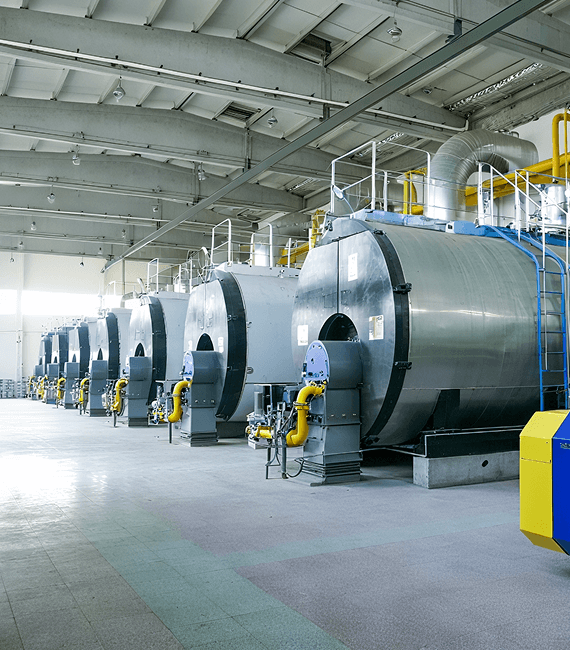

The water quality requirements for industrial boilers are extremely stringent, crucial for ensuring safe, efficient, and economical boiler operation and extending their service life. Poor water quality can lead to a series of serious problems such as boiler scaling, corrosion, and tube rupture. Water pretreatment is a process measure taken to meet these requirements.
The main reference standards for industrial boiler water quality specify that specific requirements vary depending on the boiler’s pressure level, structural design, whether a superheater is included, and the intended application of the steam. The core control indicators include:
Hazards: The primary cause of boiler scaling (mainly calcium carbonate and calcium sulfate). Scale has poor thermal conductivity (only 1/30 to 1/50 that of steel), leading to deteriorated heat transfer on heating surfaces, reduced boiler efficiency, and fuel waste (1mm of scale can cause approximately 8% fuel waste). In severe cases, it can cause metal overheating, bulging, and tube rupture.
Requirements: Very low, typically close to zero. The standard specifies boiler water hardness primarily to prevent residual hardness from forming scale inside the boiler. In practice, control relies mainly on feedwater softening/desalination pretreatment. For example, for boilers with a rated operating pressure ≤ 1.0 MPa, the total feedwater hardness requirement is ≤ 0.030 mmol/L; higher-pressure boilers have even stricter requirements or a requirement of zero.
Functions and Hazards: Appropriate alkalinity (OH⁻, CO₃²⁻) can form a protective film on metal surfaces, inhibiting corrosion (especially acidic corrosion) and helping to prevent scale formation (forming loose sludge from hardness components, facilitating blowdown removal). However, excessive alkalinity can lead to:
Californical embrittlement: Stress corrosion cracking occurring under high stress and high concentrations of NaOH, which is extremely dangerous.
Steam-water eutrophication: Boiler water foaming, drastic water level fluctuations, and steam carrying large amounts of saline solution, contaminating steam quality and damaging superheaters and steam-using equipment.
Requirements: Alkalinity needs to be controlled within a suitable range. Standards specify upper and lower limits for boiler water alkalinity for different pressures and boiler types (e.g., 6-26 mmol/L or 10-26 mmol/L, depending on pressure and boiler type). Feedwater alkalinity usually also has an upper limit requirement (e.g., ≤ 2.0 mmol/L).
Function: Directly reflects the acidity or alkalinity of water and is a key indicator for corrosion control. Too low a pH (acidic) will accelerate hydrogen depolarization corrosion and acid corrosion; too high a pH (excessively alkaline) may also promote corrosion (e.g., caustic embrittlement) or affect steam quality.
Requirements: Feedwater pH is generally required to be > 7 (slightly alkaline), typically within the range of 8.5-10.5. Boiler water pH requirements are higher, typically within the range of 10-12. Specific values are clearly defined in standards.
Hazards: High salt content leads to excessively high boiler water concentration, easily causing steam-water bubbling, increasing the salt carried by the steam, and contaminating steam quality. It is also an important indicator for measuring the degree of boiler water concentration.
Requirements: Primarily managed by controlling the dissolved solids (TDS) or chloride ion (Cl⁻) content (indirectly reflecting salt content) or conductivity of the boiler water. Standards specify strict upper limits (e.g., ranging from 2000 mg/L to 5000 mg/L, with stricter requirements at higher pressures) based on different boiler pressures and the presence or absence of superheaters. Continuous blowdown is used to control the boiler water concentration within the standard range. Lower feedwater salt content is better, usually achieved through pretreatment.
The goal of pretreatment is to treat raw water (tap water, groundwater, surface water) into softened water or demineralized water that meets the above-mentioned boiler feedwater quality requirements. Typically, this is a combined process:
Multi-media filtration: Utilizes filter media of different particle sizes, such as quartz sand and anthracite, to remove residual suspended particles and flocs from the water through mechanical retention.
Activated carbon filtration: Adsorbs and removes organic matter, residual chlorine, color, and odor from the water. Protecting subsequent ion exchange resins or membrane elements from oxidation and fouling is crucial.
Sodium ion exchange softening: The most common and economical method. It uses sodium-type cation exchange resin (NaR) to exchange Ca²⁺ and Mg²⁺ in the water, releasing Na⁺. The treated water has very low hardness (can be reduced to below 0.03 mmol/L), but the salt content (Na⁺) increases, while alkalinity remains unchanged.
After the resin becomes ineffective, it is regenerated with concentrated brine (NaCl solution) (displacing the Ca²⁺ and Mg²⁺ on the resin and converting it back to the Na form).
Reverse osmosis: Uses high pressure to force water molecules through a semi-permeable membrane, while most salts, organic matter, microorganisms, colloids, etc., are retained. It is currently the mainstream pre-desalination technology, capable of removing 90-99% of ions, organic matter, silicon, microorganisms, etc. It requires good pretreatment to protect the membrane elements. The permeate still needs further fine treatment (such as mixed bed).
Ion exchange desalination
Mixed bed system: Cation bed (H-type resin) + decarbonator (removes CO₂) + anion bed (OH-type resin). The cation bed removes cations to produce acid, the decarbonator removes CO₂, and the anion bed removes anions to produce OH⁻, which combines with H⁺ to form water. The effluent purity is relatively high.
Mixed Bed: Cation and anion exchange resins are uniformly mixed within a single exchanger. As water flows through, the cation and anion exchange reactions occur simultaneously, equivalent to numerous stages of multi-bed exchange. This results in the highest effluent purity (conductivity below 0.1 μS/cm) and is commonly used for fine treatment after reverse osmosis or multi-bed exchange. Regeneration requires separating the two resins, regenerating them separately with acid and alkali, and then mixing them thoroughly.
Electrodeionization: Ion exchange resins are filled between the membranes of an electrodialysis unit. Under a direct current electric field, ion migration removal and continuous resin electroregeneration are achieved. High-purity water can be continuously produced without the need for acid or alkali regeneration chemicals, but the investment is higher. It is typically used for fine treatment after reverse osmosis.
Chemical Dosing (In-Boiler Treatment): After pre-treated feedwater enters the boiler, additional chemical dosing is usually required.Scale Inhibitor: Used to further prevent residual hardness scaling and to promote the conversion of existing scale into loose sludge that is discharged with blowdown.
Corrosion Inhibitor: Used to inhibit corrosion of metals inside the boiler.
pH Adjuster: Used to maintain boiler water pH within the acceptable range.
Choosing a suitable water treatment solution and managing it effectively is a key investment for ensuring the safe, efficient, and long-lasting operation of the boiler.