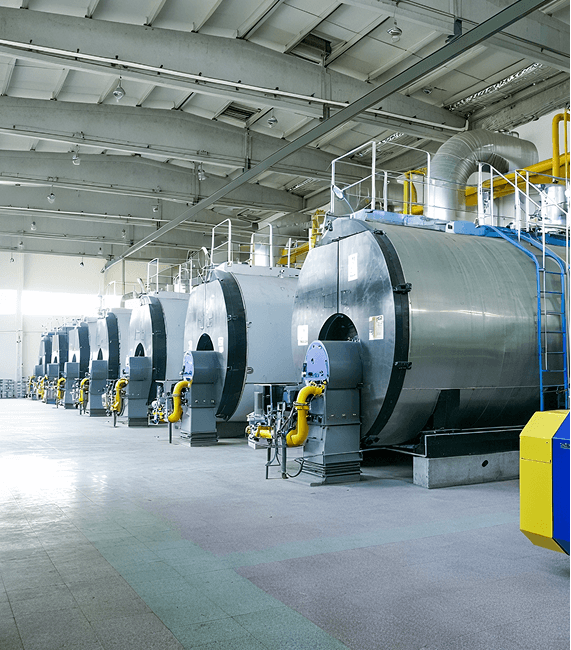

Stable power supply is the basis for the smooth operation of the thermal oil heater.Once the power is off, the circulating oil pump stops quickly, but the heat retained by the furnace and the furnace wall will not dissipate immediately.The risk of this window period caused by thermal inertia is very high. Incorrect disposal will cause the thermal oil to crack and coking, clog the furnace pipe, and damage the seal.The operation of the first few minutes of the power outage determined whether it was only a short fluctuation or a major equipment failure that took a long time.
The moment the power supply is interrupted, the control system directly loses power, the safety shut-off valve of the gas and fuel furnaces will automatically close, and the heating circuit of the electric heating furnaces will trip synchronously.However, turning off the fire does not mean that the heat disappears. The refractory materials of the furnace and the wall of the furnace pipe will retain a lot of waste heat, and the heat will continue to be transmitted to the furnace pipe for the next ten minutes.
After the circulating oil pump stops, the thermal oil no longer flows.During normal operation, the flow rate in the tube is maintained at 1 meter to 2 meters per second, and the temperature difference between the oil film and the main oil is stably controlled at 20 to 50 degrees Celsius.After the oil flow is stationary, the temperature difference between the pipe wall and the oil film will increase rapidly, and the local oil temperature will be significantly higher than the value displayed by the instrument.
The upper limit of the temperature of the mineral thermal oil film is mostly 350 degrees Celsius, and the cracking rate is nearly doubled for every 10 degrees Celsius increase in temperature.After the membrane temperature breaks through the limit, the oil product deteriorates rapidly, and when the instrument panel reads out abnormalities, the pipe wall often has thin coke.The poor thermal conductivity of the focal layer will continue to amplify the risk of overheating in subsequent operations, forming a vicious circle that is difficult to reverse.
This is the part of the entire emergency process that most requires operators to make judgments and actions at the moment of power failure.There is only one principle: first cut off the heat source, then try to keep the circulation, and finally talk about recovery.The order of these three steps cannot be reversed. Any step of rushing will turn a controllable shutdown into an equipment accident.
After a power failure occurs, the operator first confirms whether the burner relies on a safety shut-off valve to complete the flameout.The fuel-fired furnace needs to manually close the shut-off valve of the fuel pipeline, and the gas-fired furnace must also check the manual shut-off valve of the supervisor. The electric heating furnace must pull down the main circuit breaker of the heating element on the spot, and cannot only rely on the control cabinet to stop the button.
Many control systems come with automatic restart logic, and the burner will ignite on its own after power is restored in a short time.Once the thermal oil in the furnace tube has been overheated due to the interruption of circulation, re-ignition will continue to add heat to the wall of the tube, and the risk will increase sharply.The operator should cut the start switch of the heating system to the stop position, and mark the forbidden start in the control cabinet, and reset is not allowed until all inspections are completed.
This manual confirmation process takes a short time, but it can avoid the hidden dangers caused by automatic reburning.In some scenarios, in order to improve the convenience of automation, the power failure self-starting scheme is adopted, and it is placed on equipment such as thermal oil furnaces with strong thermal inertia, which is a very uneconomical trade-off between convenience and safety.
Check the operating status of the circulating oil pump as soon as possible after the power failure.If the site is equipped with an emergency generator, the operator must switch the oil pump to the emergency busbar within 30 seconds to one minute in accordance with the plan.This window period is very critical. The waste heat of the furnace is released with the highest intensity in the first two minutes. If this period is missed, the initial coke layer can easily be generated on the wall of the furnace tube.
Emergency generators generally only carry circulating oil pumps, control units and fuel pumps, and do not connect to the rest of the workshop load.This is a very realistic trade-off. Driving the full production load will increase the unit specifications exponentially, and the investment and subsequent maintenance burden will increase significantly. The only thing that really urgently needs to continue to take away the heat from the furnace tube is the circulating oil pump.The power of the supporting oil pumps for medium-sized thermal oil furnaces is mostly 15 to 45 kilowatts, and the input of the supporting units can be controlled a lot.
If there is no backup power supply, do not open the bypass valve or force the disc pump without authorization.The flow rate of the natural circulation is far from meeting the operating requirements. Blindly adjusting the valve can cause abnormal pressure and even oil leakage. The safe way is to maintain the original state of the system, wait for the power supply to be restored, and continuously record temperature changes.
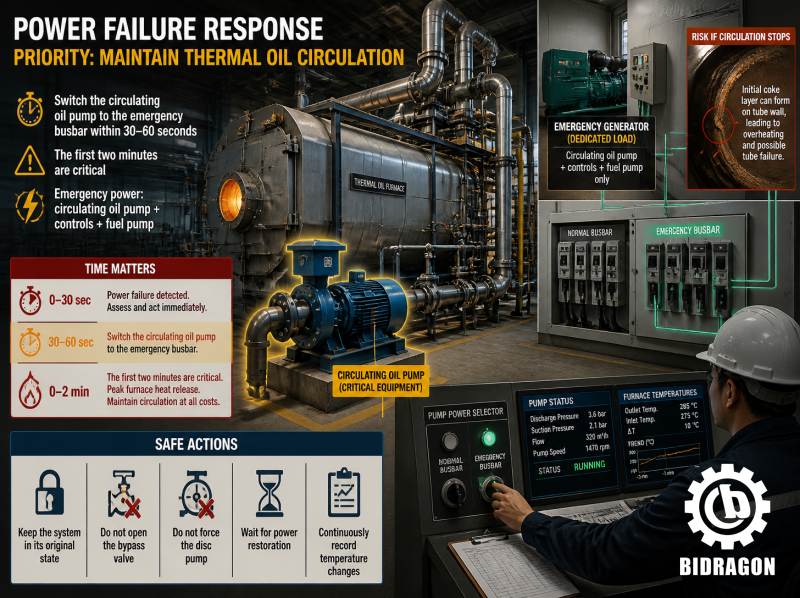
After the power failure, as long as the instrument relies on UPS or backup batteries to maintain its work, the operator must write down the inlet and outlet oil temperature, system pressure and expansion tank level at the moment of the power failure.These records are an important basis for subsequent judgment on whether the furnace tube has local overheating.Once the UPS fails, it relies on on-site pointer pressure gauges and glass thermometers to complete manual readings.
Pay attention to abnormal signals during duty.There is an intermittent muffled sound or liquid strike sound from the furnace tube, which means that the local thermal oil is close to boiling and the steam pressure is rising.The smell of burnt paste or smoke coming out of the expansion tank indicates that the oil has been overheated and decomposed.In this kind of situation, the access port cannot be opened, nor can the pressure be relieved manually, and the system must be kept closed and waiting for cooling.
Pressure changes also have reference value.The slow increase in pressure is mostly due to the thermal expansion of oil products, which is a normal phenomenon.The pressure soared in a short period of time and the safety valve took off, which means that the local oil vaporization and the risk of coking have increased significantly. After the power supply is restored, personnel need to be arranged to check the pressure difference of the furnace pipe.
The length of waste heat release in the furnace changes with the heat storage capacity of the furnace body.A medium-sized fuel-fired thermal oil furnace with a full load can reduce the furnace temperature from more than 800 degrees Celsius to 400 degrees Celsius within five minutes, but the furnace tube continues to transfer heat to the internal oil.Once the circulation stops, the heat has nowhere to transfer, and the stationary thermal oil can only be continuously heated.
According to a rough estimate of heat, the heat accumulated in the metal of the furnace tube of this kind of furnace is enough to raise the oil in the tube by 20 to 40 degrees Celsius as a whole.The real danger is the oil film close to the pipe wall. The local temperature rise can exceed hundreds of degrees Celsius. It is difficult for the main oil temperature read by the instrument to reflect this. Even if the reading is normal, the pipe wall may quietly form a coke layer.
If you want to restart the heating, you can't just stare at the import and export oil temperature. You have to wait until the export oil temperature drops below 150 degrees Celsius, and the temperature curve will stabilize and no longer rise.It often takes 30 to 60 minutes to wait in summer, and it takes less time in winter. Hasty ignition is the cause of many accidents in thermal oil furnaces.
After the power supply is restored, it cannot be directly cut into production.The operator first checks the quality of the power supply, confirms that the voltage is stable, and checks whether the relays and fuses in the control cabinet have failed under the impact of power failure.Then manually start the circulating oil pump, keep an eye on the current, outlet pressure and flow rate, and ensure that the readings meet the range given by the equipment manufacturer.Once the oil pump makes an abnormal noise or the pressure beats violently, it must stop immediately. This is probably because the falling coke block is stuck in the impeller or valve position.
After the oil flow is stable, the burner is ignited, and the heating rate is gradually increased at a low load, and the heating rate is maintained at 30 to 50 degrees Celsius per hour, reducing the thermal shock of the furnace tube and the back-end equipment.The temperature difference between the outlet temperature and the furnace tube pressure is continuously tracked during the heating stage. If the pressure difference exceeds 10% of the normal reference, it is necessary to be vigilant about the coking compression flow channel.Slowly heating up will take one to two more hours, but it can prevent a large amount of scorch from falling off and causing clogging.This kind of clogging and fault cleaning often takes half a day to a day, and it also has to bear the cost of oil filtration. This waiting period is well worth it.
Worried about sudden power failures disrupting your production and damaging your thermal oil heating system?
Bidragon offers reliable industrial thermal oil heater solutions to help ensure safer operation and stable heat supply.
Contact us today to discuss your heating needs!

The circulating oil pump is not only to transport the thermal oil to the thermal equipment, but also to maintain the inner wall of the furnace tube to be continuously washed by the oil film with a stable flow rate.Under normal operating conditions, the temperature of the pipe wall will be 20 to 40 degrees Celsius higher than that of the main body of the oil flow, relying on the flow to maintain the balance of heat transfer.Once the oil flow stops, the oil film will no longer be renewed, the heat transfer resistance will rise rapidly, and the wall temperature will rise rapidly.
When running stably, the heat absorbed by the furnace tube will be taken away by the flowing oil in time.After the power failure, the heat source disappears, but the heat accumulated in the metal of the furnace tube still needs to be released.As long as the circulation is restored, the heat storage can be taken away by the cold oil, and the oil temperature rises for a short time and then slowly falls back.The oil flow stagnates for a long time, and the heat can only continue to heat a limited amount of oil, pushing the temperature all the way, and eventually causing coking or cracking of the oil.
Therefore, most of the emergency plans give priority to protecting this pump.A 30-kilowatt oil pump with a supporting generator can protect the entire expensive furnace body and pipe network. In the industrial protection scheme, this investment can be exchanged for a high return.
Overheating of thermal oil is the first risk.Once the allowable membrane temperature is broken, the light components evaporate, the heavy components continue to condense, and the acid value and residual carbon quickly rise.The stable operation of mineral thermal oil can support five to eight years. A single severe overheating can compress the service life to one or two years. The oil will thicken and the heat transfer capacity will decline. Replacement also has to bear the time and labor costs caused by waste oil disposal, pipeline cleaning, and dehydration of cooking oil.
This is followed by coking and carbon deposition on the inner wall of the furnace tube.The thermal conductivity of the coke layer is much weaker than that of steel, which will continue to raise the wall temperature, causing the furnace tube to bulge or even burn through in severe cases, and the maintenance cycle will be extended to several weeks, and the entire production line will be shut down.Partial oil vaporization will also increase the pressure of the system, which is likely to cause seal leakage, and the leaked thermal oil can easily catch fire when it comes into contact with the high-temperature surface.The inrush current at the moment of power restoration will also damage the pump body and electrical components, and restarting directly without completing the inspection will superimpose multiple risks.
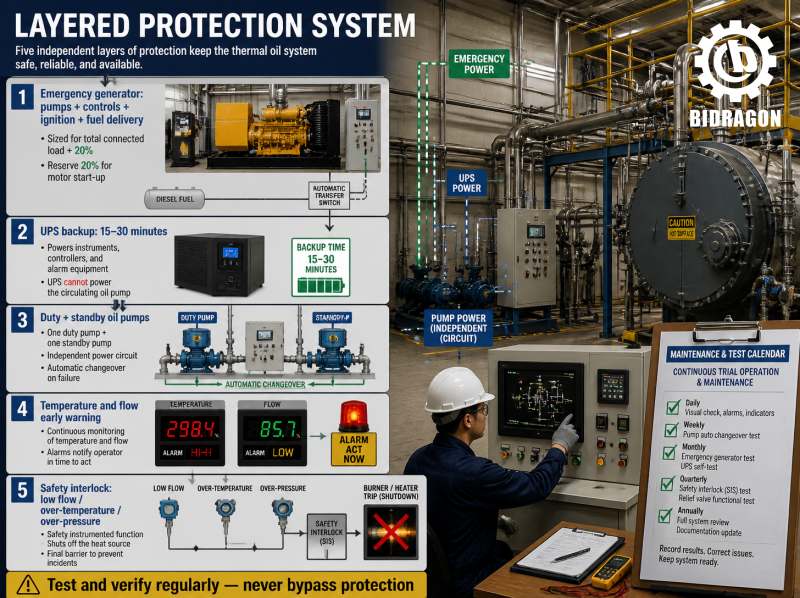
Emergency generators are the most direct means of protection. The selection capacity needs to cover circulating oil pumps, control systems, ignition components, and necessary fuel delivery pumps, and an additional 20% margin is reserved to deal with the impact of motor start-up.Diesel generators adapted to medium-sized thermal oil furnaces must also be equipped with fuel tanks and automatic switches, and trial operation and maintenance must be continuously arranged.Most of this set of equipment has been idle for a long time, and there is not much chance of being activated in one year, but the losses incurred once the protection fails are enough to cover its investment and operation and maintenance expenses for ten years.
UPS is used to maintain the operation of instruments, controllers, and alarm equipment. The backup time is controlled at 15 to 30 minutes, leaving a buffer for the generator to start, and it is unable to carry the circulating oil pump.A one-use and one-standby backup oil pump can reduce the risk of single-point failure, connect to an independent power supply circuit with automatic switching, and the protection effect will be further improved.
The temperature and flow monitoring device builds an early warning system, and the hardware cost is not high. The key is to ensure that the alarm can be delivered to the personnel on duty in a timely manner.The safety interlock serves as the final barrier, which can cut off the heat source during low flow, over temperature or overpressure.Occasionally the interlocking is triggered incorrectly, which will cause unplanned downtime, but it is still worth comparing the consequences of damage to the furnace tube. At the same time, we must adhere to regular verification to avoid long-term bypass of this set of protection by staff.
Worried about unexpected power failures damaging your thermal oil heating system?
Bidragon provides reliable industrial thermal oil heater solutions designed to support safe, stable, and efficient operation.
Contact us today to find the right heating solution for your industrial needs.
Itemized verification before restarting cannot be simplified.First verify the power supply, confirm that the voltage falls in the range of plus or minus 10% of the rated value, and at the same time check the control cabinet for burnt smell or tripping devices.Then check the mechanical part, turn the circulating oil pump to confirm that it is running smoothly, check the valve opening, and check the flange position for any traces of oil seepage.
Then check the process parameters.The liquid level of the expansion tank must be in the normal range, and a low liquid level means that there is oil leakage or vaporization during the power failure stage.The pressure of the cold state system needs to match the design index. If the temperature of the furnace tube is significantly higher than the ambient temperature, it means that the waste heat has not been dissipated and must continue to wait for cooling.
The burner should check the ignition electrode, flame detection components and fuel valve set in accordance with the manufacturer's list.The electric heating furnace needs to measure the insulation resistance of the heating element, and moisture will bury the hidden dangers of grounding.Finally, it was confirmed that the root cause of the power outage had been eliminated.To confirm the stability of the external power supply due to fluctuations in the power grid, the repair test must be completed for electrical faults in the factory.Starting when the hidden dangers have not been cleared, it is easy to stop again, and the damage to the furnace tube caused by the second overheating is often much greater than the first time.
The investment in prevention is much lower than that in post-accident repair.Regular inspections of the electrical system include the temperature of the cable connector, the wear of the contactor contacts, and the heat dissipation of the inverter. These inspections are done every quarter, which can detect many sudden power outages before they become accidents.The mechanical maintenance of the circulating oil pump includes bearing lubrication, seal inspection and calibration inspection, which directly affects whether the pump can be successfully started in an emergency.
The emergency power supply should be tested regularly.The generator is tested at no-load once a month and tested at load every six months to confirm that it can be started within the specified time and the power supply is stable under the real load.UPS batteries should be replaced according to the cycle recommended by the manufacturer. The life of lead-acid batteries is generally three to five years, and the backup time will be significantly shortened after the period is exceeded.The root cause of many accidents is not that there is no generator, but that the generator is equipped but the battery is found to have failed when it is needed.
Written operating procedures and personnel training are equally critical.The emergency process for power outages should be written as an operation card that can be posted next to the control cabinet, rather than a thick manual locked in the file cabinet.The operator does a power failure drill at least once every six months, so that the hands can do the right actions even in a state of tension.The quality of the thermal oil should be sampled and tested on a periodic basis. The changes in acid value, residual carbon and kinematic viscosity can reflect the aging rate of the oil in advance, and it also indirectly reflects whether there is already a tendency to coking inside the furnace tube.
When a thermal oil furnace experiences a sudden power failure, the entire emergency response process must follow a clear sequence. First, shut off the heat source to prevent residual furnace heat from continuously heating stagnant thermal oil. Then, make every effort to maintain oil circulation and use emergency equipment to remove accumulated heat from the heating tubes. Continue monitoring temperature and pressure to determine whether overheating has occurred. Once power is restored, gradually restart the system according to the cold-start procedure rather than rushing to resume full production capacity.
Investing in appropriate emergency protection in advance is an effective way to prevent costly accidents and minimize operational risks. Bidragon is committed to providing reliable industrial thermal oil heating solutions, helping businesses improve system safety, operational stability, and emergency preparedness.