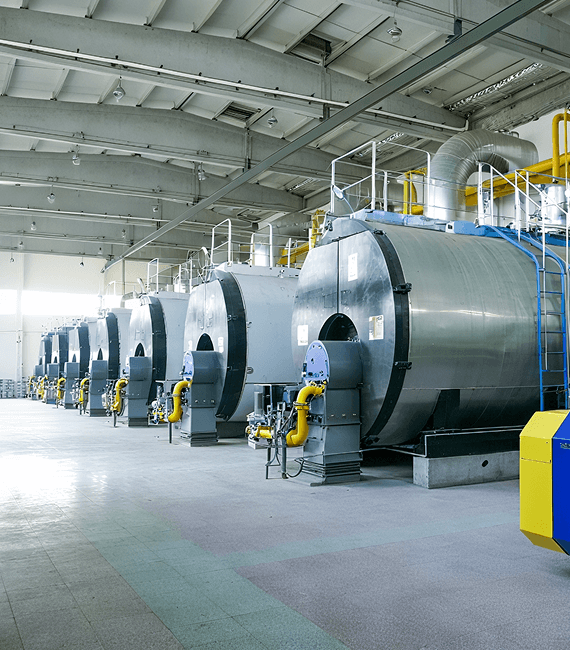

A large amount of medium and low temperature waste heat emitted from cement production can easily cause energy waste. As the core energy-saving equipment, the waste heat recovery boiler can collect and convert waste heat from the production line without fuel.The production waste heat mainly comes from suspension preheaters and clinker coolers. The industry supports two types of special boilers adapted to different heat source conditions to achieve efficient waste heat recovery.
The waste heat boiler of a cement plant is a special heat transfer equipment adapted to cement working conditions. It completely uses waste flue gas and hot air from the production line as the heat source. It does not consume fossil fuels. It can convert low-grade waste heat into usable steam, provide a stable heat source for power generation and equipment heating, and effectively reduce production energy consumption.
The complete cement waste heat recovery system includes waste heat boilers, steam conveying equipment, steam turbines, generators, condensers and closed-loop water supply systems.Each equipment works together to complete the whole process of waste heat to steam, steam stabilized transportation, thermal energy to mechanical energy, mechanical energy to electrical energy, and medium recycling and reuse in turn.
Traditional combustion boilers rely on fuel to produce heat, and their operation is stable but their energy consumption and cost are high.Waste heat boilers rely on production waste heat to operate without fuel consumption, but the heat source parameters fluctuate dynamically with production conditions, making it more difficult to adapt to working conditions and operation and maintenance control, and the equipment structure and operating standards are also significantly different from traditional boilers.
Cement waste heat power generation relies on the steam Rankine cycle to realize waste heat power generation through a closed-loop process of water supply pressurization, constant pressure endothermic, steam expansion to do work, and exhaust steam condensation and reset. It is also the general operating basis of preheater boiler and cooler boiler.
The core of cement waste heat recovery is the significant heat transfer of flue gas. The high-temperature flue gas flows through the metal heating surface of the boiler, relying on the temperature gradient of the pipe wall, through convection heat transfer and metal heat conduction, the heat of the flue gas is transmitted to the flowing water body in the pipe.
The conventional temperature of industrial flue gas is 280℃ to 380℃, and the high-speed flue gas continuously scours the heating surface to complete the three-stage heat transfer of flue gas, pipe wall, and water body.The whole process is operated in a closed environment, the flue gas is not in direct contact with the water body, and the heat exchange is only completed through the metal pipe wall.
The water body in the pipe continues to circulate in the pressurized pipeline, and the phase transition processes such as heating, boiling and vaporization, and steam overheating are completed in turn. The energy path is fixed, and the room temperature water supply can be converted into high-temperature and high-pressure steam required for power generation.
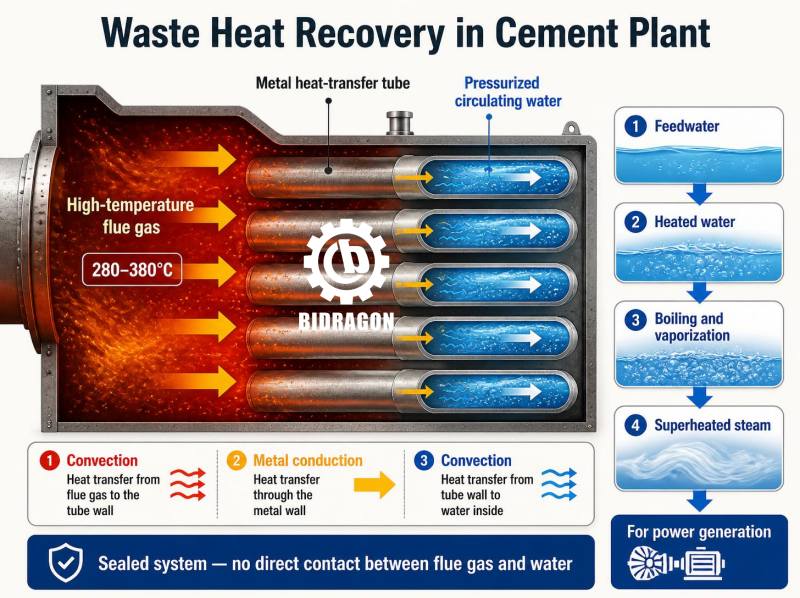
The steam generation is first preheated by the water supply, pressurized and low-temperature water replenishment enters the low-temperature zone of the boiler, and the waste heat of the low-grade flue gas is used to heat up to 100℃ to 150℃.This process can avoid damage to the pipe wall by hot and cold shocks, while fully recovering low-end waste heat and improving the overall heat transfer efficiency.
The preheated water body enters the high-temperature heat transfer zone, quickly reaches the saturation temperature and vaporizes, forming a water vapor mixture with a high water content. It cannot directly drive the steam turbine and needs to be further purified and heated.
The drum boiler separates the water vapor mixture through the built-in structure, the liquid water is refluxed and circulated, and the pure saturated steam is fed into the superheater.The high-temperature flue gas can heat up the steam to more than 300℃, stabilize the steam pressure, and meet the requirements of steam turbine power generation conditions.
Waste heat recovery boilers are divided into two categories: natural circulation and forced circulation.The natural cycle does not require power and the operation and maintenance cost is low, but the stability of steam production is greatly affected by the temperature of the flue gas.The forced circulation is driven by a circulating pump, which has strong adaptability to working conditions and stable steam production, but there is additional power consumption and component wear.
The flue gas flows through each heating surface step by step and continuously releases heat. The maximum smoke temperature at the inlet can reach 380℃. After the waste heat recovery is completed, the smoke temperature at the outlet drops to 90℃ to 120℃.
There is a significant operating trade-off in the temperature of the export smoke.Too high smoke temperature will waste waste heat and reduce power generation. Too low smoke temperature will cause low-temperature acid corrosion, damage pipe walls, shorten equipment life and increase operation and maintenance costs.
The concentration of flue gas dust is positively correlated with the pressure loss of the system. For every 10% increase in dust, the pressure loss increases by 8% to 12%, which will increase the air flow resistance and reduce the heat transfer uniformity.
High-dust working conditions can easily cause ash accumulation, wear and clogging, and 1mm ash accumulation can reduce the heat transfer efficiency by more than 15%.The high-speed dust-containing air flow scouring the pipe wall will cause the wall thickness to decay, and the blockage of the flue will intensify the pressure loss and destroy the heat transfer balance of the system.
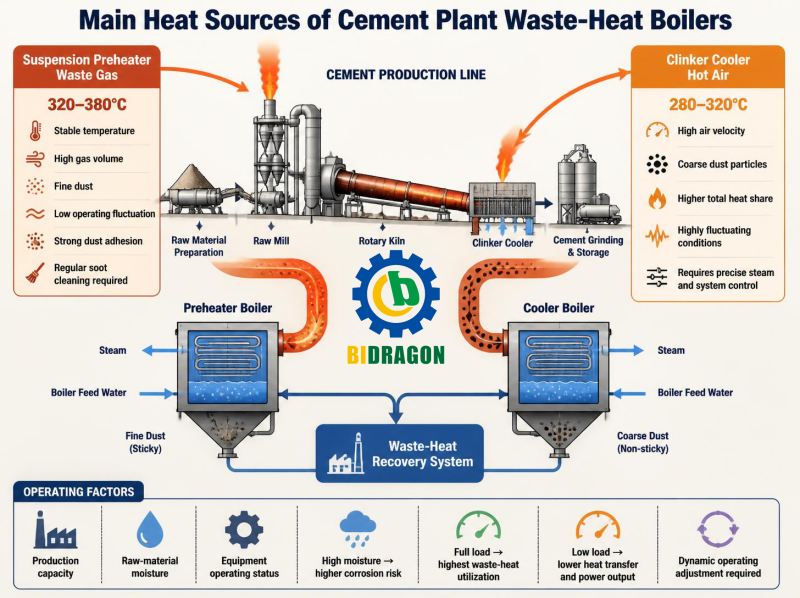
The recyclable waste heat of the cement production line mainly comes from the suspension preheater and the clinker cooler. The parameters of the two types of heat sources are very different. They are adapted to the preheater boiler and the cooler boiler respectively. It is the core energy source of the cement waste heat recovery system.
The exhaust gas temperature of the suspension preheater is stable at 320℃ to 380℃, with sufficient air volume, fine dust, and small fluctuations in working conditions, which can provide a stable basic heat source.However, the dust has strong adhesion and is easy to form stubborn ash deposits, which require normal cleaning and maintenance.
The hot air temperature of the clinker cooler is 280℃ to 320℃, the wind speed is high, the dust particles are large, and the total heat is higher, which can effectively increase the total amount of waste heat recovery.The working conditions of the heat source fluctuate violently, and the stability of the boiler's steam production and the accuracy of system regulation are more demanding.
The production capacity of the production line, the moisture content of the raw materials, and the operating state of the equipment will all change the heat source parameters.The high water content of raw materials will increase the risk of corrosion, and the utilization rate of waste heat in full-load production is the highest. Under low-load conditions, the heat transfer and power generation capacity decrease synchronously, and the operating parameters need to be dynamically adjusted with the working conditions.
The waste heat boiler of a cement plant consists of multiple types of special components working together to complete waste heat recovery, vaporization, steam production and closed-loop water circulation in steps. The structural design of each component directly determines the heat transfer efficiency, operating stability and operation and maintenance costs of the equipment.
The core heat transfer components include economizers, evaporators and superheaters to form a step-by-step heat transfer system.The economizer uses low-temperature flue gas to preheat the water supply to improve the overall energy efficiency and reduce the equipment load, but it is in a high-humidity and low-temperature environment for a long time and has a high risk of corrosion. It is a key part of operation and maintenance.The evaporator is the core steam-producing structure, and water vaporization is achieved through the endothermic of the tube bundle. Long-term high-temperature scouring is easy to wear, and the heat transfer efficiency and equipment life need to be balanced.The superheater is responsible for heating and purifying saturated steam and increasing the temperature and pressure of the steam to meet the needs of power generation. The working conditions are high in temperature and fluctuation, and the heat resistance of the pipe is demanding.
The steam drum, water circulation pipeline and flue gas passage are the basic guarantees for the operation of the system.The steam drum is used for water vapor separation and medium buffering to stabilize the water circulation. Abnormal water level and pressure can easily cause equipment failure.The rising pipe and the falling pipe form a water circulation path. The operation and maintenance cost of the natural circulation mode is low, and the forced circulation mode is more adaptable, but there is additional energy consumption and wear.The flue gas channel and pipe bundle can regularize the flow field and avoid the partial flow of flue gas. The dense pipe bundle needs to weigh the heat transfer effect, ash accumulation risk and operating resistance.
Cement waste heat power generation takes the steam Rankine cycle as the core, and there is no fuel combustion throughout the process. It relies on the precise matching of boilers, turbine generators and condensate systems to achieve closed-loop power generation.The system feeds the pressurized water into the economizer for preheating, and then absorbs heat step by step through the evaporator and superheater to generate high-temperature and high-pressure superheated steam. After the steam of the preheater boiler and the cooler boiler is stabilized, it is uniformly fed into the steam turbine, pushing the rotor to convert heat energy into mechanical energy, and then produce electrical energy through the electromagnetic induction of the generator.The low-pressure spent steam after the work is condensed into water by the condenser, pressurized and filtered, and then returned for reuse to complete the closed-loop circulation of the medium.The dual-heat source complementary mode can stabilize the steam production, effectively weaken the influence of fluctuations in chemical working conditions, and improve the overall waste heat recovery and power generation stability.
The operating parameters of the waste heat boiler are interrelated and restrict each other. They need to be linked and adapted to the production line and power generation equipment. Abnormal parameters will reduce the energy efficiency of the system and even cause safety risks.The temperature and flow rate of the flue gas determine the total amount of waste heat supply. For every 10℃ fluctuation in the smoke temperature, the steam production will fluctuate by 3%-5%, and the flow imbalance will directly reduce the waste heat utilization rate.The standard operating steam parameters of the equipment are pressure 0.8–1.2MPa and temperature 300-330℃. Low parameters will weaken the power generation efficiency, and exceeding the standard will exceed the tolerance range of the equipment, increasing the risk of pipeline damage.Steam production is the core judgment basis for heat transfer working conditions, and its abnormal fluctuations mostly correspond to common faults such as ash accumulation, flue blockage, and abnormal water level.
The water level of the steam drum needs to be strictly controlled in the range of ±50mm. If the water level is too high, it can easily cause the steam to damage the steam turbine with water, and if it is too low, it will cause the pipe bundle to dry out and the pipe wall to leak.The temperature and flow rate of the feed water need to match the heat transfer conditions. The water temperature is too low, which can easily cause thermal fatigue of the pipe wall, and the flow imbalance will cause the steam parameters to not meet the standards or the risk of overpressure of the equipment.The outlet smoke temperature, flue gas pressure loss, and the cleanliness of the heating surface are the key indicators that affect the operation of the system, which directly determine the waste heat utilization rate, flue gas patency, and heat transfer efficiency. Abnormal long-term parameters will increase operation and maintenance costs and shorten equipment life.The entire system needs to be dynamically adjusted with the load of the production line to avoid energy efficiency waste and equipment overload problems.
Affected by the high dust of cement flue gas, large fluctuations in working conditions, and the characteristics of acidic media, waste heat boilers are prone to various body failures, which greatly reduce the efficiency of heat transfer and power generation and increase operation and maintenance costs.Among them, ash accumulation and fouling are the most common problems. Dust outside the pipe and scale in the pipe will form a heat insulation layer, which directly causes the efficiency of the equipment to decrease by 20% to 40%, and frequent cleaning and cleaning will increase operation and maintenance costs and wear on the pipe wall.
Long-term erosion of the pipe bundle by high-speed and large-particle flue gas will lead to thinning of the pipe wall and reduced pressure bearing capacity, and the service life of equipment in key areas will be shortened by more than 30%, resulting in high replacement costs and downtime losses.In addition, pipe wall wear, acid corrosion, thermal deformation and welding aging can easily cause pipeline leakage, resulting in media loss and a sudden drop in steam production. In severe cases, it will directly lead to the shutdown of the power generation system.
Changes in the working conditions of the production line will also cause various operating abnormalities and control contradictions.Fluctuations in production parameters and mutations in equipment load will cause unstable steam production, abnormal water level of steam drums, and induce failures such as steam with water and dry burning of pipe bundles. Frequent system regulation will also accelerate the loss of valves, water pumps and other accessories.At the same time, the clogging of ash accumulation will increase the resistance of flue gas circulation, increase the energy consumption of the kiln tail fan, and offset the energy-saving benefits of waste heat power generation.However, there is an obvious operating trade-off in the export smoke temperature. If the smoke temperature is too low, it can easily cause low-temperature corrosion of the tail equipment. Although raising the smoke temperature can protect the safety of the equipment, it will sacrifice part of the waste heat utilization rate and reduce the overall power generation revenue.
The waste heat boiler of a cement plant can construct a complete closed loop of waste heat recovery and utilization to convert the heat energy of the waste flue gas into high-quality steam power generation.The condensed water body is recycled and reused to realize the resource utilization of waste heat and effectively reduce the energy consumption of enterprises' outsourcing.The operating efficiency and service life of equipment depend on the stability of heat transfer, steam quality, flue gas control and system linkage level.In actual production, energy efficiency, equipment protection and operation and maintenance costs need to be dynamically balanced to ensure the long-term stable, cost-effective and efficient operation of waste heat boilers.