
Fuel selection is a critical factor determining the performance of biomass steam boilers, directly impacting boiler thermal efficiency, operational stability, maintenance costs, and compliance with emission standards. Appropriate fuel enables the boiler to achieve its designed efficiency, while unsuitable fuel may lead to incomplete combustion, increased energy consumption, or even equipment failure.
This article focuses on commonly used biomass fuels in industrial steam generation scenarios, specifically addressing fuel types compatible with industrial-grade biomass steam boilers.
In the energy and industrial boiler sectors, biomass refers to organic matter derived from living organisms that can be converted into energy, serving as a vital renewable energy carrier.
Fundamentally, biomass energy originates from photosynthesis—plants convert solar energy into chemical energy stored within their organic structures. This stored energy is released through combustion or other means to generate steam and other forms of energy.
Within combustion systems, biomass fuels primarily exist in solid forms, including loose straw, granular wood pellets, and compressed biomass briquettes.
The core of biomass fuel's renewability lies in its seamless integration with the natural carbon cycle. Plants absorb atmospheric carbon dioxide during growth, and the carbon dioxide released during combustion is reabsorbed by new plants through photosynthesis, forming a closed-loop carbon cycle that does not result in a net increase of atmospheric carbon dioxide.
This fundamentally differs from fossil carbon: Fossil carbon originates from coal, oil, and other fossil fuels buried underground for millions of years. Burning these fuels releases carbon that has been sequestered underground for extended periods, disrupting natural carbon equilibrium and exacerbating the greenhouse effect. In contrast, biomass carbon remains within contemporary natural carbon cycles, resulting in a more favorable carbon footprint.
It is important to note that the renewability of biomass fuels requires meeting certain sustainability conditions. For instance, the rate of fuel acquisition must not exceed its regeneration rate to prevent ecological damage from overharvesting or deforestation. Additionally, environmental friendliness must be ensured throughout fuel production and transportation processes.
A diverse range of biomass fuels is compatible with steam boiler systems, all of which must meet the core requirements of stable combustion and the ability to consistently generate sufficient heat for water heating and steam production.
Key characteristics include moisture content, calorific value, and ash yield: excessive moisture reduces combustion efficiency and increases heat loss; calorific value directly determines energy output capacity; ash yield impacts boiler ash removal and environmental emissions.
Fuel pretreatment and consistency are critical for boiler operation. Pretreatment processes—including drying, grinding, and pelletizing—optimize fuel properties. Consistency in fuel composition, particle size, and moisture content ensures stable combustion and minimizes operational fluctuations.

Agricultural waste serves as a vital fuel source for biomass steam boilers. Derived from byproducts of agricultural production, these fuels offer abundant, readily accessible resources, exemplifying the concept of “turning waste into treasure.”
Common agricultural waste fuels include rice husks and rice straw. Rice husks possess a hard texture and relatively high calorific value, resisting coking during combustion. Rice straw, however, has a loose texture and typically high moisture content, requiring drying pretreatment to ensure combustion efficiency.
Corn cobs and crop residues are also widely utilized. Corn cobs offer higher density and superior calorific value compared to ordinary straw. Crop residues like wheat straw and soybean stalks are widely distributed, but their loose nature necessitates compression during storage and transportation.
Sugarcane bagasse and leaves are distinctive fuels in the sugar industry. Sugarcane bagasse, rich in fiber, offers stable combustion and serves as an ideal fuel for sugar mills' steam boilers; sugarcane leaves require pulverization to reduce clogging risks during transport.
The advantages of agricultural waste fuels lie in their low resource costs and widespread availability, aligning with circular economy principles. However, operational considerations include managing significant moisture fluctuations and susceptibility to decay. Effective moisture-proof storage and compressed transportation are essential to prevent resource wastage and environmental impacts.
Woody biomass fuels are among the mainstream options for biomass steam boilers. Characterized by stable calorific value and complete combustion, they suit diverse industrial steam production scenarios.
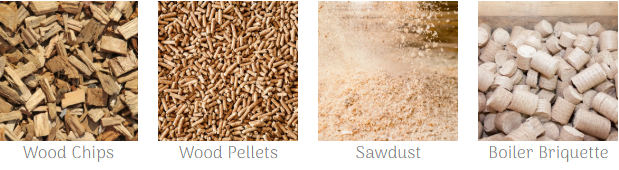
Wood chips and sawdust are the most common woody fuels. Wood chips are cut from logs or wood processing residues, offering uniform particle size compatible with most boiler feed systems. Sawdust consists of fine wood processing debris. It has low density, good air permeability, and rapid combustion rates, but care must be taken to prevent feed inlet blockages.
Wood pellets and compressed biomass briquettes are densified wood fuels. Wood pellets are formed under high pressure from sawdust, wood shavings, etc., achieving high density; compressed briquettes can be processed from various wood waste materials and come in diverse shapes.
The energy density of wood fuels is significantly influenced by their form. Shaped fuels (pellets, briquettes) possess much higher energy density than loose wood chips or sawdust, making them easier to store and transport over long distances. In terms of feeding characteristics, shaped fuels exhibit good flowability and can be adapted to automated feeding systems; loose wood fuels require specialized conveying equipment to prevent clogging.
Biomass briquettes and pellets are molded fuels produced from various biomass waste materials. Briquette feedstock typically consists of loose biomass like wood chips, straw, and rice husks, which are crushed, dried, and compressed into blocks under high pressure. Pellet feedstock is finer, often comprising sawdust or wood flour, extruded into uniformly sized pellets through high-temperature, high-pressure molding.
Densified biomass fuels significantly enhance combustion stability. On one hand, the shaping process removes excess moisture, increasing calorific value and combustion efficiency. On the other hand, the compact structure ensures more uniform oxygen supply during combustion, preventing localized overheating or incomplete burning common in loose fuels, thereby reducing pollutant emissions in flue gases.
In industrial settings, biomass briquettes and pellets are better suited for applications demanding high combustion stability and automation levels. For instance, in small-to-medium industrial steam boilers and district heating systems—particularly in regions with long fuel transport distances and stringent emission controls—the advantages of formed fuels become especially pronounced.
Fuel characteristics are directly related to biomass steam boiler performance, and their influence spans the entire process of combustion, heat transfer, and maintenance.
Fuel moisture content is a key factor affecting boiler efficiency. Excessive moisture leads to a large amount of heat being used to evaporate water during combustion, reducing effective heat output; at the same time, the water vapor produced by evaporation dilutes the oxygen in the flue gas, affecting combustion completeness and further reducing boiler thermal efficiency. Conversely, controlling moisture content within a reasonable range ensures stable combustion efficiency.
Ash content is related to the risk of slagging in the boiler. The fusible substances in the ash easily form molten slag in a high-temperature combustion environment, adhering to the furnace, heating surfaces, and other parts, causing slagging. Slagging hinders heat transfer, reduces heat exchange efficiency, and in severe cases, can block the flue, affecting the normal operation of the boiler.
Particle size needs to be compatible with the boiler's feeding system. Particles that are too large may lead to poor feeding and incomplete combustion; particles that are too small may increase the risk of dust dispersion and may also lead to excessively fast combustion, making it difficult to control the furnace temperature. Appropriate particle size ensures smooth feeding and makes the combustion process more controllable.
Fuel characteristics also affect the frequency of boiler maintenance and operational stability. High-ash, high-moisture fuels increase the frequency of furnace cleaning and heating surface ash removal; while fuels with stable characteristics reduce equipment failures, extend maintenance cycles, and ensure long-term stable operation of the boiler.
The core logic for choosing biomass fuel is prioritizing compatibility, considering factors such as boiler design, resource availability, cost control, and environmental requirements.
First, the fuel type must match the boiler design. Different boilers have different furnace structures, combustion methods, and feeding systems, requiring specific fuel selection. For example, chain grate boilers are suitable for block and flake fuels; circulating fluidized bed boilers are suitable for finer-grained fuels; and automated feeding boilers are more suitable for granular, formed fuels.
Local availability and supply stability are key to reducing operational risks. Prioritizing fuels with large production volumes and stable supply in the local or surrounding areas reduces transportation costs and the risk of supply interruptions. At the same time, attention should be paid to the seasonal characteristics of fuel harvesting, and planning for off-season storage should be carried out.
The processing and storage costs of fuel need to be considered comprehensively. Loose fuels have higher transportation and storage costs and require more space; although processed fuels have slightly higher processing costs, they are more convenient to transport and store, and the overall cost may be more favorable. In addition, the difficulty of fuel pretreatment should be considered, avoiding fuels with complex and costly pretreatment processes.
Environmental protection and emission compliance are mandatory requirements. Fuels that meet local environmental standards should be selected, controlling the sulfur and nitrogen content of the fuel to avoid excessive sulfur dioxide and nitrogen oxide emissions after combustion; at the same time, the type of fuel that can ensure emission compliance should be selected in conjunction with the boiler's exhaust gas treatment equipment.
The advantages of biomass boilers are concentrated in industrial sectors that can stably obtain biomass fuel and have continuous and stable steam demand.
Industries with stable access to biomass fuel include agricultural processing, forestry processing, and sugar refining. These industries generate large amounts of biomass waste such as straw, wood chips, and sugarcane bagasse during production, which can be directly used as boiler fuel, achieving resource recycling.
Industries that rely on process steam as a core production element can maximize the advantages of biomass boilers. These industries have stable requirements for steam pressure and temperature, and biomass boilers can continuously and stably produce steam while using their own waste as fuel, reducing energy costs.
From an operational perspective, biomass boilers can help relevant industries achieve cost control and energy independence. Compared with fossil fuels, the cost of biomass fuel fluctuates less and is often a local resource, reducing dependence on external energy supplies; at the same time, using waste to generate electricity and steam can also reduce waste disposal costs and improve overall economic efficiency.
Q: Can a Single Biomass Steam Boiler Use Multiple Fuel Types?
A: Yes, but certain conditions must be met. Some boilers are designed to accommodate fuels with similar characteristics (e.g., wood chips and wood pellets), but adjustments to the feeding system and combustion parameters are required. If fuels differ significantly (e.g., wood-based fuels versus agricultural straw), targeted boiler modifications (such as replacing grates or adjusting furnace structures) are necessary to prevent unstable combustion and efficiency losses. It is not recommended to arbitrarily switch between significantly different fuels without prior adaptation modifications.
Q: Which Biomass Fuel Is Easiest To Store And Transport?
A: Biomass pellets are the most convenient fuel type for storage and transportation. They feature high bulk density and compact size, occupying only 1/3 to 1/5 of the storage space required by loose fuels. Their uniform shape prevents clumping and spillage, allowing storage in standard silos. They suffer minimal loss during transport, resulting in significantly lower shipping costs compared to loose fuels (e.g., straw, sawdust). Biomass briquettes rank second in storage and transportation convenience, following biomass pellets.
Q: Which Fuel Provides The Most Stable Steam Output?
A: Biomass pellets offer the most stable steam output. Their highly uniform characteristics—moisture content, calorific value, and particle size—ensure stable combustion, delivering consistent heat to boilers and maintaining stable steam pressure and output. High-quality wood chips follow, achieving relatively stable steam output when properly controlled. Agricultural waste and mixed forest residues exhibit poorer steam output stability, significantly affected by fuel quality fluctuations.
Q: How Does Fuel Quality Impact Long-Term Operating Costs?
A: Fuel quality impacts long-term operating costs in multiple ways: High-quality fuel (high calorific value, low moisture, low ash content) achieves high combustion efficiency, reducing fuel consumption per unit of steam produced and directly lowering fuel procurement costs. Low-ash fuel minimizes furnace slagging and grate wear, decreasing equipment maintenance expenses and downtime losses. Consistently stable fuel prevents efficiency fluctuations caused by unstable combustion, further reducing overall operating costs. Conversely, low-quality, inconsistent fuels significantly increase fuel consumption, maintenance costs, and downtime losses, resulting in poor long-term operational economics.
Common fuels for biomass steam boilers include agricultural residues, wood waste, and various formed fuels (briquettes, pellets), each possessing distinct characteristics.
The compatibility between fuel and biomass boiler is central to ensuring operational efficiency and stability, directly impacting energy consumption, maintenance costs, and emissions performance.
When selecting biomass fuels, prioritize practical needs by focusing on compatibility, supply stability, and regulatory compliance—rather than solely pursuing fuel variety.